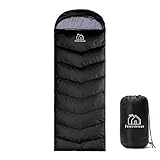
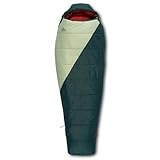
Key takeaways
- A temperature rating without stating whether it is a comfort rating, lower limit, or tested standard.
- Unclear insulation descriptions such as “high-tech warm fiber” with no fill weight or construction information.
- Photos that show a bag but do not provide user height, shoulder width, footbox width, or packed dimensions.
- A liner marketed as adding an exact number of degrees without explaining the testing method.
- Extremely low prices paired with claims of subzero performance and ultralight weight.
- Loose stitching, snagging zippers, thin spots, uneven fill, or a strong chemical odor when the product arrives.
- No care instructions, warranty terms, return window, or clear seller information.
What's inside
Choosing sleeping bag insulation is less about finding the thickest, warmest-looking bag and more about matching insulation to your trip. A common mistake is shopping by the lowest temperature number alone. Those ratings may use different testing standards, and your clothing, sleeping pad, shelter, metabolism, and moisture management all affect how warm you feel.
Another mistake is treating a sleeping bag liner as a substitute for a properly insulated bag. A liner can add comfort, protect the bag, and provide some extra warmth, but it cannot turn a lightweight summer bag into a dependable winter system. Buyers also overlook packed size, wet-weather performance, and whether a claimed temperature is a comfort rating or a survival-oriented lower limit.
As an Amazon Associate we earn from qualifying purchases at no extra cost to you. Product prices and availability are accurate as of the date shown and are subject to change.


This guide explains how to choose sleeping bag insulation for backpacking, car camping, emergency kits, and guest use in 2026. Focus on the system rather than one impressive specification.
Decide These 3 Things First
- Your lowest realistic sleeping temperature: Choose the coldest nighttime temperature you reasonably expect, then add a safety margin of about 5 to 10 degrees Fahrenheit. If temperatures may reach 35°F, a bag with a 25° to 30°F comfort rating is a more sensible target than a bag rated exactly to 35°F.
- Your moisture and storage conditions: Down offers excellent warmth for its weight but loses much of its loft when wet. Synthetic insulation tolerates damp conditions better and usually costs less. Consider whether you will camp in rain, snow, humid forests, or a dry high-desert climate.
- Your carrying and sleeping priorities: Backpackers may accept a narrower mummy shape and higher price to save 1 to 2 pounds and several inches of pack space. Car campers may prefer a wider rectangular bag, heavier insulation, and easier washing.
Size and Shape
Insulation works by trapping warm air, so a sleeping bag should leave enough room for movement without creating a large empty cavity. A bag that is too tight compresses insulation around your shoulders, hips, or feet. One that is too loose requires your body to heat extra air.
Check the manufacturer’s maximum user height and shoulder, hip, and foot dimensions. A regular adult bag commonly fits users up to about 6 feet tall, while long versions often accommodate users up to 6 feet 6 inches. Allow roughly 2 to 4 inches of length beyond your height so your feet do not press against the footbox.
Mummy bags are typically about 30 to 32 inches wide at the shoulders and taper toward the feet. Rectangular bags may measure 32 to 40 inches wide, offering more comfort but usually adding weight and reducing thermal efficiency. If you sleep on your side, use a wide sleeping pad, or wear bulky layers, look for a shoulder measurement near 32 to 34 inches rather than the narrowest available cut.
Do not confuse a liner’s dimensions with those of the sleeping bag. The Sea to Summit Reactor Regular Compact and Extreme Compact liners listed at 78 by 31.5 inches are liners intended to fit inside a bag, not standalone cold-weather insulation.
Material and Insulation Type
Down insulation delivers the best warmth-to-weight ratio and compresses efficiently. A quality down bag may weigh 1.5 to 3 pounds for three-season use, depending on size and temperature rating. Look for the fill-power number, commonly 600 to 900. Higher fill power means more loft per ounce, but it does not by itself establish a temperature rating. The amount of fill, construction, shell fabric, and fit matter too.
Synthetic insulation, usually polyester, remains the practical choice for wet climates, casual camping, and buyers on a budget. A three-season synthetic bag may weigh 2.5 to 5 pounds. It generally occupies more pack space than down and may lose loft sooner with repeated compression, but it dries more easily and often costs less.
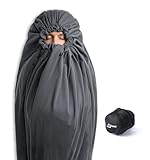
Fleece and thermal liners can make a bag feel warmer and more comfortable against the skin. For example, the Litume Fleece Mummy Sleeping Bag Liner includes a compression bag and is listed at $57.98. A liner can also keep body oils out of the main bag. However, treat liner warmth claims cautiously: the actual benefit depends on fit, clothing, ventilation, and the bag used with it.
For down, check whether the insulation has a water-resistant treatment and whether the shell is tightly woven. For synthetic bags, examine the insulation’s stated type and whether it is continuous-fill or made from separate sheets. Avoid products that simply say “warm cotton” or “premium fiber” without identifying the insulation material.
Construction and Insulation Placement
Look for insulation that stays evenly distributed. Sewn-through stitching is lighter and less expensive, but each stitch line can create a thinner area. It is common in summer and budget bags. Box-baffle construction separates the upper and lower layers, reducing cold spots and making it more appropriate for colder conditions, though it adds weight and cost.
Important features include a draft collar around the neck, a draft tube behind the zipper, and an insulated footbox. A full-length zipper improves ventilation and makes the bag easier to enter. A two-way zipper lets you open the foot area, useful in mild weather. Short half-zippers may save weight but are less flexible.
For three-season use, prioritize a hood with an adjustable drawcord, a draft collar, and a zipper draft tube. In bags intended for temperatures around 20°F or below, pay closer attention to baffle design and hood coverage than to decorative fabric or included storage accessories.
Comfort and Performance
Temperature ratings require careful reading. Under the EN or ISO testing system, the comfort rating is the temperature at which an average cold sleeper may sleep comfortably, while the lower limit represents a more conservative limit for an average warm sleeper. A separate extreme rating is not a target for normal use.
Women’s or “short” versions may use more insulation in areas where many sleepers feel cold, but fit varies by brand. If you run cold, plan to use the comfort rating rather than the lower limit. A warm sleeping pad is equally important: an insulated pad with an R-value around 4 or higher is a reasonable starting point for cool three-season nights, while colder conditions may call for an R-value of 5 to 7 or more.
Ventilation matters in warmer weather. A bag rated for 20°F can become uncomfortable at 50°F unless it has a full-length zipper, breathable lining, and a foot vent. For summer camping, a 40°F to 50°F bag or a lightweight liner-and-blanket setup may be more versatile than an overly warm winter bag.
Price Tiers
Budget: $25 to $90. Expect basic synthetic insulation, heavier fabrics, and larger packed sizes. These bags work well for sleepovers, occasional car camping, and mild-weather use. The MalloMe sleeping bags listed at $23.39 illustrate the entry-level price range, but verify the actual dimensions, temperature rating, and adult-versus-child fit before buying.
Midrange: $90 to $220. This tier typically offers better zippers, more reliable temperature information, improved hoods, and more efficient synthetic or lower-fill-power down insulation. It is often the best value for regular campers who do not need the smallest possible packed size.
Premium: $220 to $600 or more. Premium bags may use 800- to 900-fill down, lighter shell fabrics, box baffles, and highly refined fit. They make sense for frequent backpacking, alpine trips, and anyone who values a low packed weight. Do not pay premium prices for a bag with vague insulation details or no clear temperature standard.
Liners generally cost about $30 to $80. The Sea to Summit Reactor Regular Compact is listed at $48.96, while the Extreme Compact is listed at $55.96. The small price difference does not make a liner a replacement for choosing the correct bag rating.
Warranty and Long-Term Care
Check whether the warranty covers manufacturing defects for one year, several years, or the product’s practical lifetime. Damage from abrasion, washing mistakes, compression, or normal loss of loft is often excluded. A repair service can be more valuable than a broad-sounding warranty, especially for down bags and lightweight shells.
Ask whether replacement sliders, zipper repairs, patch kits, and professional cleaning are available. Store a sleeping bag loosely in a large cotton or mesh storage sack, not compressed in its stuff sack for months. Wash it according to the label, dry it completely, and never store it damp. Good care can matter more to insulation performance than a small difference in fill power.
Delivery and Setup
Most sleeping bags require no assembly, but delivery details still matter. Check the packed dimensions, included storage sack, compression sack, and expected shipping time before a trip. A bag that measures 8 by 16 inches compressed may be far easier to carry than one measuring 12 by 20 inches, even if both have similar temperature ratings.
When it arrives, unpack it and allow several hours for insulation to loft. Inspect the zipper, seams, hood cord, snaps, and any baffles before removing tags or taking it outdoors. Confirm the actual length and width against the listing. If the bag is being purchased for a child, verify that the fit is safe and appropriate; an oversized adult bag can leave too much unused air around a small sleeper.
Spec Checklist
| Spec | Budget | Mid | Premium |
|---|---|---|---|
| Typical price | $25–$90 | $90–$220 | $220–$600+ |
| Insulation | Basic synthetic | Improved synthetic or 600–750-fill down | 800–900-fill down or advanced synthetic |
| Three-season weight | 3.5–6 lb | 2.5–4.5 lb | 1.5–3 lb |
| Comfort rating | 40°F–55°F | 25°F–40°F | 0°F–35°F |
| Packed size | 10 × 18 to 14 × 24 in. | 8 × 16 to 12 × 20 in. | 6 × 12 to 9 × 18 in. |
| Construction | Sewn-through | Sewn-through or basic baffling | Box baffles, draft collar, insulated zipper |
Red Flags
- A temperature rating without stating whether it is a comfort rating, lower limit, or tested standard.
- Unclear insulation descriptions such as “high-tech warm fiber” with no fill weight or construction information.
- Photos that show a bag but do not provide user height, shoulder width, footbox width, or packed dimensions.
- A liner marketed as adding an exact number of degrees without explaining the testing method.
- Extremely low prices paired with claims of subzero performance and ultralight weight.
- Loose stitching, snagging zippers, thin spots, uneven fill, or a strong chemical odor when the product arrives.
- No care instructions, warranty terms, return window, or clear seller information.
FAQ
Is down or synthetic insulation better?
Down is lighter, warmer for its weight, and more compressible. Synthetic insulation is generally more affordable and performs more predictably when damp. Choose down for weight-conscious trips in conditions you can keep dry; choose synthetic for wet climates, beginner use, and frequent car camping.
Do sleeping bag liners add meaningful warmth?
They can add some warmth and improve comfort, but the result varies by liner, bag, fit, and sleeper. A fleece liner may feel substantially warmer than a thin fabric liner, yet it still should not replace a bag with an appropriate comfort rating.
What temperature rating should I buy?
Use the expected low temperature, then choose a comfort rating about 5 to 10 degrees colder for a safety margin. Also budget for a properly insulated sleeping pad, warm sleep clothing, and a shelter that blocks wind.
Is a mummy bag always warmer?
Usually, a well-fitted mummy bag is more thermally efficient because it reduces empty air space and covers the head with a hood. A rectangular bag may be more comfortable, especially for car camping, but it often weighs more and needs more body heat to warm the interior.