Key takeaways
- Buying by height alone: Two men of the same height can need different widths. Measure shoulders, hips, and knees as well as overall length.
- Assuming “long” means tall enough: Some long bags are only 78 inches, leaving little room for a 6-foot-4-inch camper. Read the maximum user height and actual interior length.
- Ignoring the hood: A hood can use several inches of the bag’s total length. If you are close to the stated maximum height, move up one size.
- Choosing a huge bag for cold weather: Extra empty space can reduce warmth. Pick the smallest comfortable size for winter trips and use a properly rated bag rather than relying on excess room.
- Confusing temperature ratings: A 10°F rating does not mean every sleeper will feel comfortable at 10°F. Compare comfort and lower-limit ratings when provided, and account for clothing, insulation, and your sleeping pad.
- Overlooking packed weight: A $36-$60 XXL bag may be roomy, but it can weigh substantially more than a technical long bag. Confirm the weight before planning a backpacking trip.
The Short Answer
For most tall men, the right sleeping bag is a Long, XL, or XXL size rather than a standard adult bag. Choose a bag with an interior length at least 4 to 8 inches longer than your height. That extra room allows you to slide in without pressing your head against the hood or your feet against the footbox.
As a quick guide, men up to about 6 feet 2 inches can often use a long bag measuring 78 to 81 inches. Men between 6 feet 2 inches and 6 feet 6 inches will usually be more comfortable in an XL bag measuring 84 to 87 inches. Anyone near or above 6 feet 6 inches should look for an XXL or big-and-tall model measuring roughly 90 inches or more.
Our top picks

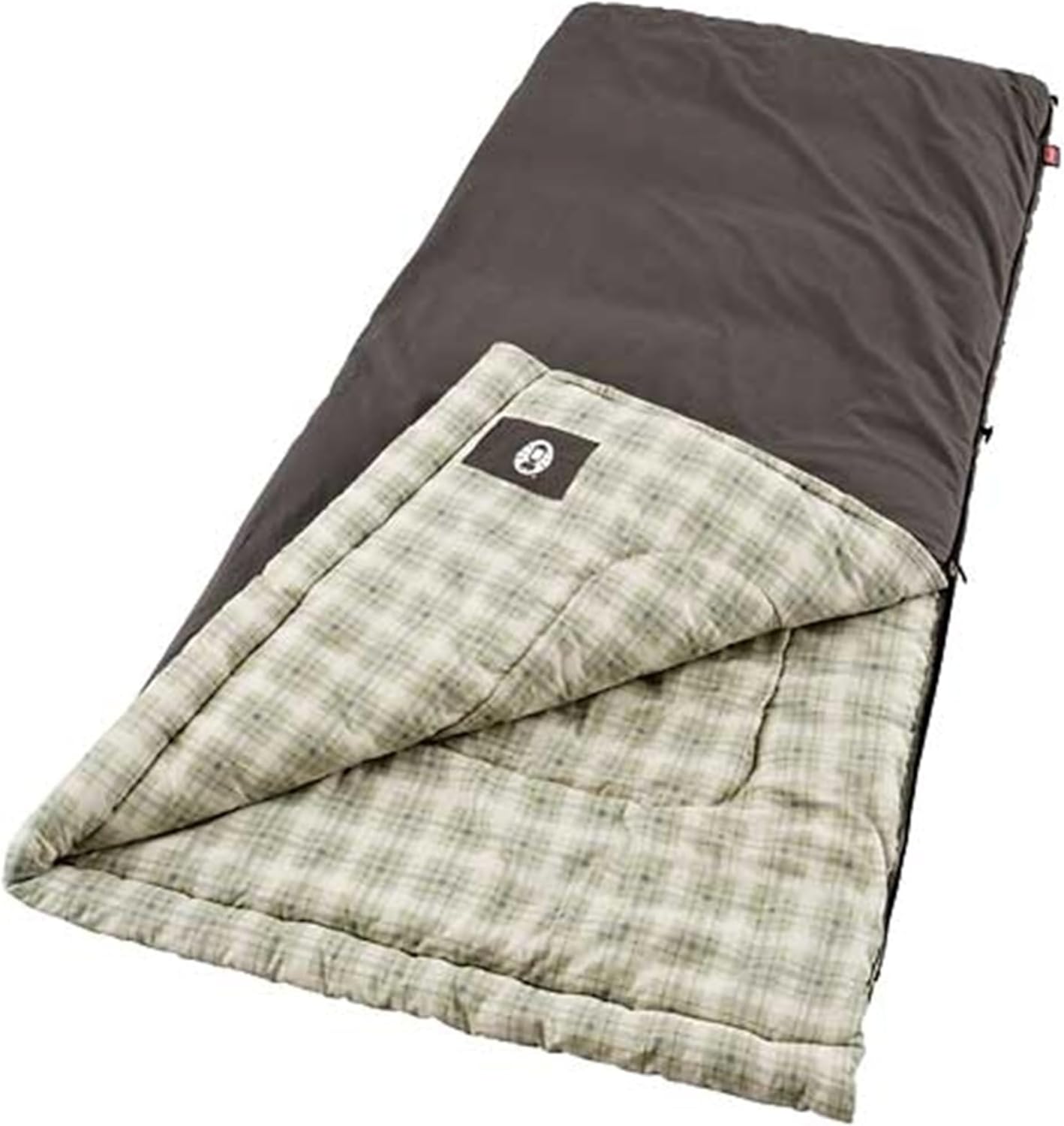 Coleman Heritage Big & Tall 10°F Flannel
- Occupancy: 1 Person
- Seasons: All Seasons
- Temperature Rating: 10°F

As an Amazon Associate we earn from qualifying purchases at no extra cost to you. Ratings are shown as listed on Amazon.
Width matters, too. A narrow mummy bag may be long enough but feel restrictive across the shoulders, hips, or knees. For side sleepers, broad-shouldered campers, or anyone who wears bulky layers, look for at least 32 to 36 inches of shoulder room. Rectangular bags commonly provide 36 to 40 inches, while roomy XXL designs can measure 38 to 42 inches wide.
Standard Sizes
Sleeping bag labels are not fully standardized, so always check the manufacturer’s interior dimensions rather than relying only on “long” or “XL.” The measurements below are useful buying benchmarks. Exterior dimensions may be slightly larger because of insulation, shell fabric, and the hood.
| Size | Typical interior length | Typical shoulder width | Approximate best height | Typical packed weight |
|---|---|---|---|---|
| Regular | 75 x 30 in (191 x 76 cm) |
30 in (76 cm) | Up to 5 ft 10 in (178 cm) | 2.5-4.5 lb (1.1-2 kg) |
| Long | 78-81 x 31-33 in (198-206 x 79-84 cm) |
31-33 in (79-84 cm) | Up to 6 ft 2 in (188 cm) | 2.75-5 lb (1.25-2.3 kg) |
| XL | 84-87 x 34-38 in (213-221 x 86-97 cm) |
34-38 in (86-97 cm) | Up to 6 ft 6 in (198 cm) | 3.5-7 lb (1.6-3.2 kg) |
| XXL or Big & Tall | 90-94 x 38-42 in (229-239 x 97-107 cm) |
38-42 in (97-107 cm) | Up to 6 ft 8 in or taller | 4.5-9 lb (2-4.1 kg) |
These are practical ranges, not guarantees. A mummy-shaped bag may list a generous maximum height but taper sharply at the feet. A rectangular bag often feels larger throughout its length but can weigh more and retain heat less efficiently. If you are between sizes, choose the larger bag for comfort, especially if you sleep on your side or plan to wear clothing inside it.
For car camping, a heavier big-and-tall bag is usually a sensible trade-off. For backpacking, pay closer attention to packed size and weight. A long or XL backpacking bag may weigh about 3 to 5 pounds, while a generously insulated XXL rectangular bag can weigh 6 pounds or more. A compression sack can reduce volume, but it cannot make a heavy bag light.
How to Measure Your Space
- Measure your height. Stand straight against a wall without shoes and record the distance from the floor to the top of your head. Add 4 to 8 inches for sleeping room. Use the larger allowance if the bag has a thick hood, if you move frequently, or if you prefer extra foot space.
- Measure shoulder width. Ask someone to measure across the widest part of your shoulders while you stand naturally. Add at least 4 to 6 inches for clothing and comfortable movement. For example, a 21-inch shoulder measurement usually calls for approximately 26 to 30 inches of usable upper-body space.
- Measure hip and knee room. Lie on your back with your knees slightly raised, then measure the widest area from side to side. A bag that fits your shoulders may still be too narrow at the hips or knees.
- Check foot length and shape. Your toes should not press firmly against the end of the bag. Aim for roughly 2 to 4 inches of extra length at your feet, but avoid an excessively large empty area in cold weather because extra air is harder to warm.
- Compare interior dimensions. Look for measurements labeled “interior,” “body dimensions,” or “fits users up to.” Do not compare a bag’s stuff-sack length with another bag’s sleeping length; they describe different things.
- Consider your sleeping position. Back sleepers can usually use a narrower design. Side sleepers need more width at the shoulders, hips, and knees. A rectangular, semi-rectangular, or oversized mummy bag may be better than a standard mummy shape.
By Room or Use Case
Backpacking
For backpacking, select the smallest bag that lets you fully extend your legs and move your shoulders. A tall man around 6 feet 3 inches may need a long or XL mummy bag, but a full XXL model can add unnecessary bulk. Target a packed weight of about 3 to 5 pounds when possible, and check the packed dimensions against your backpack’s sleeping-bag compartment.
A lightweight XXL sleeping bag advertised for approximately 41-59°F may suit summer and mild three-season trips, but do not choose it for cold nights solely because it is labeled XXL. Fit and warmth rating are separate considerations.
Car camping and base camping
Car camping gives you more freedom to prioritize width and comfort. A rectangular XL or XXL bag can feel more like a bed and leaves room to bend your knees. The VENTURE 4TH 3-Season XXL Backpacking Sleeping Bag, listed around $55, is an example of the kind of larger-format option shoppers may compare when they want more room without moving into premium pricing.
For colder camping, the Coleman Heritage Big & Tall 10°F Flannel Sleeping Bag is designed for adults up to 6 feet 7 inches and is commonly listed around $100-$105. Its flannel-lined, big-and-tall format is more appropriate for campers who value interior space and warmth over a minimal packed load.
Hunting, fishing, and work trips
For extended outdoor stays, choose a durable shell, a roomy cut, and enough space for base layers. A 38- to 42-inch shoulder width is helpful when sleeping in insulated clothing. Check whether the bag is machine washable and whether the shell is water resistant rather than waterproof. A water-resistant shell can handle condensation and light moisture, but it should not be treated as a substitute for a dry shelter.
Guest use and emergency storage
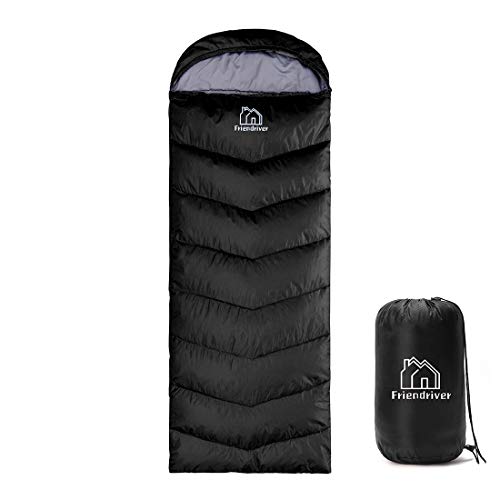
An oversized rectangular bag is often the most versatile choice for a guest room, cabin, or emergency kit. The Friendriver XL widened bag, listed around $20, and similar low-cost XL models can provide extra width at a modest price. Budget bags may weigh more, have less precise temperature ratings, or pack larger, so they are generally better for occasional use than long-distance backpacking.
Common Sizing Mistakes
- Buying by height alone: Two men of the same height can need different widths. Measure shoulders, hips, and knees as well as overall length.
- Assuming “long” means tall enough: Some long bags are only 78 inches, leaving little room for a 6-foot-4-inch camper. Read the maximum user height and actual interior length.
- Ignoring the hood: A hood can use several inches of the bag’s total length. If you are close to the stated maximum height, move up one size.
- Choosing a huge bag for cold weather: Extra empty space can reduce warmth. Pick the smallest comfortable size for winter trips and use a properly rated bag rather than relying on excess room.
- Confusing temperature ratings: A 10°F rating does not mean every sleeper will feel comfortable at 10°F. Compare comfort and lower-limit ratings when provided, and account for clothing, insulation, and your sleeping pad.
- Overlooking packed weight: A $36-$60 XXL bag may be roomy, but it can weigh substantially more than a technical long bag. Confirm the weight before planning a backpacking trip.
FAQ
What size sleeping bag should a 6-foot-4-inch man buy?
Start with an XL bag measuring at least 84 inches long. If the hood is bulky, you sleep on your side, or you want room for clothing, choose an XXL bag around 90 inches. Verify the actual interior length instead of relying on the XL label.
Should tall men choose a mummy or rectangular sleeping bag?
Choose a mummy bag for lower weight and better heat retention, provided its shoulder and knee measurements are comfortable. Choose a rectangular or semi-rectangular bag for more space, easier movement, and car camping. Tall side sleepers often prefer the latter.
How much extra length should a sleeping bag have?
Allow approximately 4 to 8 inches beyond your height. Less than 4 inches can create pressure at the hood or footbox, while substantially more can leave an unnecessarily large area to warm.
Are XXL sleeping bags worth the extra cost?
They are worth considering if regular or long bags restrict your shoulders, hips, or feet. Prices range from about $20 for basic widened bags to $100 or more for insulated big-and-tall models. For occasional camping, a budget XXL may be adequate; for frequent backpacking, pay more attention to weight, packed size, and clearly stated temperature ratings.