
What bottle water is the best is really two questions: which type suits your taste and diet, and whether buying it makes sense at all. FDA rules define eleven categories with specific requirements, and the differences are printed on the label if you know what to look for. No single brand wins outright.
Our top picks


As an Amazon Associate we earn from qualifying purchases at no extra cost to you.
As an Amazon Associate we earn from qualifying purchases.
By Jake Thompson, gear writer for Roger Bacon Outdoors.
🛒 Best Price Today on Amazon
Prime members get fast, free shipping on everything above, plus member-only deals. New members get a 30-day free trial — cancel anytime.
What Bottle Water Is the Best: How Labels Are Regulated
Anyone asking what bottle water is the best should start with the label, because terms like artesian and spring are not marketing flourishes. The FDA regulates bottled water as a food under the Federal Food, Drug and Cosmetic Act, and 21 CFR 165.110 sets standards of identity for every category listed below.
Spring, Artesian and Well Water
Spring water must derive from an underground formation from which the water flows naturally to the surface of the earth. Artesian water comes from a well tapping a confined aquifer where the water level stands above the top of that aquifer, and may be collected with assistance from external force.
Well water is simply water from a bored or drilled hole tapping an aquifer, and ground water comes from a subsurface saturated zone under pressure equal to or greater than atmospheric, not under the direct influence of surface water. None of these categories carries a minimum mineral requirement.
Mineral Water and the 250 ppm Rule
Mineral water is the strictest category. It must contain no less than 250 parts per million of total dissolved solids, come from a source tapped at one or more bore holes or springs, originate from a geologically and physically protected underground source, and contain no added minerals.
Labelling thresholds follow directly from that figure. If TDS falls below 500 ppm the label must state low mineral content, and above 1,500 ppm it must state high mineral content instead. Between those two numbers no additional statement is required, which is where most European mineral waters sit.
Purified, Distilled and Reverse Osmosis
Purified or demineralised water is produced by distillation, deionisation, reverse osmosis or another suitable process meeting the definition in the United States Pharmacopeia. Mineral content is close to zero by design, since the entire point of the process is removing dissolved solids.
The source is frequently municipal tap water, and the FDA requires that fact to be declared. If bottled water comes from a community water system, the label must say from a community water system or from a municipal source, which is worth checking before paying a premium for it.
Sparkling Water and What Is Excluded
Sparkling bottled water contains the same amount of carbon dioxide it had at emergence from the source, which is why naturally sparkling mineral waters are labelled differently from carbonated purified water. The gas may be replaced after treatment to restore the original level.
Seltzer, soda water and tonic water are classified as soft drinks and fall outside bottled water regulation entirely. That is a meaningful distinction, because those products are not held to the standards of identity or the standards of quality that apply to everything above.
Deciding What Bottle Water Is the Best for You
Once the label categories are clear, what bottle water is the best for you comes down to what you want from it and what you will pay. Four factors do most of the work, and all of them are either printed on the bottle or published by the bottler on request.
| Type | FDA requirement | Typical mineral content | Common source |
|---|---|---|---|
| Mineral water | Not less than 250 ppm TDS, no added minerals | 250 ppm and above | Protected underground source |
| Spring water | Flows naturally to the surface | Varies, no legal minimum | Underground formation |
| Artesian water | Confined aquifer under pressure | Varies by geology | Drilled well |
| Purified water | Distillation, deionisation or reverse osmosis | Near zero | Often municipal supply |
| Sparkling water | Same CO2 as at emergence | Depends on base water | Spring or mineral source |
TDS Is What You Actually Taste
Total dissolved solids describes the mineral load, and it drives flavour more than any other measurable property, so it largely settles what bottle water is the best to your own palate. Purified waters sit near zero and taste neutral. High-TDS mineral waters taste distinctly of their source geology.
The 250 ppm mineral water threshold is a useful reference point. Waters below it are not required to declare mineral content in the same way, and some well-known spring waters fall just under the line, which is why a spring label tells you less about taste than a TDS figure does.
Sodium and Mineral Content
Calcium, magnesium and sodium levels vary enormously between sources, and anyone managing sodium intake should read the analysis rather than assume bottled water is negligible. High-mineral waters can carry meaningful sodium, and the label warning above 1,500 ppm TDS is a first indicator.
For most people this is a preference question rather than a health one, but it is the kind of detail worth checking if a doctor has given you specific guidance. Bottlers publish full mineral analyses, and mineral water may not have minerals added after the fact under FDA rules.
pH and Alkaline Water Claims
Alkaline waters are marketed on pH values above neutral, sometimes with added minerals or through electrolysis. The pH of any water changes rapidly on contact with stomach acid, and the evidence supporting broad health benefits from drinking alkaline water remains limited and contested.
Treat pH as a taste characteristic rather than a health specification. If you prefer the mouthfeel of a higher-pH water, that is a perfectly good reason to buy it. Claims that go beyond taste deserve the same scepticism you would apply to any other supplement marketing.
Who Regulates What
Bottled water is regulated by the FDA as a food, while tap water is regulated by the EPA under separate drinking water rules. FDA quality standards for contaminants are set in response to the EPA requirements for tap water, so the two frameworks track each other closely.
One detail surprises people: the FDA does not approve bottled water firms or individual products. Compliance is the bottler’s responsibility, enforced after the fact, which is a different model from pre-market approval and worth understanding before treating any label as a guarantee.
Bottled Water Outdoors: Cost, Weight and the Alternative
For anyone deciding what bottle water is the best for camping, hiking or travel, the honest answer is usually none of them. Three practical factors work against carrying bottled water into the outdoors, and they get worse the longer and further you go from a shop.
Cost per Litre Over a Trip
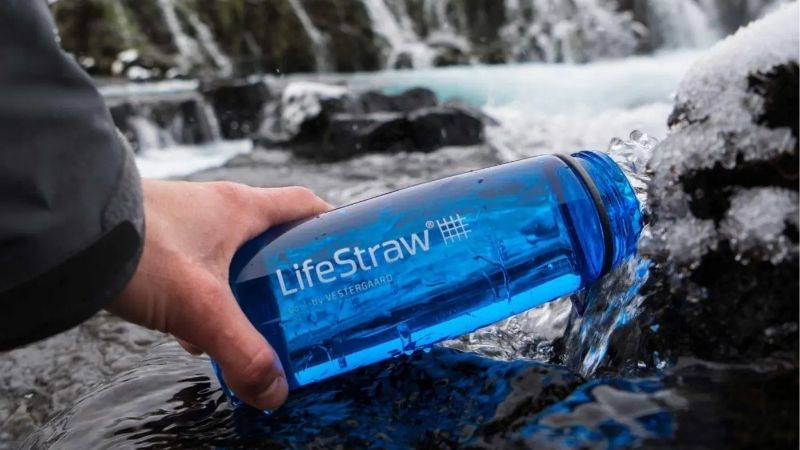
Bottled water is among the most expensive liquids you can buy by volume, and on a multi-day trip the arithmetic compounds quickly. LifeStraw calculates that one of its membrane microfilters, rated for 4,000 litres, replaces the equivalent of 8,000 single-use plastic bottles.
LifeSaver publishes a running cost of around three cents per litre for its Liberty purifier across a 2,000 litre cartridge. Against typical retail bottled water pricing, a filtering bottle recovers its purchase price within weeks for anyone currently buying bottled water daily.
Weight and Logistics on the Trail
Water weighs about a kilogram per litre regardless of what container it arrives in, so carrying three days of bottled water is not a realistic plan for anything beyond car camping. The practical approach is carrying capacity and treating water from sources along the route.
A Katadyn BeFree flask weighs roughly 63 grams and collapses flat when empty. A LifeStraw Go bottle is 247 grams in the 650 millilitre size. Either lets you carry one bottle and refill from streams or taps, which is lighter and cheaper than any bottled option over a weekend.
Prices, Tariffs and Seasonal Timing
If you are switching to a filtering bottle, timing matters this year. Industry survey data indicates 84% of outdoor businesses expect to be affected by new tariffs, with costs rising roughly 7.7% overall and specialised plastics, including filter media, reported up 10 to 15%.
Late summer is also peak demand, since bottles sell alongside backpacks and rain gear before the school year. With inflation near 4.2% and an estimated tariff burden of about $1,600 per US household in 2026, buying before the rush avoids both higher prices and thin stock.
Frequently Asked Questions
These four questions cover what readers ask most often when comparing bottled water types and deciding whether to carry on buying it at all. All answers reflect FDA labelling rules as written rather than any particular brand’s marketing position on the merits of its own product.
What bottle water is the best for everyday drinking?
There is no universal answer, because the differences are largely taste and mineral content rather than safety. If you like a defined mineral flavour, choose a mineral water above 250 ppm TDS. If you prefer neutral water, purified suits you. Both meet the same FDA quality standards.
Is spring water better than purified water?
Not inherently. Spring water carries whatever minerals its source geology contains and has no legal minimum, while purified water has had dissolved solids deliberately removed. Which one is better depends entirely on whether you want minerals in your water or want them taken out.
Does bottled water expire?
The water itself does not spoil, but bottles carry best-before dates because plastic can affect taste over long storage, particularly in heat or sunlight. Store bottles somewhere cool and dark, and treat any change in taste or smell as a reason to discard rather than to persist.
Is bottled water safer than tap water?
Not automatically. FDA bottled water quality standards are set in response to EPA requirements for tap water, so both frameworks target comparable contaminant limits. In much of the United States and Europe the practical difference is taste rather than safety in any measurable sense.
See More:
- Best Water Filtering Bottle: 5 Picks by What They Remove
- Best Water Bottle Filter: Micron Ratings and Cartridge Life
- Best Water Filtration Bottle: 5 Picks and What Tests Mean
- Filtered Water Bottle Best Picks for Daily Use: 5 Compared
- Best Water Bottle Purifier: Virus Protection and 5 Picks
Final Thoughts
What bottle water is the best comes down to reading the label rather than the brand. Mineral water above 250 ppm TDS tastes of its source, purified water tastes of nothing much, and both are held to the same quality standards. Outdoors, a filtering bottle beats every one of them on cost and weight.

Write Your Review
No reviews yet. Be the first to share your experience!