
Best water bottle filter comparisons should start with pore size, not brand. Ratings here run from 0.1 to 0.2 microns for microfilters, while purifier cartridges use a different mechanism entirely. Cartridge life ranges from around 250 litres to 4,000, which changes the true cost per litre. Flow rate matters too.
Our top picks


As an Amazon Associate we earn from qualifying purchases at no extra cost to you.
As an Amazon Associate we earn from qualifying purchases.
By Jake Thompson, gear writer for Roger Bacon Outdoors.
🛒 Best Price Today on Amazon
Prime members get fast, free shipping on everything above, plus member-only deals. New members get a 30-day free trial — cancel anytime.
How to Judge the Best Water Bottle Filter Element
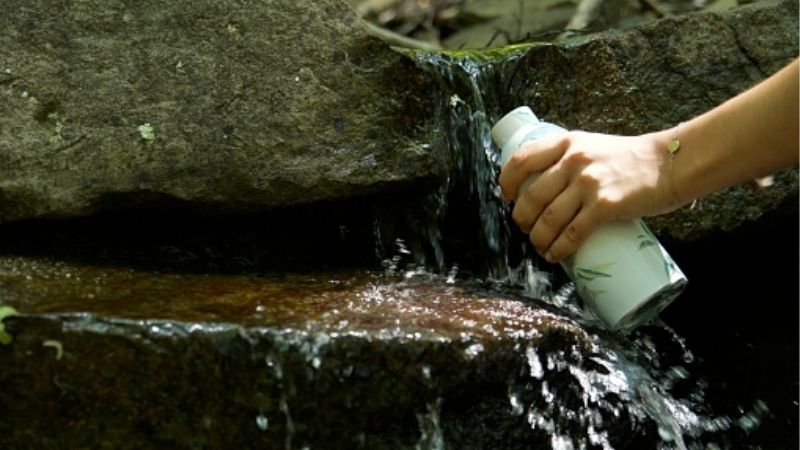
The bottle is packaging. The filter element inside it is the product, and it is where the meaningful differences sit. Three numbers describe any cartridge honestly: what size particle it stops, how fast water moves through it, and how many litres it handles before it needs replacing.
Pore Size and What It Excludes
Hollow-fibre membranes are rated by nominal pore size. LifeStraw’s Go membrane is 0.2 microns and Katadyn’s EZ-Clean membrane is 0.1, and both stop bacteria and protozoa at published rates of 99.999% and above. Neither touches viruses, which are around 0.02 microns across.
That gap is why purifier cartridges exist and why the best water bottle filter for travel costs more per litre. Grayl’s press cartridges are rated for viruses as well as bacteria and protozoa, and additionally reduce chemicals, heavy metals and pesticides that pass straight through any microfiltration membrane.
Flow Rate and How It Degrades
Flow separates these elements more than removal rates do. The Katadyn BeFree membrane delivers roughly 2 litres per minute, while the LifeStraw Go straw runs nearer 0.5 litres per minute and requires deliberate suction. Grayl presses a full 710 millilitres through in about eight seconds.
Every element slows as it loads with sediment. Independent testing suggests planning around roughly two thirds of advertised capacity in field conditions, because flow becomes impractically slow well before the membrane stops being safe. Backflushing and rinsing recover some, but not all, of the original rate.
Cartridge Life and Replacement Cost
Rated lifespans vary by more than an order of magnitude, which is why the best water bottle filter on price is rarely the cheapest to own. A LifeStraw membrane handles up to 1,000 gallons, about 4,000 litres or roughly five years of daily use, while a Grayl cartridge is rated at around 250 litres.
Carbon capsules are the short consumable in any two-stage design. LifeStraw rates its capsule at 26 gallons, about 100 litres or two months of regular drinking, and sells replacements separately. Work the cost of those capsules into the purchase before comparing bottles on price alone.
Best Water Bottle Filter Elements, Compared
Five filter systems compared on the element rather than the container. The best water bottle filter for backcountry streams is not the one for questionable tap water abroad, so match the pore rating and cartridge life to the water source you expect to face most often.
| Filter | Pore rating | Flow rate | Rated life | Carbon stage |
|---|---|---|---|---|
| LifeStraw Go membrane microfilter | 0.2 micron | approx. 0.5 L/min | 4,000 L | Yes, 100 L capsule |
| Katadyn BeFree EZ-Clean | 0.1 micron | approx. 2 L/min | Flow-limited | Optional AC version |
| Grayl GeoPress cartridge | Purifier, virus-rated | 710 ml in approx. 8 sec | approx. 250 L | Integrated |
| Grayl UltraPress cartridge | Purifier, virus-rated | Press action | approx. 250 L | Integrated |
| LifeStraw Go carbon capsule | Taste and chemical stage | Inline | 100 L / approx. 2 months | Is the carbon stage |
LifeStraw Go Membrane Microfilter – Longest Rated Life
Rated at 0.2 microns and up to 1,000 gallons, this element removes 99.999999% of bacteria including E. coli and salmonella, 99.999% of parasites including giardia and cryptosporidium, and 99.999% of microplastics. It is independently lab-tested against US EPA and NSF/ANSI drinking water protocols.
Its most useful design feature is that flow stops completely at end of life, removing any guesswork about replacement. The drawbacks are a modest 0.5 litre per minute flow that demands real suction effort, and no virus protection whatsoever regardless of how long the membrane lasts.
Katadyn BeFree EZ-Clean – Fastest and Finest
A 0.1 micron hollow-fibre membrane in a collapsible HydraPak flask, delivering around 2 litres per minute, which is four times the LifeStraw Go straw. The whole assembly weighs roughly 63 grams, making it the lightest filtration option here and the easiest to carry as a backup.
Cleaning is done by swishing the membrane in clean water rather than backflushing with a syringe. The standard version has no carbon stage, so chlorine taste and chemicals pass through untouched, and reviewers consistently note that flow degrades noticeably even with careful maintenance.
Grayl GeoPress Cartridge – Only Virus Protection Here
The GeoPress cartridge is a purifier rather than a microfilter, removing viruses alongside bacteria and protozoa while also reducing chemicals, heavy metals, pesticides and microplastics. Operation is a press stroke that pushes 710 millilitres of water through in roughly eight seconds.
Rated life is around 250 litres, roughly one sixteenth of a LifeStraw membrane, so cost per litre is much higher. The cartridge must also be dried properly between trips to avoid odours, which is easy to neglect when you pack a bottle away still damp after a journey.
Grayl UltraPress Cartridge – Same Protection, Smaller Format
The UltraPress uses the same press-purification approach in a 500 millilitre bottle aimed at trail running and fast packing. Protection is equivalent to the GeoPress, including virus removal, with the filter integrated into the bottle so there is nothing to assemble at the water source.
Cartridge life is likewise around 250 litres, so running cost per litre matches the GeoPress while you carry less water per fill. Independent testers also flag that the narrower body is awkward to fill from shallow streams, which is a practical limitation on rocky or low-water terrain.
LifeStraw Carbon Capsule – The Consumable You Forget
The activated carbon capsule is the second stage in LifeStraw’s Go bottles and does no biological work at all. Its role is reducing chlorine, organic chemical matter and odours, which is what makes treated tap water taste acceptable rather than like a swimming pool.
Rated at 26 gallons or roughly 100 litres, it needs replacing about every two months of regular use, and it gives no mechanical warning when spent. The signal is taste. Order capsules alongside the bottle, because running without one leaves you with safe water that nobody wants to drink.
Replacement Costs, Tariffs and Buying Timing
Cartridges are where the real spending happens over a few years, so it is worth understanding what has moved this year. The best water bottle filter on a cost-per-litre basis is decided as much by consumable pricing as by the initial purchase, and both are exposed to current tariffs.
Filter Media Sits Inside the Tariff Exposure
Industry survey data indicates 84% of outdoor businesses expect to be affected by new tariffs, with costs rising roughly 7.7% overall and specialised plastics reported up 10 to 15%. Hollow-fibre membranes, moulded cartridge housings and stainless bottle bodies all fall inside that exposure.
Manufacturers have said openly that published prices are estimates while supply chains settle. In a category built on repeat consumable purchases, an increase in cartridge pricing compounds far more than a one-off increase on the bottle itself does over the same period.
Late Summer Is Peak Bottle Season
Filtering bottles sell alongside backpacks and rain gear in the weeks before the school year, and that demand runs through late August into September. Popular sizes thin out during that window, and replacement cartridges often go out of stock before the bottles they belong to.
Ordering consumables with the bottle avoids the specific frustration of owning a filtration system you cannot use because a two-month capsule is unavailable. Keeping one spare on hand is cheap insurance and removes the temptation to run a spent carbon stage for longer than you should.
Do the Cost per Litre Arithmetic
With inflation near 4.2% and an estimated tariff burden of about $1,600 per US household in 2026, running costs deserve real scrutiny. A membrane rated for 4,000 litres spreads its price very thinly, while a 250 litre purifier cartridge does not, and that difference widens every year.
Against bottled water the comparison remains lopsided. LifeStraw calculates that one membrane replaces the equivalent of 8,000 single-use plastic bottles, so anyone currently buying bottled water daily recovers the cost of a filtering bottle within weeks rather than months.
Frequently Asked Questions
These four questions cover the practical maintenance and selection issues that determine whether a filter element reaches its rated life. All answers assume normal recreational use and regular cleaning, since neglect is the most common reason cartridges fail early in this category.
Which best water bottle filter suits international travel?
A purifier cartridge, not a microfilter. Only the Grayl elements here are rated for virus removal, which is the relevant risk in parts of Southeast Asia, Africa and Central and South America. Accept the shorter 250 litre cartridge life as the cost of appropriate protection in those regions.
How should I clean a hollow-fibre filter?
Rinse with clean water and let it air-dry fully before storage. Katadyn’s EZ-Clean membrane is designed to be swished in clean water rather than backflushed with a syringe. Never use a dishwasher, and never put a damp filter into a sealed bag, which is how odours and mould start.
Why has my flow rate dropped so much?
Sediment loading. Every membrane slows as particles accumulate in the fibres, and independent testing suggests planning around two thirds of the advertised capacity for that reason. Pre-filtering cloudy water through a bandana before it reaches the cartridge extends usable flow noticeably.
Can I freeze a filter to store it?
No. Water trapped inside hollow fibres expands when frozen and ruptures them, which destroys the membrane without any visible damage and without stopping the flow. That is the most dangerous failure mode in this category, because a broken element still passes water that looks perfectly clean.
See More:
- Best Water Filtering Bottle: 5 Picks by What They Remove
- Best Water Filtration Bottle: 5 Picks and What Tests Mean
- Best Water Bottle Purifier: Virus Protection and 5 Picks
- What Bottle Water Is the Best? Types, TDS and Label Rules
Final Thoughts
The best water bottle filter is chosen on pore rating first and cost per litre second. A 0.2 micron LifeStraw membrane offers the longest life, the Katadyn BeFree the fastest flow, and only the Grayl cartridges handle viruses. Whichever you pick, dry it properly and never let it freeze.

Write Your Review
No reviews yet. Be the first to share your experience!