
Filtered water bottle best-in-class status is usually awarded on filtration alone, but the bottle you keep using is the one that is easy to drink from, easy to clean and comfortable to carry full. These five are compared on capacity, weight, drinking effort and daily handling. The filters differ too.
Our top picks


As an Amazon Associate we earn from qualifying purchases at no extra cost to you.
As an Amazon Associate we earn from qualifying purchases.
By Jake Thompson, gear writer for Roger Bacon Outdoors.
🛒 Best Price Today on Amazon
Prime members get fast, free shipping on everything above, plus member-only deals. New members get a 30-day free trial — cancel anytime.
Choosing the Filtered Water Bottle Best Suited to Daily Carry
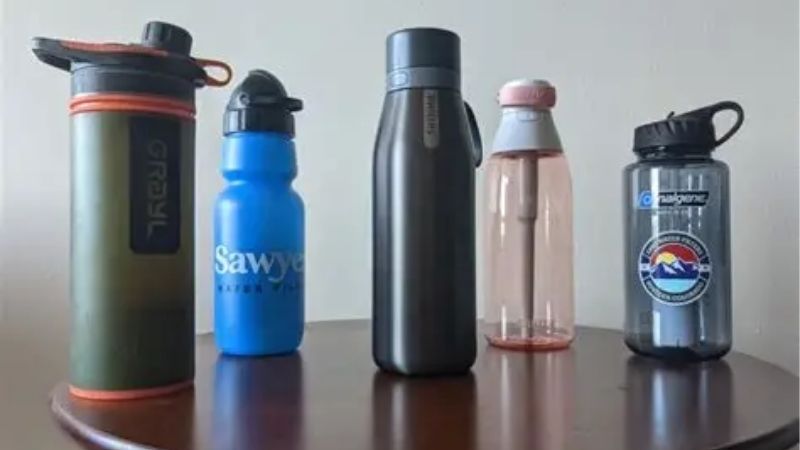
Filtration performance is table stakes. What separates a bottle you use every day from one that migrates to the back of a cupboard is the physical experience of drinking, refilling and washing it. Three practical factors decide that, and none of them appear on the front of the packaging.
How You Actually Get Water Out
Three mechanisms dominate. Straw bottles like the LifeStraw Go require you to suck water through the membrane, which delivers around 0.5 litres per minute and takes noticeable effort. Squeeze flasks like the Katadyn BeFree flow at roughly 2 litres per minute with hand pressure instead.
Press purifiers work differently again: fill an outer sleeve, push an inner bottle through the cartridge in about eight seconds, then drink from a sealed vessel. Anyone with limited jaw strength should avoid straw designs, because the filtered water bottle best for them is one that needs no suction at all.
Weight and Size When Full, Not Empty
Empty weights look similar across the category, but capacity changes the carried load considerably. The LifeStraw Go in 650 millilitres weighs 247 grams empty and the 1 litre version 268 grams, yet the larger bottle carries an extra 350 grams of water on every fill.
Height matters for storage. The 1 litre Go stands 28 centimetres tall, which clears most cup holders and many side pockets. The Katadyn BeFree collapses as it empties, taking almost no pack space on the return leg, which is the strongest argument for a soft flask over a rigid bottle.
Cleaning, Drying and Leaks
Bottles that are awkward to clean stop being used, so the filtered water bottle best for a household is usually the one that survives a dishwasher. LifeStraw states its Go bottle and cap are dishwasher safe once the filters come out: the container goes in the machine, the membrane never does.
Drying discipline matters most with press purifiers, which develop odours if packed away damp. Leak resistance is the other daily consideration, and the LifeStraw Go range is designed leak-proof with a carabiner for clipping to a bag, which suits commuting more than a soft flask does.
Filtered Water Bottle Best Picks for Everyday Use
Five options ranked on how they behave day to day rather than on filtration claims. The filtered water bottle best for a desk and a commute is rarely the one you would carry on a fast hike, so start from where the bottle will spend most of its life. Specifications are manufacturer-published.
| Model | Capacity | Empty weight | Drinking method | Best for |
|---|---|---|---|---|
| LifeStraw Go Series 22 oz | 650 ml | 247 g | Straw, approx. 0.5 L/min | Everyday carry |
| LifeStraw Go Series 1 L | 1 L / 34 oz | 268 g | Straw, approx. 0.5 L/min | Longer days, fewer refills |
| LifeStraw Go Stainless | 18 oz / 24 oz | Heavier, insulated | Straw | Hot and cold drinks |
| Katadyn BeFree 0.6L | 600 ml | approx. 63 g | Squeeze, approx. 2 L/min | Fast hiking, packs flat |
| Grayl UltraPress | 500 ml | Press mechanism | Press, approx. 8 sec | Travel, virus protection |
LifeStraw Go Series 22 oz – Best All-Round Daily Bottle
Six hundred and fifty millilitres, 247 grams and 28 centimetres tall, in BPA-free plastic made from 50% post-consumer recycled material. The two-stage filter pairs a 0.2 micron membrane with an activated carbon capsule, and the bottle ships with a carabiner for clipping to a bag or pack strap.
It is the easiest bottle here to live with, since the container and cap go in the dishwasher once the filters come out. The limitation is drinking effort: around 0.5 litres per minute through the straw means steady suction, which some users find tiring over a full day at a desk.
LifeStraw Go Series 1 L – Fewer Refills
The litre version uses identical filtration and adds only 21 grams of empty weight over the 650 millilitre model, at 268 grams. For anyone who resents refilling, that is a straightforward upgrade, and the filter economics are unchanged because both use the same membrane and carbon capsule.
Height is the cost. At 28 centimetres it does not fit every cup holder or bottle cage, and a full litre of water adds noticeable weight to a bag. If you refill easily during the day, the smaller version is the more comfortable one to actually carry around.
LifeStraw Go Stainless – Best for Temperature
The stainless steel Go bottles carry the same 0.2 micron membrane and carbon capsule but add double-wall vacuum insulation, which the Tritan plastic versions do not have. Sizes are 18 and 24 ounces, and the filtration performance is identical to the plastic models in every respect.
You pay in weight and price, and stainless is less forgiving when dropped on rock. It is the right choice if you want cold water through a hot afternoon or if the bottle doubles as a coffee flask, and the wrong one if grams matter on a hike.
Katadyn BeFree 0.6L – Lightest and Fastest
A collapsible HydraPak flask with a 0.1 micron EZ-Clean hollow-fibre membrane, weighing roughly 63 grams and measuring about 2.6 by 10.4 inches. Flow reaches around 2 litres per minute by squeezing, four times the LifeStraw straw, and the flask packs flat once empty.
There is no carbon stage in the standard version, so chlorine taste and chemicals pass through untouched, and no virus protection. Flow also drops noticeably with use even when the membrane is cleaned, so plan around roughly two thirds of the advertised capacity in real conditions.
Grayl UltraPress – Best for Travel Days
A 500 millilitre press-style purifier that removes viruses as well as bacteria and protozoa, plus chemicals, heavy metals and pesticides. Fill the outer sleeve, press, and drink from a watertight bottle with a spout, with nothing to assemble or suck through at the water source.
Cartridge life is around 250 litres, far shorter than a microfilter membrane, and it must dry fully between trips or it develops odours. Testers also note the narrow body is awkward to fill from shallow streams, which is a practical annoyance on low-water terrain.
Back-to-School Demand, Tariffs and Timing
Two seasonal forces affect what the filtered water bottle best matched to your needs costs right now. These bottles sell alongside backpacks and rain gear in the weeks before term starts, and this year’s tariff changes have pushed up costs across plastics, filter media and stainless steel in the same window.
Bottles Are a Back-to-School Item
Water bottles sit with backpacks and rain jackets among the things families buy in late August and September, and that demand thins popular sizes and colours before availability recovers. If a specific capacity matters to you, ordering ahead of the rush avoids substituting the wrong one.
Replacement carbon capsules are worth adding to the same order. LifeStraw rates its capsule at 26 gallons, roughly 100 litres or two months of regular drinking, and running out mid-term is how a good bottle ends up abandoned in a cupboard tasting of chlorine.
Plastics and Filter Media Are Tariff-Exposed
Industry survey data indicates 84% of outdoor businesses expect to be affected by new tariffs, with costs rising roughly 7.7% overall and specialised plastics reported up 10 to 15%. Moulded bottle bodies, hollow-fibre membranes and stainless components all sit inside that exposure.
Manufacturers have said openly that published prices are estimates while supply chains settle. That matters more here than in most categories, because the real spend is the bottle plus several years of consumables rather than a single purchase you make once.
Work Out What It Costs to Run
With inflation near 4.2% and an estimated tariff burden of about $1,600 per US household in 2026, the ongoing cost deserves attention. A membrane rated for 4,000 litres spreads its price very thinly, while a 250 litre purifier cartridge carries a much higher cost per litre poured.
Against bottled water the comparison is not close. LifeStraw calculates that one membrane replaces the equivalent of 8,000 single-use plastic bottles, so anyone currently buying bottled water daily recovers the purchase price within weeks rather than months of switching.
Frequently Asked Questions
These four questions cover the practical issues that decide whether a filtering bottle stays in daily use. All answers assume the bottle is rinsed regularly and the filter dried between trips, since neglect is what turns a good bottle into an unpleasant one.
Which filtered water bottle best suits a daily commute?
A 650 millilitre plastic Go bottle for most people: light enough at 247 grams, leak-proof, dishwasher safe with the filters removed and fitted with a carabiner. Choose the stainless version instead if you want insulation, and the litre size if you rarely pass a tap during the day.
Do I need a filter for ordinary tap water?
Not for safety in most developed municipal systems, but the carbon stage noticeably improves taste by reducing chlorine and organic compounds. The membrane matters when you fill from unfamiliar taps, airport bathrooms or campsite supplies where you cannot verify the source.
How do I stop the bottle smelling musty?
Dry it properly. Remove the filter after use, rinse it with clean water and let both parts air-dry fully before storing. Packing a damp filter into a sealed bag is the single most common cause of odours, and press purifiers are the most sensitive to it.
Can I use these bottles for anything other than water?
No. Sports drinks, juice, coffee and anything with sugar or particulates will clog a hollow-fibre membrane quickly and cannot be rinsed out. Use a separate ordinary bottle for those, and keep the filtering one for water only if you want the membrane to reach its rated life.
See More:
- Best Water Filtering Bottle: 5 Picks by What They Remove
- Best Water Bottle Filter: Micron Ratings and Cartridge Life
- Best Water Bottle Purifier: Virus Protection and 5 Picks
- What Bottle Water Is the Best? Types, TDS and Label Rules
Final Thoughts
The filtered water bottle best for you is the one whose drinking method and cleaning routine you will tolerate every day. The 650 millilitre LifeStraw Go suits most commutes, the litre version cuts refills, the stainless model adds insulation, and the BeFree wins for fast hiking.


Write Your Review
No reviews yet. Be the first to share your experience!