
Best water bottle purifier products differ from filters in one decisive way: they remove viruses, which are around ten times smaller than the bacteria a 0.2 micron membrane stops. That matters in specific regions and nowhere else, so this guide covers when you need one and what it costs to run. Filters are cheaper.
Our top picks




As an Amazon Associate we earn from qualifying purchases at no extra cost to you.
As an Amazon Associate we earn from qualifying purchases.
By Jake Thompson, gear writer for Roger Bacon Outdoors.
🛒 Best Price Today on Amazon
Prime members get fast, free shipping on everything above, plus member-only deals. New members get a 30-day free trial — cancel anytime.
When You Actually Need the Best Water Bottle Purifier
Most people who buy a purifier do not need one, and a significant number who need one buy a microfilter by mistake. The distinction is geographic rather than technical, so the decision starts with where you will drink rather than with which brand has the most impressive packaging.
Where Viral Contamination Is a Genuine Risk
Viruses in drinking water are associated with human sewage contamination, which is why they concentrate in regions with limited wastewater infrastructure. Specialist guidance consistently points to parts of Southeast Asia, Africa and Central and South America as the destinations where viral risk is genuinely realistic.
North American and European backcountry water carries bacteria and protozoa, chiefly giardia and cryptosporidium, but viral risk there is low enough that microfilters are the standard recommendation. Buying a purifier for a Colorado creek means paying more per litre for protection you will not use.
How Purifiers Differ Mechanically
Microfilters work by pore size, and 0.1 or 0.2 microns simply cannot trap something measuring around 0.02 microns. Every best water bottle purifier closes that gap either with far finer ultrafiltration or with a press-through cartridge combining media that captures particles a straight membrane would pass.
LifeSaver uses ultrafiltration at 0.015 microns, roughly 15 nanometres, which is small enough to physically block viruses. Grayl uses a press cartridge that combines filtration with ion exchange and adsorption, which is also what allows it to reduce chemicals and heavy metals.
What That Protection Costs to Run
Running a best water bottle purifier is expensive per litre. A Grayl cartridge is rated at around 250 litres against 4,000 for a LifeStraw membrane microfilter, a sixteenfold difference. The LifeSaver Liberty sits between them at 2,000 litres, giving a published running cost of about three cents per litre.
Weight is the other cost, and it is easy to underestimate. The Liberty weighs 425 grams for a 400 millilitre capacity, roughly seven times a Katadyn BeFree flask that holds half a litre more water. Carrying virus protection you will never use is a real penalty on any trip where grams matter.
Best Water Bottle Purifier Picks, Plus Two That Are Not
Three genuine purifiers followed by two popular bottles regularly mistaken for them. The best water bottle purifier is worth its premium only where viral risk exists, so the last two entries are here specifically to stop you buying the wrong tool for the wrong destination.
| Model | Class | Removes viruses | Cartridge life | Capacity |
|---|---|---|---|---|
| Grayl GeoPress | Press purifier | Yes | approx. 250 L | 710 ml |
| LifeSaver Liberty | 0.015 micron ultrafiltration | Yes, 99.99% | 2,000 L | 400 ml |
| Grayl UltraPress | Press purifier | Yes | approx. 250 L | 500 ml |
| LifeStraw Go Series | 0.2 micron microfilter | No | 4,000 L membrane | 650 ml / 1 L |
| Katadyn BeFree 0.6L | 0.1 micron microfilter | No | Flow-limited | 600 ml |
Grayl GeoPress – Broadest Protection in One Bottle
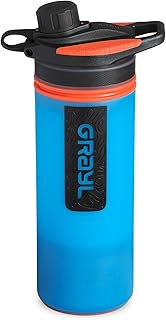
A 710 millilitre press purifier removing viruses, bacteria and protozoa while also reducing chemicals, heavy metals, pesticides and microplastics. You fill the outer sleeve, press the inner bottle down in roughly eight seconds, then drink from a sealed watertight vessel with a spout.
It is the most convenient option here because there is nothing to pump and nothing to suck through. The costs are a 250 litre cartridge needing replacement far more often than a microfilter, a bulky body, and a requirement to dry it fully between trips or it develops persistent odours.
LifeSaver Liberty – Strongest Certification and Longest Life
Ultrafiltration at 0.015 microns removing 99.99% of viruses, bacteria, parasites and microplastics, with stated performance exceeding NSF protocol P231 and WHO 2011 standards. An inline hand pump delivers about 1.2 litres per minute, and a 5-foot scavenger hose reaches awkward water sources.
The 2,000 litre cartridge is eight times a Grayl and includes a failsafe that stops flow when spent, so you cannot drink unpurified water by accident. Against that, it weighs 425 grams, holds only 400 millilitres, and the carbon disc handling metals lasts just 100 litres.
Grayl UltraPress – Lightest Press Purifier
The same press purification as the GeoPress in a 500 millilitre body aimed at trail running and fast packing, with the filter integrated into the bottle so nothing needs assembling at the source. Protection is equivalent, including virus removal and chemical reduction.
Cartridge life matches the GeoPress at roughly 250 litres, so cost per litre is identical while you carry less water per fill. Independent testers also note the narrower bottle is awkward to fill from shallow streams and puddles, which is a real limitation on low-water terrain.
LifeStraw Go Series – Excellent Filter, Not a Purifier
Included here because it is the bottle most often bought by mistake for international travel. The 0.2 micron membrane removes 99.999999% of bacteria and 99.999% of parasites and microplastics, tested against US EPA and NSF/ANSI protocols, and lasts up to 4,000 litres.
What it cannot do is stop viruses, which pass straight through a 0.2 micron pore. For North American and European backcountry it is the better buy on every measure including cost per litre. For a trip where viral contamination is plausible, it is the wrong tool regardless of price.
Katadyn BeFree 0.6L – Finest Microfilter, Still Not a Purifier
The 0.1 micron EZ-Clean membrane in a 63 gram collapsible flask delivers around 2 litres per minute, the fastest flow in this comparison. Half the pore size of the LifeStraw Go sounds like it should close the gap on viruses, and this is where buyers get caught out.
It does not. Viruses are roughly an order of magnitude smaller again than 0.1 microns, so finer microfiltration changes nothing about viral protection. Buy the BeFree for its weight and speed on trails where bacteria and protozoa are the realistic threats, and buy a proper purifier for anywhere they are not the whole picture.
Travel Timing, Cartridge Costs and Tariffs
A best water bottle purifier is bought for a specific trip, which makes timing part of the decision rather than an afterthought. Ordering ahead matters more than usual because the cartridge is a short-life consumable, and current tariff conditions have already moved pricing across filter media and moulded components.
Order the Spare Cartridge With the Bottle
A 250 litre Grayl cartridge covers a few weeks of heavy travel use rather than a whole season. Buying a spare at the same time avoids discovering mid-trip that the element is spent, which in a region carrying genuine viral risk means falling back on bottled water for the rest of the journey.
Failsafe designs help but do not solve this. The LifeSaver Liberty stops flowing entirely when its cartridge is finished, which protects you from drinking unpurified water and simultaneously leaves you without a working bottle unless a replacement is already in your luggage.
Filter Media Is Tariff-Exposed
Industry survey data indicates 84% of outdoor businesses expect to be affected by new tariffs, with costs rising roughly 7.7% overall and specialised plastics reported up 10 to 15%. Ultrafiltration cartridges, press housings and moulded bottle bodies all sit inside that exposure.
Manufacturers have said openly that published prices are estimates while supply chains settle. In a category where the consumable costs a meaningful fraction of the bottle, an increase on cartridges affects total ownership far more than a one-off change to the purchase price.
Late Summer Thins the Range
Filtering and purifying bottles sell alongside backpacks and rain gear before the school year, and replacement cartridges frequently sell out ahead of the bottles themselves. If a trip is booked for autumn, ordering now avoids substituting a format you did not want.
With inflation near 4.2% and an estimated tariff burden of about $1,600 per US household in 2026, buying the correct class of bottle once matters more than saving twenty dollars. A purifier bought for a trip that needed only a microfilter is money spent on cost per litre you will keep paying.
Frequently Asked Questions
These four questions cover the decisions travellers face most often. All answers assume the bottle is used as designed and dried properly between trips, since damp storage is the fastest way to ruin any cartridge regardless of what it is certified to remove.
Do I need the best water bottle purifier for Europe?
No. Municipal water across most of Europe is treated to standards where a microfilter is more than sufficient, and in many countries the tap water needs nothing at all. A carbon stage for taste is the realistic benefit, which any two-stage filter bottle already provides.
Can I add virus protection to a filter I already own?
Not to the membrane itself, but chemical treatment works alongside it. Drops or tablets handle viruses, and filtering afterwards removes the sediment and much of the taste. It is slower than a purifier and requires a wait time, but it costs a fraction of a dedicated bottle.
What does NSF P231 mean on the label?
P231 is the NSF protocol covering microbiological water purifiers, which includes virus removal in its test criteria. Seeing it referenced, as LifeSaver does for the Liberty, is a reliable signal that a product is a purifier rather than a microfilter with confident marketing copy.
Do purifiers remove heavy metals?
Some do, through a separate stage. Grayl states heavy metal reduction on its cartridges, and LifeSaver uses an activated carbon disc that addresses lead, nickel and cadmium but lasts only 100 litres. Ultrafiltration alone does nothing for dissolved metals regardless of pore size.
See More:
- Best Water Filtering Bottle: 5 Picks by What They Remove
- Best Water Filtration Bottle: 5 Picks and What Tests Mean
- Filtered Water Bottle Best Picks for Daily Use: 5 Compared
- What Bottle Water Is the Best? Types, TDS and Label Rules
Final Thoughts
The best water bottle purifier is only the best choice where viruses are a real risk. The Grayl GeoPress is the most convenient, the LifeSaver Liberty the most certified and longest lasting, and the UltraPress the lightest. Anywhere else, a microfilter costs far less per litre.

Write Your Review
No reviews yet. Be the first to share your experience!