
Best water filtering bottle shopping goes wrong when buyers assume every bottle handles the same threats. A 0.2 micron membrane stops bacteria and parasites but not viruses, which are roughly ten times smaller. These five bottles are compared on pore size, flow rate and how long each cartridge lasts.
Our top picks


 LifeStraw Personal Water Filter for Hiking
Removes over 99.999999 percent of waterborne bacteria
Filters down to 1 micron to catch microplastics
Rated to filter up to 4,000 liters of water
Filters water only as you drink, no storage reservoir
Listing does not specify virus removal capability


As an Amazon Associate we earn from qualifying purchases at no extra cost to you.
As an Amazon Associate we earn from qualifying purchases.
By Jake Thompson, gear writer for Roger Bacon Outdoors.
🛒 Best Price Today on Amazon
Prime members get fast, free shipping on everything above, plus member-only deals. New members get a 30-day free trial — cancel anytime.
What the Best Water Filtering Bottle Actually Removes
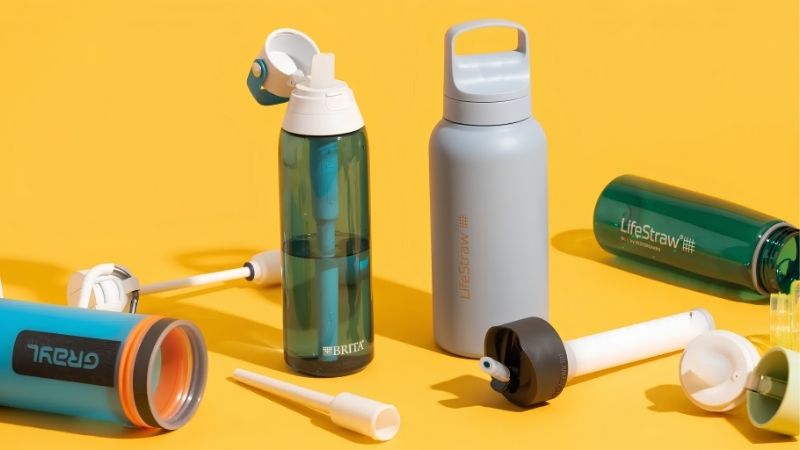
The single most important distinction in this category is filter versus purifier, and most product pages blur it. Getting it right determines whether a bottle is appropriate for a Colorado creek, a tap in Mexico or neither. Three specifications tell you what you are actually buying.
Micron Rating Sets the Biological Limit
Hollow-fibre microfilters are rated by pore size. The LifeStraw Go series filters to 0.2 microns and the Katadyn BeFree to 0.1, and both remove bacteria and protozoa at very high rates. LifeStraw publishes 99.999999% for bacteria including E. coli and salmonella, and 99.999% for parasites.
Neither stops viruses, which measure around 0.02 microns and pass straight through. That is not a defect; it is the design brief. For North American and European backcountry water, where bacteria and protozoa are the realistic risks, a 0.1 or 0.2 micron microfilter is exactly the right tool.
Purifiers Use a Different Mechanism
Where viral risk exists, you need a purifier rather than a microfilter. Grayl’s press-style bottles remove viruses alongside bacteria and protozoa, and also reduce chemicals, heavy metals, pesticides and microplastics, which straight microfiltration cannot address at all.
That capability costs cartridge life. Grayl cartridges are rated for around 250 litres, against 4,000 litres for a LifeStraw membrane microfilter. For international travel in regions where viral contamination is plausible, the shorter service life is the price of adequate protection.
Carbon Stages Handle Taste, Not Pathogens
Activated carbon does nothing biological. Its job is reducing chlorine, organic chemical matter and odours, which is what makes filtered tap water palatable. LifeStraw pairs a carbon capsule with its membrane in a two-stage design, while the standard Katadyn BeFree omits carbon entirely for maximum flow.
Carbon is also the consumable that runs out first by a wide margin, and it is the recurring cost behind every best water filtering bottle. LifeStraw rates its capsule at 26 gallons, about 100 litres or roughly two months of regular use, against 1,000 gallons for the membrane behind it.
Best Water Filtering Bottle Picks From 0.6 to 1 Litre
Five bottles covering everyday tap use through international travel. The best water filtering bottle for a weekend hike is not the one for a trip to a region with viral contamination, so read the removal column before the capacity column. All figures are manufacturer-published.
| Model | Capacity | Type | Removes | Cartridge life |
|---|---|---|---|---|
| LifeStraw Go Series 22 oz | 650 ml / 22 oz | 0.2 micron + carbon | Bacteria, parasites, microplastics | 4,000 L membrane, 100 L carbon |
| Grayl GeoPress | 710 ml / 24 oz | Press purifier | Viruses, bacteria, protozoa, chemicals | approx. 250 L |
| Grayl UltraPress | 500 ml / 16.9 oz | Press purifier | Viruses, bacteria, protozoa, chemicals | approx. 250 L |
| Katadyn BeFree 0.6L | 600 ml | 0.1 micron hollow fibre | Bacteria, protozoa | Flow declines with use |
| LifeStraw Go Stainless | 18 oz / 24 oz | 0.2 micron + carbon | Bacteria, parasites, microplastics | 4,000 L membrane, 100 L carbon |
LifeStraw Go Series 22 oz – Best Everyday Bottle
Six hundred and fifty millilitres, 247 grams and 28 centimetres tall, in BPA-free plastic made from 50% post-consumer recycled material. The two-stage system pairs a 0.2 micron membrane microfilter with an activated carbon capsule, and it is independently lab-tested against US EPA and NSF/ANSI protocols.
Removal rates are 99.999999% of bacteria, 99.999% of parasites and 99.999% of microplastics, plus chlorine and sediment reduction. Flow through the straw is around 0.5 litres per minute, which requires steady sucking, and anyone with limited jaw strength will find that resistance genuinely tiring.
Grayl GeoPress – Best for International Travel
A 710 millilitre press-style purifier that removes viruses in addition to bacteria and protozoa, and also reduces chemicals, heavy metals, pesticides and microplastics. You fill the outer sleeve, press the inner bottle down in roughly eight seconds, and drink from a sealed, watertight vessel.
The cartridge is rated at about 250 litres, far shorter than a microfilter membrane, and it must be dried properly between trips or it develops odours. It is also bulkier and heavier than a hollow-fibre bottle, which is the trade-off for the only virus protection in this comparison.
Grayl UltraPress – Lighter Purifier Option
The UltraPress delivers the same press-and-drink purification in a smaller 500 millilitre body, aimed at trail running, fast packing and anyone who found the GeoPress too bulky for a pack pocket. The bottle is integrated into the filter, so there is nothing to assemble at the water source.
Capacity is the obvious compromise, and independent testers note the narrower bottle is awkward to fill from shallow streams and puddles. Cartridge life matches the GeoPress at roughly 250 litres, so the running cost per litre is identical while you carry a third less water.
Katadyn BeFree 0.6L – Fastest Flow
A collapsible HydraPak flask with an EZ-Clean hollow-fibre membrane rated at 0.1 microns, weighing around 63 grams and measuring roughly 2.6 by 10.4 inches. Flow reaches about 2 litres per minute, four times the LifeStraw Go, which makes it the fastest option here by a wide margin.
The standard version has no carbon stage, so it does nothing for chlorine taste or chemicals, and there is no virus protection. Flow also drops noticeably with use even when cleaned, and independent reviewers suggest planning around roughly two thirds of the advertised capacity in real conditions.
LifeStraw Go Stainless – Best Insulated Option
The stainless steel Go bottles use the same two-stage 0.2 micron membrane and carbon capsule as the plastic version but add double-wall vacuum insulation, which the Tritan bottles do not have. Sizes run 18 and 24 ounces, and the filtration performance is identical to the plastic models.
You pay for that in weight and price, and stainless bottles are less forgiving if dropped on rock. Filter economics are unchanged: the membrane handles up to 1,000 gallons while the carbon capsule needs replacing after roughly 26 gallons, or about two months of daily drinking.
Back-to-School Demand and What Tariffs Mean Here
Two things shape the price of a best water filtering bottle right now. Late summer is peak season for bottle purchases as the school year approaches, and this year’s tariff changes have moved costs across plastics, filter media and stainless steel in the same period.
Bottles Are a Back-to-School Category
Water bottles sit alongside backpacks and rain jackets as items families buy in the weeks before term starts, and that demand runs through late August into September. Popular sizes and colours in the filtering ranges thin out during that window before availability improves again in autumn.
If you need a bottle for a specific trip, buying before the rush avoids substituting a size you did not want. The replacement carbon capsules are worth ordering at the same time, since a two-month consumable is easy to forget until the water starts tasting of chlorine again.
Filter Media and Plastics Are Tariff-Exposed
Industry survey data indicates 84% of outdoor businesses expect to be affected by new tariffs, with costs rising roughly 7.7% overall and specialised plastics reported up 10 to 15%. Hollow-fibre membranes and moulded bottle bodies both sit inside that exposure, as does stainless steel hardware.
Manufacturers have said openly that published prices are estimates while supply chains settle. That matters more than usual in this category, because the real cost is the bottle plus several years of replacement cartridges rather than the one-off purchase price.
Work Out the Cost per Litre
With inflation near 4.2% and an estimated tariff burden of about $1,600 per US household in 2026, the running cost of a best water filtering bottle deserves the same attention as its sticker price. A 4,000 litre membrane spreads its cost thinly; a 250 litre purifier cartridge does not.
Set against bottled water the maths still favours filtration heavily. LifeStraw calculates that one membrane replaces the equivalent of 8,000 single-use plastic bottles, which pays back the purchase within the first weeks of daily use for anyone currently buying bottled water regularly.
Frequently Asked Questions
These four questions cover the decisions that matter most before buying. All answers assume the bottle is used as designed, cleaned regularly and dried between trips, since neglected filters lose flow and develop odours faster than any specification sheet suggests they should.
Is the best water filtering bottle safe for foreign tap water?
Only if it is a purifier. Microfilters at 0.1 or 0.2 microns handle bacteria and protozoa but let viruses through, and viral contamination is a genuine risk in parts of Southeast Asia, Africa and Central and South America. For those destinations choose a Grayl or another virus-rated purifier.
How do I know when the filter is finished?
LifeStraw’s membrane stops water flowing entirely at end of life, which is the clearest possible signal. Carbon capsules give no such warning, so replace them when taste or smell changes, roughly every 26 gallons. Hollow-fibre flasks slow gradually rather than stopping outright.
Do these remove lead or heavy metals?
Standard hollow-fibre microfilters do not. Grayl purifiers state reduction of heavy metals and chemicals, and activated carbon stages reduce some organic compounds, but neither is a substitute for a bottle specifically certified for lead if that is your concern at home.
Can I put a filter bottle in the dishwasher?
The bottle and cap usually yes, the filter never. LifeStraw states its Go bottles are dishwasher safe once the filters are removed. Heat and detergent damage hollow-fibre membranes, so rinse those with clean water only and air-dry them fully before storing the bottle away.
See More:
- Best Water Bottle Filter: Micron Ratings and Cartridge Life
- Filtered Water Bottle Best Picks for Daily Use: 5 Compared
- Best Water Filtration Bottle: 5 Picks and What Tests Mean
- Best Water Bottle Purifier: Virus Protection and 5 Picks
- What Bottle Water Is the Best? Types, TDS and Label Rules
Final Thoughts
The best water filtering bottle is the one matched to the water you will actually drink. A 0.2 micron LifeStraw Go covers everyday tap and North American backcountry, the Katadyn BeFree wins on flow, and only the Grayl bottles handle viruses. Budget for cartridges, not just the bottle.

Write Your Review
No reviews yet. Be the first to share your experience!