
Key takeaways
What's inside
Best backpack for commuting by bike has to solve three problems a walking commute never raises: rain arriving horizontally, a sweating back, and being visible after dark. This guide covers waterproof construction, ventilation systems, and load stability, then compares five packs built specifically for riding in weather.
As an Amazon Associate we earn from qualifying purchases at no extra cost to you. Product prices and availability are accurate as of the date shown and are subject to change.


As an Amazon Associate we earn from qualifying purchases at no extra cost to you. Product prices and availability are accurate as of the date shown and are subject to change.
By Jake Thompson, gear writer at Roger Bacon Outdoors.
🛒 Best Price Today on Amazon
Prime members get fast, free shipping on everything above, plus member-only deals. New members get a 30-day free trial — cancel anytime.
How to Choose the Best Backpack for Commuting by Bike
Riding changes every requirement for the best backpack for commuting. The bag sits at a different angle, rain hits it from the front rather than above, and your back has no airflow for the whole journey. Three features determine whether the best backpack for commuting works on a bike or merely tolerates it.
Waterproof Construction Versus Water Resistance
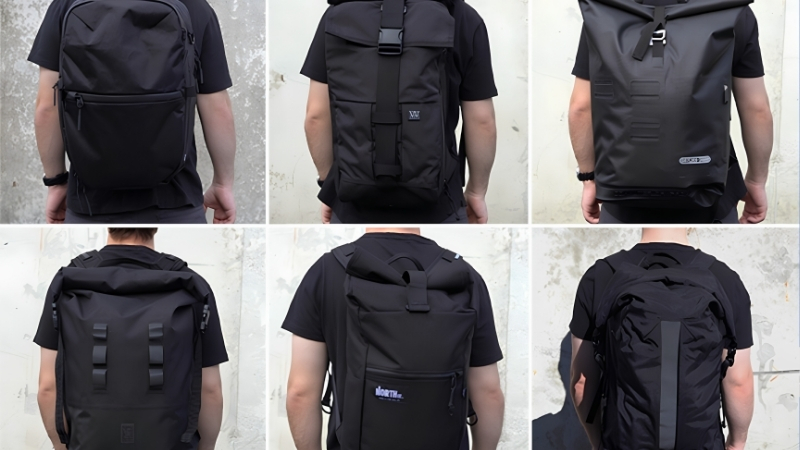
Water-resistant fabric handles drizzle and fails in sustained rain, because water enters through zip lines and seams rather than through the material. A roll-top closure with welded seams keeps contents dry in genuinely bad weather, which is the difference between arriving with a working laptop and not.
If you prefer a zipped bag, look for a waterproof internal liner or a permanently attached rain cover. A cover stored in a pocket is only useful if you stop to deploy it, and rain rarely gives notice. Riders who commute daily generally end up with a roll-top.
Back Ventilation and Sweat Management
A flat panel pressed against your spine for forty minutes produces a soaked shirt regardless of the weather. Tensioned mesh back systems hold the pack a centimetre or two off your body, letting air move through, and that single feature changes how you arrive more than anything else on the bag.
Ventilated systems cost some capacity and a little weight because the frame curves the bag away from you. On a short ride the trade is questionable; past about twenty minutes it is worth it. Channelled foam panels are a cheaper middle ground that helps without the full frame.
Load Stability, Visibility, and Fit
A bag that shifts when you stand on the pedals is distracting and, on a fast descent, genuinely unsafe. Compression straps that pull the load against your back plus a sternum strap and a light waist strap keep everything still. Cycling-specific packs are cut shorter so they clear your lower back.
Visibility matters from October onward. Reflective panels on the rear and sides, plus a loop or clip for a rear light, are worth insisting on. A high-visibility rain cover doubles as a safety feature, which is a reasonable argument for buying a bright colour rather than black.
Top Picks: Best Backpack for Commuting by Bike
Every best backpack for commuting below prioritises weather protection and stability over office styling, which is the correct trade for a daily ride. Capacities and waterproof ratings come from manufacturer listings and vary between model years, so confirm laptop sizing on the current version before ordering.
| Model | Capacity | Weather Protection | Back System | Best For |
|---|---|---|---|---|
| Ortlieb Velocity 23L | 23 L | Fully waterproof roll-top | Padded panel | Heavy rain riding |
| Vaude Bike Alpin 30+5 | 30-35 L | Rain cover included | Ventilated frame | Longer rides |
| Deuter Race EXP Air | 12-15 L | Rain cover included | Airstripes mesh | Fast light commutes |
| Osprey Radial 26 | 26 L | Rain cover included | AirSpeed suspended mesh | Ventilation |
| Two Wheel Gear Pannier Backpack | ~20 L | Water resistant | Padded panel | Converting to a pannier |
1. Ortlieb Velocity 23L – Best in Heavy Rain
Ortlieb makes waterproof cycling luggage and nothing else, and the Velocity is the benchmark. A welded roll-top body keeps contents dry through sustained downpours rather than merely resisting them, and the single-compartment design means there are no zips for water to find a way through.
The trade-offs are real: one large compartment means minimal organisation, the back panel is padded rather than ventilated so you will sweat, and the styling is unmistakably utilitarian. If your commute involves genuine weather and a laptop you cannot risk, nothing here protects better.
2. Vaude Bike Alpin 30+5 – Best for Longer Rides
At 30 litres expandable to 35, this handles a commute plus a change of clothes and a lunch, which is what longer rides actually require. The ventilated frame keeps the pack off your back, and a helmet holder and integrated rain cover cover the practical details.
The frame system adds weight and the pack looks technical rather than smart. Waterproofing relies on the cover rather than the body, so it needs deploying before rain arrives. For a commute over half an hour where ventilation matters most, it balances everything well.
3. Deuter Race EXP Air – Best for Fast Light Commutes
Built for road riding rather than carrying, this suits a short fast commute with minimal kit. The Airstripes back system provides real airflow at a low weight, the profile is aerodynamic rather than boxy, and the expansion zip adds a few litres when you need them.
Twelve to fifteen litres will not take a large laptop or a change of shoes, so this is a bag for riders who leave clothes at the office. Organisation is minimal. If your commute is short, fast, and light, it is far more comfortable than a general daypack.
4. Osprey Radial 26 – Best Ventilation
The AirSpeed suspended mesh panel is the most effective ventilation system here, holding the entire bag clear of your back so air moves freely. Twenty-six litres covers a laptop and clothes, and a kickstand-style base lets the bag stand upright when you set it down.
The suspended panel pushes the load further from your spine, which is slightly less stable on rough surfaces, and the bag is bulky compared with road-focused packs. Waterproofing depends on the included cover. For riders who arrive drenched in sweat rather than rain, this solves the actual problem.
5. Two Wheel Gear Pannier Backpack – Best Convertible
This one takes the weight off your back entirely when you want it to. Hooks fold out so the bag mounts to a rear rack as a pannier, then convert back to shoulder straps at the other end, which is the ideal setup for a long ride with a heavy load.
It requires a rear rack, adds hardware weight when worn as a backpack, and the water resistance is not on Ortlieb’s level. Capacity is moderate. For anyone with a rack fitted who resents carrying weight on a warm ride, the conversion is genuinely useful.
Tariffs, Darker Commutes, and Buying Timing
Costs have shifted and the riding calendar changes what matters in a bag. Both are worth understanding before you settle on the best backpack for commuting through an autumn and winter of riding.
Technical Fabric Costs Have Risen
An Outdoor Industry Association survey found 84 percent of member businesses expect tariff impacts, with costs rising roughly 7.7 percent overall. High-tenacity nylon and the coated and welded fabrics used in waterproof cycling luggage have climbed 10 to 15 percent, which is the higher end of the range.
For packs between $100 and $250, that is a real figure. Brands have been unusually direct that quoted forward pricing is provisional while supply chains settle, so a model you have already chosen is generally worth buying rather than deferring into next season.
Autumn Is When the Requirements Change
From late September the commute gets darker and wetter, which moves reflectivity and genuine waterproofing from nice-to-have to necessary. Demand for waterproof packs and high-visibility covers climbs sharply in that window, and the brighter colourways are usually the first to sell through.
Buying before the weather turns also means you can test the roll-top closure and the rain cover on a dry day rather than discovering a problem at six in the morning in November. Fitting a rear light to the bag’s loop is easier done in advance too.
Where the Discounts Land
The calendar is predictable for a non-urgent purchase. Prime Big Deal Days in mid-October and the Black Friday through Cyber Monday window in late November bring the deepest cuts on cycling gear, with early deals often appearing in the days ahead of each event.
Cycling accessories are also frequently gifted, so popular models thin out before those windows close. Track prices with a wishlist, but weigh the saving against riding through a wet October with a bag that does not keep water out of your laptop compartment.
Frequently Asked Questions
These come up constantly from riders hunting the best backpack for commuting after one soaking journey home. Short answers below.
Backpack or panniers for a bike commute?
Panniers keep weight off your back and off your spine entirely, which matters most on longer rides and warmer days. Backpacks are faster to remove, work on any bike without a rack, and stay with you off the bike. Convertible designs cover both at the cost of some weight.
How do I stop arriving sweaty?
A ventilated back system that holds the pack off your spine helps more than anything else, and carrying less helps almost as much. Beyond that, riding slightly slower for the last five minutes and unbuckling the sternum strap lets airflow start before you get off the bike.
Is a rain cover enough?
For occasional showers, yes, provided you deploy it before the rain starts. For a daily commute in a wet climate, a genuinely waterproof roll-top body is more reliable because it needs no action from you. Covers also blow loose at speed if not secured properly.
How much reflectivity do I need?
Reflective panels on the rear and both sides, plus a loop for a rear light, is the practical minimum from October onward. Reflective material only works when a light source hits it, so it supplements rather than replaces a proper rear light on the bike or bag.
See More:
- Best trekking sleeping bag
- Best sleeping bag for backpacking
- Best women backpack for work
- Best backpack for backpackers
Final Thoughts
The best backpack for commuting by bike is the one that keeps water out without you doing anything and lets air move across your back. Decide first whether your climate justifies a fully waterproof roll-top or whether a rain cover will do, then prioritise ventilation over capacity, since a soaked shirt ruins a commute more reliably than a slightly small bag does. Sort it out before the clocks change and the reflective panels start earning their place.






Write Your Review
No reviews yet. Be the first to share your experience!