Key takeaways
- No torso measurement: A generic “one size fits all” harness may be difficult to fit securely.
- Unclear load rating: Capacity in liters does not tell you how many pounds the frame can comfortably carry.
- Hip belt that is decorative: A thin, narrow, or non-adjustable belt may fail to transfer weight from your shoulders.
- Overstated waterproofing: A water-resistant coating is not a substitute for seam sealing and dry-bag protection.
- Very low weight without construction details: If a large pack weighs under 2 pounds, investigate the frame, fabric, and recommended load carefully.
- Return restrictions: Final-sale terms are risky when fit depends on torso length and hip-belt sizing.
Buying a backpacking pack by volume alone is one of the most common mistakes shoppers make. A 65-liter pack is not automatically better than a 55-liter model, and a low price does not necessarily mean poor performance. The wrong torso length, an overloaded frame, or straps that cannot be adjusted can make even a well-reviewed backpack uncomfortable after a few miles.
For this backpacking backpack buying guide torso length is the starting point, not an afterthought. Capacity, frame design, materials, hip-belt fit, and load range all matter together. The right pack should carry your expected gear without forcing you to overpack, while transferring most of the weight to your hips. Use the measurements and price ranges below to compare models objectively in 2026.
Our top picks


 WoneNice 50L
- Recommended Uses For Product: Travel
- Strap Type: Adjustable
- Compatible Device Size Maximum: 23.6 Inches
As an Amazon Associate we earn from qualifying purchases at no extra cost to you. Ratings are shown as listed on Amazon.
Decide These 3 Things First
- Your trip length: A weekend trip with compact gear usually needs 40 to 55 liters. A three- to five-day trip commonly fits in 55 to 70 liters. Winter equipment, bulky sleeping bags, or limited access to resupply may require 70 liters or more.
- Your loaded weight: Add the weight of food, water, shelter, sleeping gear, clothing, and the pack itself. Packs designed for 20 to 35 pounds feel very different from those built to manage 40 to 55 pounds.
- Your torso length: Measure from the prominent bone at the base of your neck to the top of your hip bones. Many adults fall between 16 and 21 inches, but adjustability matters more than assuming you need a small, medium, or large.
Measure torso length with a flexible tape, or ask someone to help. Bend your head forward and locate the C7 vertebra, the bony bump at the base of your neck. Place your hands on your hips with your thumbs pointing toward each other. Measure from the C7 point to the imaginary line connecting the tops of your hip bones. Compare that number with the manufacturer’s torso range.
Size and Capacity
Pack volume should match your gear, not your aspirations. A 40- to 50-liter pack is suitable for ultralight weekend trips when your shelter, sleeping bag, and clothing compress well. A 50- to 65-liter pack is the most versatile range for many three-season backpackers. Choose 65 to 75 liters when carrying a larger tent, a synthetic sleeping bag, cold-weather layers, or equipment for children.
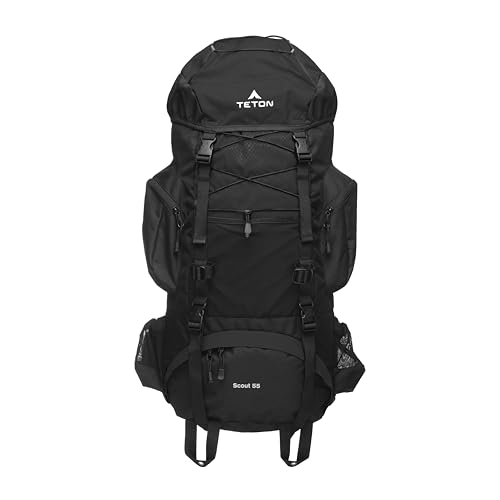
Do not fill unused space simply because it is available. An empty 65-liter pack may weigh more than a streamlined 50-liter model and can encourage unnecessary gear. For reference, the Teton 55L Scout is aimed at the compact weekend-to-multi-day category, while the Teton 65L Scout models offer additional room for bulky equipment. The listed prices of about $100 and under $150 make them examples of value-oriented capacity choices, not proof that one size fits every trip.
Also check external dimensions. A practical backpacking pack often measures roughly 24 to 32 inches tall, 12 to 16 inches wide, and 8 to 12 inches deep. Dimensions affect airline handling, narrow trails, and how far the load sits away from your back. A tall, narrow shape generally keeps weight closer to your center of gravity.
Material and Weather Protection
Common pack fabrics include polyester, nylon, and ripstop nylon. Denier ratings typically range from about 100D for lightweight panels to 600D or higher for abrasion-prone areas. Lower-denier fabric can reduce weight, but heavier fabric is generally more reassuring around rock, brush, and rough camp surfaces.
Water resistance is not the same as waterproof construction. A water-resistant coating may delay saturation during a light shower, while taped seams and waterproof zippers provide stronger protection. Many traditional packs are not fully waterproof because stitching, pockets, and zipper openings remain vulnerable. A removable rain cover is useful; keep maps, electronics, and sleeping insulation in waterproof liners or dry bags as well.
The WoneNice 50L backpack, listed for under $50, illustrates the budget end of the market with a stated waterproof design and included rain cover. Treat those claims as useful features, but inspect the closure system and seam construction before relying on the pack during prolonged rain.
Construction and Frame Design
An internal frame helps stabilize the load and transfers weight toward the hip belt. Entry-level packs may use a simple aluminum stay, plastic sheet, or foam structure. More advanced models can combine dual stays, a frame sheet, load lifters, and a tensioned back panel.
For loads below about 25 pounds, a lightly structured pack may be comfortable and efficient. Between 25 and 40 pounds, look for a substantial hip belt, firm lumbar support, and load-lifter straps. Above 40 pounds, prioritize a rigid frame, reinforced stitching, and a hip belt that does not fold under pressure. A pack rated for 50 pounds should not be assumed comfortable at that weight unless the harness is correctly fitted.
Inspect stress points: shoulder-strap anchors, hip-belt wings, compression-strap stitching, pocket seams, and the base panel. Reinforced bartacks or multiple rows of stitching are preferable at these locations. Compression straps should pull the load inward without blocking access to side pockets or water bottles.
Comfort and Performance
Torso length is the fit measurement that controls everything else. The shoulder straps should curve around your shoulders without digging into your neck. The hip belt should sit directly over your hip bones, not around your waist. After tightening the belt, the shoulder straps should remain snug but carry only a portion of the weight.
Use the load-lifter straps at the top of the shoulders to pull the pack slightly toward your upper back. They usually work best at an angle of roughly 30 to 45 degrees from the shoulder strap to the pack. The sternum strap should stabilize the shoulder straps without restricting breathing.
Ventilation systems vary. A close-fitting foam back panel usually carries weight efficiently but may feel warmer. A suspended mesh panel can increase airflow, though it may move the load farther behind you. For hot-weather hiking, ventilation can be valuable; for heavy loads, close contact and stability may matter more.
When trying on a pack, load it with 15 to 20 pounds before judging comfort. Walk, climb stairs, and bend forward. Check for pressure on your hips, collarbones, lower back, and neck. A pack that feels comfortable empty can feel entirely different when loaded.
Price Tiers
Budget backpacking packs generally cost about $40 to $120. They often provide useful capacity, an internal frame, multiple pockets, and a rain cover, but may weigh 4 to 6 pounds and offer limited torso adjustment. They are reasonable for occasional trips and moderate loads.
Midrange packs typically cost $120 to $250 and often weigh about 2.5 to 4 pounds. Expect better harness adjustment, more durable zippers, stronger load transfer, and improved ventilation. This tier is usually the best balance for regular three-season backpacking.
Premium packs commonly cost $250 to $500 or more and may weigh 2 to 3.5 pounds. Their advantages can include lighter fabrics, precise torso and hip-belt sizing, refined suspension systems, and replaceable components. They are most worthwhile when you hike frequently or carry a demanding load, not simply because the price is higher.
Warranty and Replacement Support
Read the warranty before buying. A limited one-year warranty may cover manufacturing defects but exclude abrasion, overloaded frames, stains, and normal wear. Some brands offer longer coverage, but terms differ for buckles, zippers, fabric, and frame components.
Look for clearly stated repair or replacement procedures. A repairable hip-belt buckle can extend a pack’s useful life, while a discontinued proprietary buckle may be difficult to replace. Keep your receipt, product registration information, and photos of any defect. Warranty support should be evaluated alongside price: saving $30 is less attractive if a broken frame leaves you without a practical remedy.
Delivery and Assembly
Backpacks do not require assembly in the furniture sense, but they do require setup. Allow 10 to 15 minutes to remove packaging, adjust the torso, position the hip belt, and route compression straps. If the product arrives with a detachable daypack, frame stay, or hydration sleeve, confirm that every component is included before a trip.
Check delivery timing and return conditions before ordering. A useful test period should let you adjust the pack indoors with a loaded weight of at least 15 pounds. Do not remove tags or take the pack outside until you confirm the torso range, hip-belt size, and return window. A rain cover, hydration port, and sternum strap should be listed in the box contents rather than assumed.
Spec Checklist
| Spec | Budget | Mid | Premium |
|---|---|---|---|
| Typical capacity | 45–65 L | 50–70 L | 40–65 L |
| Pack weight | 4–6 lb | 2.5–4 lb | 2–3.5 lb |
| Comfortable loaded range | 15–30 lb | 20–40 lb | 20–45 lb |
| Torso adjustment | Fixed or 16–21 in | 16–23 in | 15–24 in with fine adjustment |
| Fabric range | 300D–600D polyester or nylon | 210D–420D nylon | 70D–400D ripstop or technical nylon |
| Price range | $40–$120 | $120–$250 | $250–$500+ |
| Weather protection | Coating and/or rain cover | Coating plus rain cover | Coated fabric, cover, or weather-sealed design |
Red Flags
- No torso measurement: A generic “one size fits all” harness may be difficult to fit securely.
- Unclear load rating: Capacity in liters does not tell you how many pounds the frame can comfortably carry.
- Hip belt that is decorative: A thin, narrow, or non-adjustable belt may fail to transfer weight from your shoulders.
- Overstated waterproofing: A water-resistant coating is not a substitute for seam sealing and dry-bag protection.
- Very low weight without construction details: If a large pack weighs under 2 pounds, investigate the frame, fabric, and recommended load carefully.
- Return restrictions: Final-sale terms are risky when fit depends on torso length and hip-belt sizing.
FAQ
How do I know if a backpack torso length is correct?
Compare your measured torso length with the brand’s adjustment range. Once loaded, the hip belt should sit over your hip bones, the shoulder straps should follow your shoulders, and the load lifters should angle upward without pulling excessively. If the belt fits but the shoulder straps gap badly, the torso may be too long.
Is a 55-liter or 65-liter backpack better?
Choose 55 liters for compact three-season gear and shorter trips. Choose 65 liters if you carry bulky equipment, extra layers, a larger shelter, or several days of food. The smaller option is usually easier to control when full, while the larger option provides flexibility but can encourage overpacking.
How heavy should a backpack be when packed?
A common target is 20 to 30 percent of your body weight, though experience, fitness, and pack design vary. Many recreational backpackers should aim for 20 to 35 pounds, including the pack, food, and water. Test the actual loaded weight at home before committing to a long hike.
Do I need an internal-frame backpack?
For most overnight and multi-day trips, an internal frame is the safest general-purpose choice. It improves stability and weight transfer, particularly above 20 to 25 pounds. Frameless packs can work for experienced ultralight hikers carrying less than about 20 pounds, but they require disciplined packing and a compact gear setup.