What's inside
MSR tent review shoppers face a crowded lineup, so this MSR tent review compares six current shelters worth buying in 2026. From the ultralight FreeLite to the roomy, value-focused Elixir, we weigh real trail numbers, floor space, and storm performance so you can match the right MSR tent to the trips you actually take.
As an Amazon Associate we earn from qualifying purchases.
By Jake Thompson
How to Choose the Right MSR Tent
Before jumping to our picks, it helps to know what separates one MSR shelter from the next. This MSR tent review groups the range by weight class, livability, and season rating, since MSR builds distinct families rather than one do-it-all model. The four questions below narrow the field fast.
Weight vs. Livability
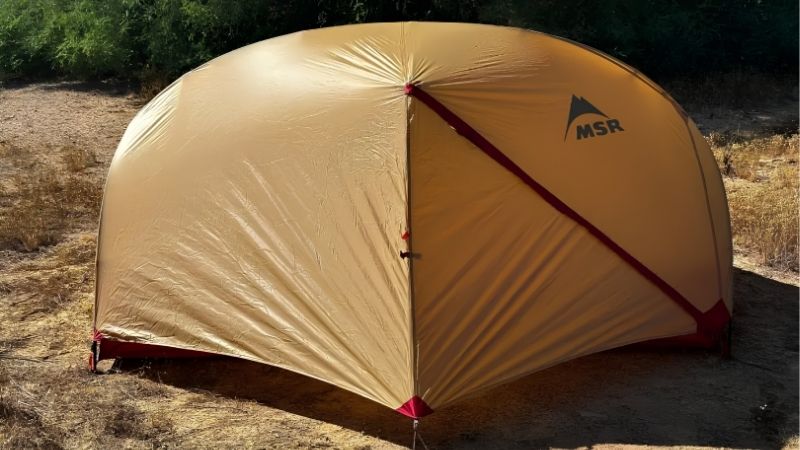
MSR spreads its tents across a clear weight spectrum. The FreeLite 2 lands near 898 g (about 2 lb) as a semi-freestanding, mesh-heavy build, while the Hubba Hubba LT 2P sits around 1,412 g with more fabric and a freestanding pole set. Heavier is not worse; it usually buys headroom and wind stability.
Think about how you camp. If you count ounces on long thru-hikes, the FreeLite rewards you; if you value sitting up and riding out storms, the freestanding Hubba Hubba LT earns its extra grams.
Season Rating and Weather
Most MSR tents here are three-season shelters tuned for spring through fall. The Access line is the exception, using a transverse pole and tougher Easton Syclone poles to handle light snow and gusts, at a weight closer to a three-season tent than a mountaineering rig.
Fabrics matter too. MSR pairs 20D ripstop nylon flies with DuraShield or Xtreme Shield coatings rated around 1,200 to 1,500 mm. That handles typical rain, though a real storm still rewards taut guylines and smart site selection.
Poles, Hardware, and Durability
MSR leans on DAC aluminum poles across the premium range, backed by a lifetime pole guarantee. The 2025-era Elixir and Hubba updates added all-metal corner hardware and straight-zipper doors, which are easier to use one-handed and less likely to snag in the dark.
Aluminum poles and metal hardware are also where tariffs bite, more on that below. For durability, the Elixir’s 68D polyester floor shrugs off gritty sites, while the FreeLite’s thinner fabrics reward a footprint and gentle handling.
Intended Use: Backpacking, Bikepacking, or Base Camp
MSR now splits its Hubba family by use case. The Hubba Hubba LT is the all-rounder, the Bikepack version ships with shortened poles and handlebar-friendly sacks, and the Hubba Hubba HD beefs up coverage for nastier forecasts. Picking by use case saves you from over- or under-buying.
Solo hikers can drop to the 1P versions to save weight and cash, while couples who want elbow room should look at the roomier Elixir or a 3P. Be honest about who sleeps inside and what you haul.
Top Picks: The Best MSR Tents Right Now
The core of this MSR tent review is the shortlist below. Each pick is a current, widely available model chosen to cover different budgets, weights, and trip styles. The table gives a quick side-by-side; the write-ups explain who each MSR tent actually suits.
| Model | Type | Weight (2P) | Floor Area | Best For |
|---|---|---|---|---|
| FreeLite 2 | Semi-freestanding UL | ~2 lb / 898 g | ~29 sq ft | Thru-hikers, gram counters |
| Hubba Hubba LT 2 | Freestanding | ~3 lb 6 oz | ~29 sq ft | All-round backpacking |
| Elixir 2 | Freestanding value | ~4.8 lb | ~29 sq ft | Beginners, rough use |
| Access 2 | 4-season light | ~3 lb 10 oz | ~29 sq ft | Shoulder season, snow |
| Hubba Hubba HD 2 | Freestanding, stormy | Burlier build | ~29 sq ft | Wet, exposed camps |
| Hubba Hubba Bikepack 2 | Freestanding, bike | ~1,343 g | ~29 sq ft | Bikepacking |
MSR FreeLite 2
Best for thru-hikers and gram counters, the FreeLite 2 is MSR’s ultralight answer at roughly 898 g. It stays semi-freestanding with a hubbed pole set, keeps two doors and two vestibules, and uses a cutaway fly plus micromesh canopy to trim weight while still bugproofing summer camps.
The trade-offs are real: thin fabrics reward a footprint and careful pitching, and the semi-freestanding rear must be staked to tension the floor. It also costs more than the Elixir. For weight-first backpackers, it is the most trail-ready shelter in this MSR tent review.
MSR Hubba Hubba LT 2
The Hubba Hubba LT is the do-everything pick. At about 3 lb 6 oz with roughly 29 sq ft of floor, it fits two wide pads, pitches fast thanks to a symmetrical freestanding design, and rides out weather on DAC poles with a PFAS-free, taped-seam fly. Internal pockets and a drying line add real livability.
It costs more than value tents and outweighs a dedicated ultralight shelter, so ounce-counters may look elsewhere. But for most backpackers who want one tent for the bulk of three-season trips, the Hubba Hubba LT is the easiest MSR tent to recommend.
MSR Elixir 2
Beginners and hard-on-their-gear campers should start with the Elixir 2. Around 4.8 lb with a tough 68D polyester floor, aluminum poles, and a 1,500 mm coating, it is built to survive gritty sites and learning-curve mistakes. Updated straight-zipper doors and an included footprint sweeten strong value.
The catch is weight and pack size: at nearly 5 lb it is a chore on long backcountry miles. Treat it as a car-camping and short-trip workhorse rather than a thru-hiking tool, and it delivers durability that outlasts pricier ultralight rivals.
MSR Access 2
Shoulder-season and light-snow campers should look at the Access 2. It adds a transverse pole and tougher Easton Syclone poles that flex with wind, giving four-season reassurance near 3 lb 10 oz, close to a three-season tent. Reduced mesh and a fuller fly trap warmth on cold nights.
It is not a true mountaineering tent, and the warmer, less-airy build can feel stuffy in summer heat. For hunters, skiers, and early-spring backpackers who want year-round versatility without a heavy expedition tent, though, the Access hits a rare sweet spot.
MSR Hubba Hubba HD 2
When the forecast turns ugly, the Hubba Hubba HD trades grams for protection. It builds on the symmetrical Hubba layout with heavier-duty fabrics and more coverage, aimed at campers who spend real time inside during wind and rain. Setup stays quick, so you can get dry fast when a squall hits.
That durability adds weight and cost, making it overkill for fair-weather weekends. But for wet, exposed base camps where a lighter tent would flex and leak, the HD is the shelter that lets you wait out the weather in comfort.
MSR Hubba Hubba Bikepack 2
Cyclists get a purpose-built option in the Hubba Hubba Bikepack, about 1,343 g for the 2P. Shortened 12-inch poles and handlebar-friendly stuff sacks fit between brake levers and on frame bags, while the tent keeps the Hubba’s roomy, storm-worthy performance for camp.
Off the bike, the split-packing sacks are less convenient than a single stuff sack, and it carries a small price premium over the standard model. For dedicated bikepackers, that specialization is exactly the point.
What Tariffs and Timing Mean for MSR Tent Buyers in 2026
Prices in 2026 move for reasons unrelated to the tents themselves. Trade policy and the calendar both shape what you pay, and MSR’s aluminum-pole builds sit in the crosshairs. No MSR tent review is complete without this, so here is how to read the market before you buy.
Metal Tariffs and Pole Costs
Section 232 steel-and-aluminum tariffs (around 50%) remain in force and were untouched by this year’s court rulings on other duties. Because MSR tents rely on aluminum DAC poles and metal corner hardware, those tariffs push component costs up directly, and brands say future pricing is hard to predict.
The takeaway is simple: when a model you want is in stock at a fair price, buying it often beats waiting for a dip that tariffs may erase. Metal-heavy gear like tents is exactly where this pressure shows up first.
A Split Market and Closeout Deals
The 2026 price picture is bifurcated. Premium brands are raising tags, while mid-tier makers pass costs straight to shoppers, which squeezes the value tier hardest.
The bright spot: retailers are clearing pre-tariff inventory through late 2026, so closeout deals cluster between premium and mid-range gear. Watching for those markdowns is the most reliable way to save.
Seasonal Timing
Timing helps too. Late August into September is a pre-sale window with full sizes and colors in stock before peak demand. Amazon’s fall Prime event is expected in early October, so a wishlist now lets you pounce on early deals.
For the deepest cuts, Black Friday and Cyber Monday in late November remain the year’s low point. If a specific MSR tent is a must-have, buy at the start of a sale to avoid stockouts.
Frequently Asked Questions
A few questions come up again and again when readers work through an MSR tent review. Here are quick, practical answers to help you finalize a choice.
Are MSR tents worth the price?
Generally, yes. You pay for durable fabrics, reliable DAC poles backed by a lifetime pole guarantee, and a three-year warranty. If you camp often, the longevity and easy pitches usually justify the cost over the cheaper tents you replace sooner, which is why they anchor this MSR tent review.
Which MSR tent is best for beginners?
The Elixir is the easy answer. Its tough 68D floor, included footprint, and forgiving freestanding pitch handle learning-curve mistakes, and it costs far less than the ultralight models. Step up to the Hubba Hubba LT only when you plan longer backcountry miles.
FreeLite or Hubba Hubba LT?
Choose the FreeLite if weight is the priority and you accept thinner fabrics and staking a semi-freestanding tent. Choose the Hubba Hubba LT for a freestanding pitch, more wind stability, and better all-round livability at a modest weight penalty.
Do I need a footprint?
For ultralight models like the FreeLite, a footprint is strongly recommended to protect the thin floor. Tougher tents like the Elixir already include one. A footprint also speeds cleanup and extends the life of any MSR tent.
See More:
Final Thoughts
There is no single winner in this MSR tent review, because the right MSR tent depends on your trips. Ounce-counters should grab the FreeLite, most backpackers will be happiest with the Hubba Hubba LT, beginners get the most value from the Elixir, and cold-weather campers should eye the Access. Whichever you choose, buy when stock and pricing line up, since tariff pressure on aluminum poles makes waiting a gamble.