REI tent review shoppers love the Co-op’s value, so this REI tent review compares seven current tents for 2026. From the budget Trailmade to the ultralight Flash Air, we weigh real numbers, floor space, price, and weather protection so you can match the right REI tent to how, where, and how often you camp.
As an Amazon Associate we earn from qualifying purchases.
Our top picks


 Coleman Sundome Camping Tent with Rainfly
- Product Group: Outdoors
- Binding: Sports


As an Amazon Associate we earn from qualifying purchases at no extra cost to you. Ratings are shown as listed on Amazon.
By Jake Thompson
How to Choose the Right REI Tent
REI Co-op tents span entry-level to genuinely ultralight, so knowing the lineup prevents overspending. This REI tent review sorts them by weight, price, and intended use, and notes which include a footprint. The factors below help you land on the right model.
Backpacking vs. Car Camping
Weight sorts the range fast. The Half Dome and Trail Hut hover near 6 lb with footprints, fine for car camping or short hikes but heavy on long trails. The Flash and Flash Air drop well under 3 lb for real backcountry duty.
Match the tent to your miles. Weekend campers and beginners get value and durability from the Half Dome, while thru-hikers and fastpackers should spend up for the lighter Flash line. Being honest about trip length saves both money and a sore back.
Price and Value
Value is REI’s calling card. The Trailmade 2 starts around 199 dollars, the Trail Hut 2 near 259, and the Half Dome 2 around 329, each often including a footprint that rivals charge extra for. That bundled value is a big part of the appeal.
Ultralight costs more. The Flash and Flash Air climb toward 400 to 500 dollars, still undercutting many premium brands. Decide how much weight savings is worth to you before jumping from the value tier to the light one.
Weather Protection and Fabrics
Heavier REI tents protect well. The Half Dome uses a tough 75D polyester floor and a 40D fly with a full-coverage design that blocks wind and rain, making it reassuringly sturdy for three-season camping.
Lighter tents trade margin for grams. The Flash Air is a capable ultralight shelter but can suffer condensation and needs careful staking. Decide how much storm insurance you want before chasing the lowest weight in the lineup.
Setup and Livability
REI’s HubCheck pole system and color-coded corners make many models beginner-friendly to pitch, and the Half Dome’s more vertical sidewalls and light-diffusing pockets add real comfort inside.
Livability scales with size and weight. The roomy Half Dome and Base Camp feel spacious, while ultralight tents run tighter and lower. Think about how much time you spend inside before prioritizing weight over headroom.
Top Picks: The Best REI Co-op Tents Right Now
The heart of this REI tent review is the shortlist below. Each pick is a current Co-op model spread across price, weight, and use. The table gives a fast side-by-side, and each write-up explains who that REI tent actually fits.
| Model | Type | Approx. Weight | Price Tier | Best For |
|---|---|---|---|---|
| Trailmade 2 | Freestanding entry | Heavier | Budget | First-timers, value |
| Trail Hut 2 | Freestanding value | ~6 lb | Budget | Car camping, beginners |
| Half Dome 2 | Freestanding | ~4 lb 13 oz min | Mid | Durable all-rounder |
| Half Dome 3 | Freestanding | Heavier | Mid | Trios, roomy pairs |
| Flash 2 | Freestanding light | ~2 lb 13 oz | Mid-high | Lightweight backpacking |
| Flash Air 2 | Ultralight hybrid | ~2 lb range | Mid-high | Ounce counters |
| Base Camp 6 | Geodesic car camping | Heavy | High | Families, stormy sites |
REI Co-op Trailmade 2
First-timers on a budget should start with the Trailmade 2, around 199 dollars with a footprint included. It is freestanding, easy to pitch, and roomy enough for two, offering honest value for casual campers testing the waters.
It is the heaviest and most basic tent here, with simpler fabrics and weaker foul-weather margin. For weekend campgrounds and gentle forecasts, though, it is a genuinely affordable, no-fuss entry into camping.
REI Co-op Trail Hut 2
The Trail Hut 2, near 259 dollars, shares much of the Half Dome’s DNA in a slightly less refined package. It is freestanding, durable, and roomy, with a full-coverage fly and included footprint, a strong pick for car campers on a tighter budget.
It uses bulkier materials, weighs close to 6 lb, and skips some thoughtful touches, so it is a poor long-trail tent. For beginners and campground use where weight does not matter, it is a solid, dependable value.
REI Co-op Half Dome 2
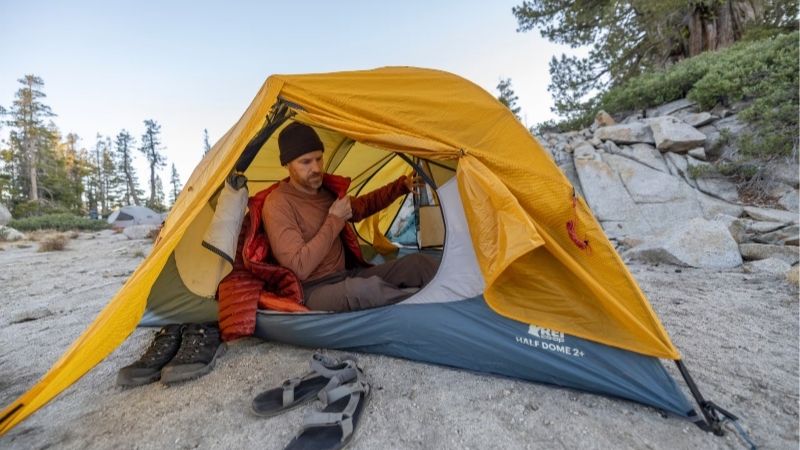
The Half Dome 2 is the durable all-rounder, near 4 lb 13 oz minimum with a tough 75D floor, 40D fly, refined pole architecture, and light-diffusing pockets. Its full-coverage fly and stout build feel reassuringly sturdy for three-season camping.
At close to 6 lb with the footprint and a bulky pack size, it is heavy for serious backpacking. But for beginners, car campers, and short overnights who want durability and value, it remains one of the best buys in this REI tent review.
REI Co-op Half Dome 3
The Half Dome 3 scales the formula up for trios or couples who want extra room, keeping the durable fabrics, freestanding pitch, and vertical sidewalls that make the interior livable. It is a comfortable base for group weekends.
The added space brings more weight and bulk, so it is even less suited to long miles. For families and car campers who prioritize interior room and toughness over portability, it is a roomy, hard-wearing option.
REI Co-op Flash 2
Backpackers wanting a lighter tent without leaving the Co-op should look at the Flash 2, around 2 lb 13 oz. It shaves well over 2 lb versus the Half Dome, keeps two doors, and pitches quickly, making it a capable three-season trail tent.
It costs more and uses thinner fabrics than the Half Dome, so it needs gentler handling. For weight-conscious campers who still want value pricing, though, it is a smart middle ground between durable and ultralight.
REI Co-op Flash Air 2
Ounce counters should consider the Flash Air 2, REI’s most serious ultralight effort, using a trekking-pole-friendly hybrid design to cut weight dramatically. The one-person version drops to about 1 lb 11 oz, and the two-person stays impressively light.
The trade-offs are real: it can condensate badly, the small poles are fiddly, and it needs careful staking. For minimalist backpackers chasing a low base weight at a fair price, however, it is a commendable ultralight shelter.
REI Co-op Base Camp 6
Families and stormy-site campers should look at the Base Camp 6, a geodesic dome built to shrug off wind and rain with a burly pole structure and full-coverage fly. It offers generous space for group car camping in rough weather.
It is heavy, expensive, and packs large, so it never leaves the trunk. But for exposed campgrounds and family trips where weather protection and living space matter most, it is a fortress of a tent.
What Tariffs and Timing Mean for REI Tent Buyers in 2026
REI pricing in 2026 is shaped by more than the Co-op’s value focus. Trade policy and the shopping calendar both move the tag, and aluminum-pole tents feel the pressure directly. No REI tent review can ignore this, so here is how to read the market before buying.
Metal Tariffs and Pole Costs
Section 232 steel-and-aluminum tariffs near 50% remain in force and were untouched by this year’s rulings on other duties. Because tents rely on aluminum poles and metal hardware, those tariffs raise costs directly, and brands say future pricing is hard to predict.
The takeaway is to buy when your model is in stock at a fair price rather than waiting for a dip tariffs may cancel. Value tents feel this squeeze quickly, since their margins are thin to begin with.
A Split Market and Closeout Deals
The 2026 market has split. Premium brands raise tags with pricing power, while mid-tier and value makers pass costs straight to shoppers, pressuring exactly the affordable tier REI is known for.
The upside: REI’s Garage and Outlet clearances, plus broad pre-tariff inventory selloffs through late 2026, put closeout deals within reach. Members can also stack the annual dividend and sales for extra savings on a REI tent.
Seasonal Timing
Timing matters too. Late August into September brings full stock before peak demand, back-to-school pushes packs and shelters early, and Amazon’s fall Prime event is expected in early October, so a wishlist now sets up early deals.
The deepest discounts still land on Black Friday and Cyber Monday in late November, alongside REI’s own sales, when tents make popular gifts. For a must-have model, buy early in a sale to beat stockouts.
Frequently Asked Questions
A few questions recur whenever readers dig into a REI tent review, so here are short, useful answers to help you finalize a pick.
Are REI Co-op tents good value?
Yes. They frequently include a footprint, carry solid warranties, and undercut premium brands on price. The Half Dome and Trail Hut deliver durable, roomy shelters for the money, which is why they are perennial beginner favorites.
Half Dome or Flash?
Choose the Half Dome for durability, value, and car camping or short trips where weight is not critical. Choose the Flash to shave over 2 lb for real backpacking, accepting thinner fabrics and a higher price for the savings.
Is the Flash Air good for beginners?
Not really. Its trekking-pole hybrid pitch, condensation tendencies, and fiddly small poles reward experience. Beginners are better served by the freestanding, forgiving Half Dome or Trail Hut before stepping into ultralight territory.
Do REI tents include a footprint?
Many value models like the Trailmade, Trail Hut, and Half Dome bundle one, while ultralight tents like the Flash Air often do not. A footprint protects the floor, speeds cleanup, and extends the life of any tent in this REI tent review.
See More:
Final Thoughts
There is no single winner in this REI tent review, because the right REI tent depends on your trips and budget. Beginners and car campers get the most from the Half Dome, weight-focused hikers should eye the Flash, and families will love the Base Camp. Whichever you choose, buy when stock and pricing align, since tariff pressure on aluminum poles makes waiting a gamble.