Key takeaways
- Trusting the capacity label alone: “Two-person” means two sleeping spots, not two roomy personal areas. Compare actual dimensions.
- Ignoring pad width: Two wide or rectangular pads may not fit in a narrow 48-inch floor.
- Counting the vestibule as bedroom space: A vestibule is useful storage, but it may not be fully enclosed or tall enough for living space.
- Choosing by peak height only: A tall center does not mean the entire tent is tall or spacious.
- Forgetting door placement: One door can force one camper to climb over the other. Two doors improve access and ventilation.
- Buying oversized without checking conditions: Larger tents often weigh more, catch more wind, and require a larger level campsite.
- Skipping the footprint measurement: The footprint may be slightly smaller than the tent floor and will not fix an interior that is too narrow.
The Short Answer
For two adults, choose a tent with at least 30 to 35 square feet of floor area. A typical two-person tent measures about 84 to 90 inches long by 48 to 60 inches wide (213 to 229 by 122 to 152 cm). That rating usually means two people can sleep inside with little extra room for clothing or gear.
For a more comfortable fit, look for a tent labeled “2-person” with a floor width of 54 to 60 inches (137 to 152 cm), especially if both campers use wider sleeping pads. If you want room for backpacks, shoes, or a dog inside the sleeping area, a three-person tent is often the better choice. It commonly provides 42 to 50 square feet of floor space.
Our top picks

 Clostnature Waterproof Camping Tent for 2 Person
- Occupancy: 2 Person
- Seasons: 3 Season
- Water Resistance Technology: PU 2000mm


As an Amazon Associate we earn from qualifying purchases at no extra cost to you. Ratings are shown as listed on Amazon.
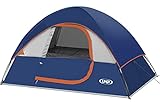
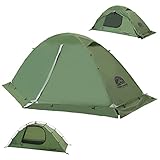
In 2026, many affordable two-person dome tents cost roughly $35 to $65. Examples in this category include the Amazon Basics model at about $40, the UNP tent at about $40, the Clostnature tent at about $40, and the Night Cat backpacking tent at about $60. Prices can change, but the main difference between these options is usually weight, packed size, weather protection, and interior design rather than the “two-person” label alone.
Standard Sizes
Tent capacity is based mainly on floor space, but manufacturers do not use one universal measurement. Always check the listed floor dimensions, peak height, packed size, and weight before buying. The following ranges are useful planning standards:
| Tent size | Typical floor dimensions | Floor area | Best for |
|---|---|---|---|
| 1-person | 84–90 × 30–40 in (213–229 × 76–102 cm) |
18–25 sq. ft. (1.7–2.3 sq. m) |
One camper, minimal gear |
| 2-person compact | 84–90 × 48–52 in (213–229 × 122–132 cm) |
28–33 sq. ft. (2.6–3.1 sq. m) |
Two adults backpacking |
| 2-person comfortable | 84–92 × 54–60 in (213–234 × 137–152 cm) |
32–38 sq. ft. (3.0–3.5 sq. m) |
Two adults with modest gear |
| 3-person | 90–96 × 66–72 in (229–244 × 168–183 cm) |
41–48 sq. ft. (3.8–4.5 sq. m) |
Two adults, a child, or extra gear |
| 4-person | 96–108 × 80–84 in (244–274 × 203–213 cm) |
53–63 sq. ft. (4.9–5.9 sq. m) |
Two adults wanting generous space |
A standard sleeping pad is commonly 20 to 25 inches wide (51 to 64 cm). Two 25-inch pads require at least 50 inches of interior width before allowing for curved walls, pockets, or tapering at the foot. That is why a tent listed as 48 inches wide may feel noticeably tight, even though it technically sleeps two.
Height matters too. A peak height of 40 to 45 inches (102 to 114 cm) is typical for a lightweight backpacking tent. A car-camping dome may reach 48 to 60 inches (122 to 152 cm), making it easier to sit up and change clothes. Peak height is measured at the highest point, so sloping walls mean only part of the floor has that headroom.
How to Measure Your Space
- Measure both sleepers. Add each person’s shoulder width, then add at least 2 to 4 inches (5 to 10 cm) of breathing room. For two 22-inch shoulders, a minimum interior width of about 48 inches is practical.
- Measure sleeping length. Take the taller person’s height and add 6 to 12 inches (15 to 30 cm). Someone 72 inches tall should generally look for an interior length of 84 inches or more.
- Measure the sleeping pads, not just the people. Place the pads side by side and measure their combined width. Include the thickness of bulky pads because tall sidewalls can reduce usable shoulder space.
- Allow space for gear. A backpack may occupy 2 to 4 square feet, while boots and clothing can take another 1 to 2 square feet. Use vestibules for dirty or wet items whenever possible.
- Check the usable shape. A rectangular floor is easier to share than a tapered floor. Look at the floor plan and not only the maximum width, since the widest measurement may occur at the shoulders.
- Measure your storage and vehicle. Compare the tent’s packed dimensions with your closet, trunk, or backpack. Many two-person tents pack to approximately 18 to 24 inches long and 6 to 8 inches in diameter, though ultralight models can be smaller.
- Account for clearance. Select a flat campsite larger than the tent footprint. Leave enough room for guy lines, rain runoff, and doors to open without hitting a tree, vehicle, or neighboring tent.
By Room or Use Case
Backpacking and hiking
For backpacking, a compact two-person tent is usually the right size. Prioritize a packed weight of about 3 to 5 pounds (1.4 to 2.3 kg) for a budget model, or less than 3 pounds (1.4 kg) for a lighter setup. A floor around 84 to 90 inches long by 48 to 54 inches wide saves weight and fits two standard pads, but it leaves little room for bags.
Look for two doors and two vestibules if both campers will enter and exit during the night. Aluminum poles may add durability without the weight of heavier steel poles. A full-coverage rainfly, sealed seams, and a bathtub-style floor are more important than extra peak height when carrying the tent on a trail.
Car camping
When the tent travels in a car, choose comfort over the smallest packed size. A two-person tent measuring 90 by 60 inches (229 by 152 cm) gives two adults more shoulder room, while a three-person model allows space for bags. A 48- to 60-inch peak height makes sitting up easier.
Dome tents are straightforward to assemble and generally provide good wind resistance. For warm-weather camping, prioritize mesh panels and two-way doors for ventilation. A rainfly should extend over the doors or create a vestibule so wet footwear does not have to sit on the sleeping floor.
Cold-weather or shoulder-season camping
Cold conditions usually call for a little extra interior space, but not an oversized tent. A two-person tent around 54 to 60 inches wide can accommodate insulated sleeping bags without compressing them against the walls. Avoid choosing a much larger tent solely for warmth: more interior air takes longer to warm, and a larger structure can be heavier and harder to stabilize.
Check the tent’s stated season rating carefully. A three-season tent is designed for rain, wind, and moderate conditions, while a four-season tent uses stronger poles and less mesh for snow and severe weather. The capacity label does not indicate weather performance.
Camping with a child or dog
Two adults plus a child, large dog, or substantial gear will usually be more comfortable in a three-person tent. For two adults and a small dog, a spacious two-person tent with a floor at least 54 inches wide may work, particularly if the dog sleeps at the foot. Keep claws away from thin tent floors and use a protective mat outside the tent rather than placing sharp or muddy items inside.
Festivals and occasional backyard use
For short trips, a budget two-person dome tent can be adequate. Prioritize easy setup, interior pockets, a removable rainfly, and a carry bag. Expect many inexpensive models to weigh 4 to 6 pounds (1.8 to 2.7 kg), which is acceptable when carrying the tent only from a car to a campsite. Confirm the floor dimensions before purchase because some low-cost tents provide less width than their capacity name suggests.
Common Sizing Mistakes
- Trusting the capacity label alone: “Two-person” means two sleeping spots, not two roomy personal areas. Compare actual dimensions.
- Ignoring pad width: Two wide or rectangular pads may not fit in a narrow 48-inch floor.
- Counting the vestibule as bedroom space: A vestibule is useful storage, but it may not be fully enclosed or tall enough for living space.
- Choosing by peak height only: A tall center does not mean the entire tent is tall or spacious.
- Forgetting door placement: One door can force one camper to climb over the other. Two doors improve access and ventilation.
- Buying oversized without checking conditions: Larger tents often weigh more, catch more wind, and require a larger level campsite.
- Skipping the footprint measurement: The footprint may be slightly smaller than the tent floor and will not fix an interior that is too narrow.
FAQ
Is a two-person tent big enough for two adults?
Yes, if both adults are comfortable sleeping close together and storing most gear in vestibules. Choose at least 54 inches of interior width for a more comfortable fit. Taller or broad-shouldered campers may prefer a three-person tent.
What size tent is best for two people and gear?
A two-person tent with 32 to 38 square feet of floor area and one or two vestibules is a practical choice. If large backpacks must stay inside, consider a three-person tent with approximately 41 to 48 square feet.
How tall should a two-person tent be?
Choose at least 40 inches (102 cm) for sleeping and a compact backpacking setup. For sitting up and changing clothes, look for 48 to 60 inches (122 to 152 cm), while remembering that the full height is available only near the center.
Should I buy a three-person tent for two people?
Buy a three-person tent when comfort, a child, a dog, or indoor gear storage matters more than minimum weight. For long backpacking trips, a two-person tent is usually lighter and smaller. For car camping, the extra floor area is often worth the modest increase in packed size.