Key takeaways
- A listing says “carbon” but does not clearly identify carbon fiber shafts.
- No stated maximum length, collapsed length, or pair weight.
- Locks slip during an at-home pressure test or require excessive force to close.
- Visible cracks, splinters, bubbling finish, or deep chips in a carbon shaft.
- Thin, nonadjustable wrist straps that dig into the hand.
- No information about replacement tips, baskets, or warranty terms.
- A very low price paired with vague specifications and no product dimensions.
Carbon trekking poles can make long hiking days feel easier, especially when you are carrying a pack, crossing uneven ground, or protecting sore knees on descents. But shoppers often make the same mistakes: buying the lightest pair without checking the lock design, choosing a fixed-length pole that does not fit their height, or assuming every “carbon” pole is equally durable.
When learning how to choose carbon trekking poles, focus less on color, included accessories, and broad claims such as “ultra strong.” The practical details are adjustability, section construction, grip shape, usable length range, and whether replacement parts are available. Carbon poles are excellent for many hikers, but they need to suit the terrain and the way you hike.
Our top picks



As an Amazon Associate we earn from qualifying purchases at no extra cost to you. Ratings are shown as listed on Amazon.
In 2026, a good-value carbon pair typically costs less than many premium outdoor-brand options while still providing adjustable flip locks, cork or foam grips, and trail baskets. The goal is not to buy the most expensive poles; it is to buy a pair that fits, locks securely, and will be comfortable after several hours on the trail.
Decide These 3 Things First
- Will you prioritize low weight or maximum abuse resistance? Carbon fiber is generally lighter and dampens vibration better than aluminum, but aluminum is more likely to bend rather than crack after a severe side impact. For maintained trails, backpacking, and long-distance walking, carbon is a strong choice. For frequent scrambling, off-trail travel, or icy conditions where poles may wedge between rocks, consider whether aluminum is the safer fit.
- Do you need adjustable poles? Most adults should choose telescoping poles with a range around 24 to 53 inches, or roughly 65 to 135 cm. Adjustability matters when several people share a pair, when climbing steep grades, and when shortening poles for storage or travel.
- What kind of grip feels best in your hand? Cork is popular for warm-weather hiking because it can feel less clammy over long distances. EVA foam is soft, light, and especially useful when a pole has an extended foam grip for steep uphill sections. A good grip shape matters more than a decorative finish.
Size and Adjustability: Start With the Right Length
For level ground, set a trekking pole so your elbow forms approximately a 90-degree angle when the tip rests beside your foot. For many adults, this lands somewhere between 43 and 51 inches. A person around 5 feet 2 inches may commonly use a setting near 43 to 45 inches, while someone around 6 feet may be closer to 49 to 51 inches. These are starting points, not strict rules.
Adjustable carbon trekking poles commonly extend to 53 or 54 inches (about 135 to 137 cm) and collapse to 24 to 27 inches. That collapsed size fits well on the outside of a daypack or inside many checked bags. Shorter folding designs can pack down to 14 to 16 inches, but they usually have less length adjustment.
On climbs, shorten each pole by about 2 to 4 inches to avoid raising your shoulders. On long descents, lengthen them by about 2 to 4 inches for a more upright stance. If you traverse a sidehill, shorten the uphill pole and lengthen the downhill pole as needed. This is why a useful adjustment range is more valuable than a single “fits most” length claim.
Material: Understand What “Carbon Fiber” Means
Carbon fiber poles are valued primarily for low weight. A pair often weighs about 14 to 18 ounces without accessories, compared with roughly 18 to 24 ounces for many aluminum telescoping pairs. That difference can be noticeable over a full day of repeated pole swings.
Look for poles described as carbon fiber shafts rather than products that only mention carbon in the finish or handle details. Some manufacturers specify carbon grades such as 3K carbon fiber. That description refers to the woven fiber style, but it does not independently tell you everything about real-world durability. Shaft diameter, wall thickness, joint design, and lock quality all matter.
Carbon is well suited to hiking trails, walking paths, and backpacking routes where you want less weight and reduced vibration through the hands. Its main limitation is impact behavior: a hard sideways blow against a rock can cause cracking or splintering rather than the visible bend you might see in aluminum. Inspect a carbon shaft after a fall, a vehicle-door mishap, or a hard rock strike. Do not continue using a pole with a visible crack, deep gouge, splintering, or soft spot.
Construction and Locks: The Parts That Keep a Pole Reliable
Most adjustable carbon trekking poles have two or three shaft sections. Three-section poles are the common choice because they balance packability and a broad adjustment range. A two-section pole has fewer joints but may collapse only to about 30 to 35 inches, making it less convenient to pack.
External flip locks are usually the easiest system to inspect and adjust. You should be able to open the lever, set the length, close it firmly, and hike without slipping. Many locks include a small adjustment screw or dial so you can increase tension when the lever begins to feel loose. Test both poles before a trip: plant the tips on the floor, lean progressively into the grips, and confirm that no section slides inward.
Twist-lock systems can work well, but they are slower to adjust with gloves and can be harder to troubleshoot when wet or muddy. For most buyers, external flip locks are the more practical choice.
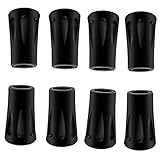
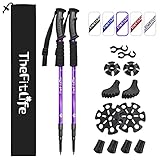
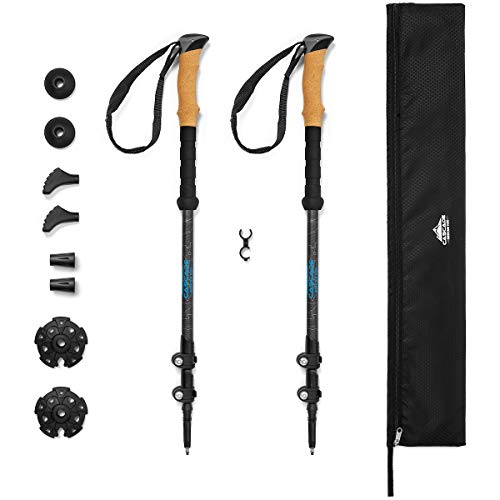
Check the tip system, too. Carbide tips provide traction on dirt, rock, and ice. Removable rubber tip covers are helpful for pavement, travel, and reducing noise on hard surfaces. A versatile set should include small trekking baskets for ordinary trails and wider snow baskets, often 3 to 4 inches across, if you expect soft snow or sand.
Comfort and Trail Performance: Grips, Straps, and Accessories
Your hands touch the grips for thousands of steps, so comfort is not a minor feature. Cork grips can gradually conform to your hand and are a classic choice for warm, dry hiking. EVA foam grips tend to feel softer immediately and handle moisture well. Extended foam sleeves below the main grip let you choke down on the poles during short, steep climbs instead of stopping to adjust the shaft length.
Choose wrist straps that are at least about 0.75 to 1 inch wide, adjustable, and free of sharp seams. The strap should support part of your hand pressure; you should not need to clench the grip tightly all day. Put your hand up through the bottom of the strap loop, then bring the strap across your palm before gripping the handle. This positioning reduces hand fatigue and helps prevent a dropped pole.
Do not overvalue large accessory bundles. Two rubber tip covers, two small trail baskets, and two snow baskets are useful. More important is whether the baskets thread on securely and whether replacement tips and baskets can be purchased later.
Price Tiers: What Your Budget Should Buy
Budget carbon poles: about $45 to $70 per pair. This category can offer real value for casual hikers and walkers. At around $48 to $65, expect adjustable three-section poles, flip locks, EVA or cork-style grips, carbide tips, and a basic basket set. The referenced TrailBuddy 3K carbon model at about $50 and several carbon options around $55 to under $70 fit this range. Carefully inspect locks and shaft finish when they arrive.
Mid-range carbon poles: about $70 to $130 per pair. Expect more refined grip ergonomics, lower overall weight, better straps, more consistent lock hardware, and a clearer replacement-parts policy. This is often the sweet spot for regular day hikers and backpackers who use poles several times a month.
Premium carbon poles: about $130 to $220 or more per pair. Premium pricing may bring more compact folding designs, very low weights around 11 to 14 ounces per pair, specialized grips, and stronger service support. They make sense for frequent backpackers, trail runners who use poles, and travelers who care about a short packed length. They are not automatically the most durable choice for rocky off-trail use.
Warranty, Delivery, and Setup
Read the warranty language before buying, especially the exclusions. Many warranties cover manufacturing defects but not normal tip wear, lost baskets, accidental breakage, airline damage, or damage caused by getting a pole trapped between rocks. A one-year limited warranty is common in lower price tiers, while longer coverage can be valuable if replacement sections are actually available.
When the package arrives, confirm that it contains two poles, the listed baskets, tip covers, and straps. Measure the extended length against the product description, then test every lock at several settings. Assembly is usually limited to attaching baskets and rubber tip covers. Do not force baskets with mismatched threads; a cross-threaded basket can be difficult to remove later.
Before the first hike, set both poles to the same length, tighten locks according to the manufacturer’s instructions, and walk around the block for 10 to 15 minutes. Make adjustments before a full-day trail outing.
Spec Checklist
| Spec | Budget | Mid | Premium |
|---|---|---|---|
| Typical pair price | $45–$70 | $70–$130 | $130–$220+ |
| Typical weight per pair | 16–20 oz. | 14–18 oz. | 11–15 oz. |
| Common adjustment range | 24–53 in. | 24–53 in. | 14–53 in., depending on folding design |
| Lock style | External flip locks | Refined flip locks or hybrid systems | Lightweight folding or premium lever systems |
| Grip materials | EVA foam or cork-style composite | Cork and/or extended EVA foam | Advanced foam, cork, and highly shaped grips |
| Included accessories | Rubber tips and basic baskets | Trail and snow baskets; replacement options | Specialized baskets, compact storage, service support |
Red Flags
- A listing says “carbon” but does not clearly identify carbon fiber shafts.
- No stated maximum length, collapsed length, or pair weight.
- Locks slip during an at-home pressure test or require excessive force to close.
- Visible cracks, splinters, bubbling finish, or deep chips in a carbon shaft.
- Thin, nonadjustable wrist straps that dig into the hand.
- No information about replacement tips, baskets, or warranty terms.
- A very low price paired with vague specifications and no product dimensions.
FAQ
Are carbon trekking poles worth it?
They are worth it for hikers who value lower swing weight, quieter vibration feel, and pack-friendly gear. They are especially appealing for long day hikes and backpacking. If you regularly jam poles between boulders or hike rugged off-trail terrain, aluminum may offer more forgiving impact behavior.
What length trekking poles do I need?
Choose an adjustable model that lets you create about a 90-degree elbow angle on level ground. For many adults, a maximum length of 53 to 54 inches works well. Shorten poles 2 to 4 inches uphill and lengthen them 2 to 4 inches downhill.
Can carbon trekking poles be used in snow?
Yes, provided they have properly fitted snow baskets. Wider baskets keep the pole from sinking deeply into soft snow. Use carbide tips for traction, inspect shafts after falls, and avoid forcefully levering a pole that is trapped beneath snow or between rocks.
How long do carbon trekking poles last?
There is no fixed mileage limit. Longevity depends on impacts, lock maintenance, storage, and tip wear. Replace worn carbide tips or rubber covers as needed, keep flip locks clean, and retire any carbon pole with cracking, splintering, or structural damage.