
Key takeaways
What's inside
Best tent for camping family trips is rarely the one matching your headcount, because manufacturer capacity ratings assume shoulder-to-shoulder sleeping with no gear inside. This guide covers real floor space, peak height, weather protection, and setup time, then compares five tents built for groups.
As an Amazon Associate we earn from qualifying purchases at no extra cost to you. Product prices and availability are accurate as of the date shown and are subject to change.


As an Amazon Associate we earn from qualifying purchases at no extra cost to you. Product prices and availability are accurate as of the date shown and are subject to change.
By Jake Thompson, gear writer at Roger Bacon Outdoors.
🛒 Best Price Today on Amazon
Prime members get fast, free shipping on everything above, plus member-only deals. New members get a 30-day free trial — cancel anytime.
How to Choose the Best Tent for Camping Family Trips
Family camping fails on small things: a tent nobody can stand up in, a rainstorm that finds the seams, or a pitch that takes an hour in fading light with children waiting. The best tent for camping family use solves all three, and three specifications tell you whether it will.
Capacity Ratings Versus Real Floor Space
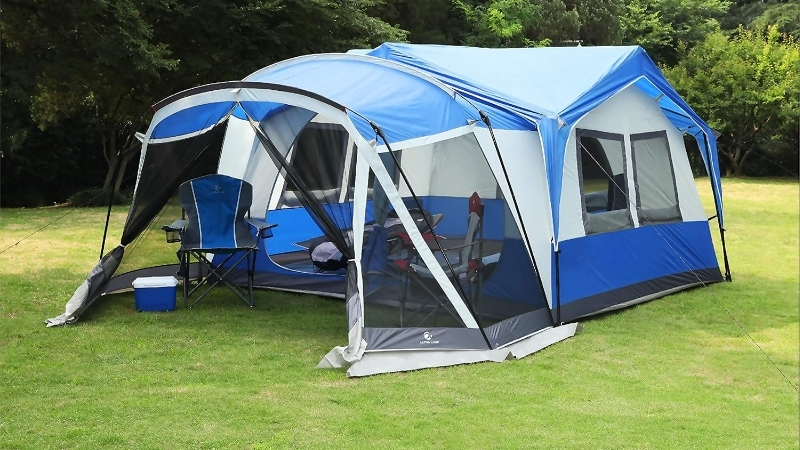
A six-person rating means six sleeping pads laid edge to edge with no room for bags, boots, or space to move. The working rule is to subtract two: buy an eight-person tent for a family of four to six if you want gear inside and room to change without elbowing someone.
Check the floor dimensions rather than the rating. Roughly 30 square feet per person is comfortable for a family trip, against the 20 or so most capacity ratings assume. Also confirm the floor length works for the tallest person, since some tents run short of 84 inches in one direction.
Peak Height, Doors, and Room Dividers
Standing height changes the experience of a rainy afternoon more than any other feature. Cabin-style tents with near-vertical walls reach six to seven feet at the peak and hold that height across most of the floor, while dome tents taper sharply and lose usable space at the edges.
Two doors are worth insisting on for any tent sleeping more than four, because a single door means climbing over people at night. Room dividers help with older children or mixed groups, though they cut ventilation, so look for a tent where the divider is removable rather than sewn in.
Weather Protection and Setup Time
On any best tent for camping family shortlist, look at rainfly coverage rather than the hydrostatic head number alone. A partial fly that stops above the windows will leak in wind-driven rain no matter how high its waterproof rating, while a full-coverage fly reaching close to the ground protects the walls and creates a sheltered entry.
Setup time claims deserve scepticism. Instant tents with pre-attached poles genuinely pitch in one to two minutes; conventional cabin tents take fifteen to thirty with two people. Practise once in the garden before the trip, because reading instructions in wind and rain with a tired family is grim.
Top Picks: Best Tent for Camping Family Trips
The best tent for camping family groups ranges widely, and these five run from a fast-pitching budget dome to a weather-serious cabin for exposed sites. Dimensions and capacity ratings come from manufacturer specifications and vary between model years, so verify the floor size and fly coverage on the current listing before you order.
| Model | Rated Capacity | Approx. Floor | Peak Height | Best For |
|---|---|---|---|---|
| Coleman Skydome 8 | 8 person | ~12 x 9 ft | ~5 ft 11 in | Value and quick pitch |
| CORE 9 Person Instant Cabin | 9 person | ~14 x 9 ft | ~6 ft | Fastest setup |
| Eureka Copper Canyon LX 6 | 6 person | ~10 x 10 ft | ~7 ft | Standing room |
| Kelty Wireless 6 | 6 person | ~10 x 10 ft | ~6 ft | Balanced quality |
| Marmot Limestone 6 | 6 person | ~10 x 8 ft | ~6 ft 4 in | Bad weather sites |
1. Coleman Skydome 8 – Best Value
Coleman’s Skydome design solves the main complaint about dome tents by pushing the walls outward, adding usable space near the edges without losing the wind-shedding shape. It pitches in around five minutes with two people, and the pre-attached rainfly removes a step in bad weather.
Peak height stops just short of six feet, so taller adults will stoop, and the fabrics are lighter than premium tents which shows over many seasons. Ventilation is adequate rather than generous. For occasional family trips at established campgrounds, the value is difficult to argue against.
2. CORE 9 Person Instant Cabin – Fastest Setup
Pre-attached telescoping poles mean this genuinely goes up in about a minute, which matters more than any other feature when you arrive after dark with tired children. Nine-person rating gives a family of five real space, and the included room divider separates sleeping areas when needed.
Instant tents are heavier and bulkier packed than conventional ones because the poles never detach, so this is a car-camping tent only. The hinged poles are also the most likely failure point over time. For campgrounds where you drive to the pitch, the speed is worth it.
3. Eureka Copper Canyon LX 6 – Best Standing Room
Near-vertical walls and a seven-foot peak make this feel like a room rather than a shelter, and that height carries across most of the floor instead of only at the centre. A rainy afternoon inside is genuinely tolerable, which is the point of a cabin tent for family use.
The partial rainfly is the compromise, covering the roof but leaving the mesh windows exposed to wind-driven rain, so this suits fair-weather campgrounds better than exposed sites. The tall profile also catches wind. Where the forecast is reasonable, no tent here is more comfortable to live in.
4. Kelty Wireless 6 – Best Balance of Quality and Price
Kelty pitches this between budget and premium, and the details show it. Two doors with proper vestibules keep boots out of the sleeping area, the fly reaches lower than most tents at this price, and the pole structure is stiffer than the value options when wind picks up.
At around six feet of peak height it is not a full standing-room cabin, and the six-person rating realistically suits four people with gear. Setup takes longer than an instant tent. For families who camp several times a year and want something that lasts, it is the sensible middle.
5. Marmot Limestone 6 – Best for Bad Weather
When the site is exposed and the forecast is poor, construction quality stops being abstract. The Limestone uses a full-coverage fly, taped seams, and a pole structure designed to hold shape in wind rather than flex against it, which is what separates a bad night from a fine one.
It costs considerably more than the value options and gives up interior volume compared with a cabin tent of the same rating. Setup also takes longer than instant designs. For coastal, alpine, or shoulder-season camping where weather is a genuine variable, that trade is straightforward.
Tariffs, End-of-Season Timing, and Buying Windows
Tent pricing has moved this year, and the retail calendar for tents is unusual. Both are worth understanding before choosing the best tent for camping family trips, because the cheapest time to buy is not the same as the time with the best selection.
Pole and Fabric Costs Have Risen
An Outdoor Industry Association survey found 84 percent of member businesses expect tariff impacts, with costs up roughly 7.7 percent overall. Aluminium duties hit tent poles and stakes directly, while high-tenacity nylon used in flysheets and floors has climbed 10 to 15 percent on top of that.
On tents in the $200 to $500 range, that is a meaningful shift rather than a few dollars. Brands have been unusually candid that any forward pricing is an estimate while supply chains settle, which is a reasonable argument against waiting many months on a specific model.
Late Summer Clearance Versus Autumn Stock
Retailers clear tent inventory from late August as the peak camping season winds down, which produces genuine discounts on last season’s colours and sizes. The trade-off is selection: the most popular capacities sell out first, and what remains is often the size nobody wanted.
If you camp through autumn or plan a shoulder-season trip, buying now means the tent is in your hands with time to pitch it once at home. That practice run is more valuable than most people expect, particularly with a conventional cabin tent rather than an instant one.
Where the Deepest Cuts Land
For next season’s purchase, the calendar favours patience. Prime Big Deal Days in mid-October and the Black Friday through Cyber Monday window in late November carry the largest outdoor markdowns of the year, and early deals often appear in the days leading up to each event.
Tents are also a common family gift, so the best-reviewed models thin out before those windows close. Build a wishlist now and track prices rather than shopping on the day, and buy early in the sale if there is a specific size and colour you actually want.
Frequently Asked Questions
These are the questions that come up most often from families choosing the best tent for camping family trips after outgrowing a two-person shelter. Short, practical answers below.
What size tent do I need for a family of four?
A six-person tent is the realistic minimum, and eight-person is comfortable if you want gear inside and room to change. Capacity ratings assume sleeping pads edge to edge with nothing else in the tent. Subtracting two from the rating gives a much more honest number to plan around.
Are instant tents worth the extra cost?
If you arrive at campgrounds late or camp with young children, yes. Cutting setup from twenty-five minutes to two changes the mood of an arrival completely. The costs are packed bulk, weight, and hinged poles that eventually wear. For car camping only, most families find the trade worthwhile.
How do I stop condensation inside the tent?
Open every vent even when it is cold, keep the fly off the inner wall where possible, and avoid cooking or drying wet clothes inside. Four people breathing overnight release a surprising amount of moisture. Condensation is almost always ventilation rather than a leak in the fabric.
Do I need to seam seal a new tent?
Most quality tents ship with factory-taped seams, so no. Budget tents sometimes leave the fly seams untaped, and those benefit from a seam sealer applied before the first trip. Test any new tent with a garden hose at home rather than discovering the answer during a night of rain.
See More:
- Best trekking sleeping bag
- Best sleeping bag for backpacking
- Best women backpack for work
- Best backpack for backpackers
Final Thoughts
The best tent for camping family trips is the one sized two people above your headcount, tall enough for the adults to stand, and covered by a fly that reaches low enough for the weather you actually camp in. Decide first whether standing room or storm protection matters more, since few tents deliver both. Pitch it once at home before the trip, and buy in the late-summer clearance window if selection still looks good.




Write Your Review
No reviews yet. Be the first to share your experience!