
Key takeaways
What's inside
Best women backpack for work decisions usually fail on fit rather than looks, because most packs are cut for a longer torso than they need to be. This guide covers strap geometry, laptop protection, and materials that survive a wet platform, then compares five packs that hold up on a daily commute through winter.
As an Amazon Associate we earn from qualifying purchases at no extra cost to you. Product prices and availability are accurate as of the date shown and are subject to change.


As an Amazon Associate we earn from qualifying purchases at no extra cost to you. Product prices and availability are accurate as of the date shown and are subject to change.
By Jake Thompson, gear writer at Roger Bacon Outdoors.
🛒 Best Price Today on Amazon
Prime members get fast, free shipping on everything above, plus member-only deals. New members get a 30-day free trial — cancel anytime.
How to Choose the Best Women Backpack for Work
A commuting pack has to do three jobs at once: carry a laptop safely, sit comfortably for a walk plus a train ride, and still look right walking into a meeting. Those goals pull in different directions, and the best women backpack for work is whichever one resolves them for your routine.
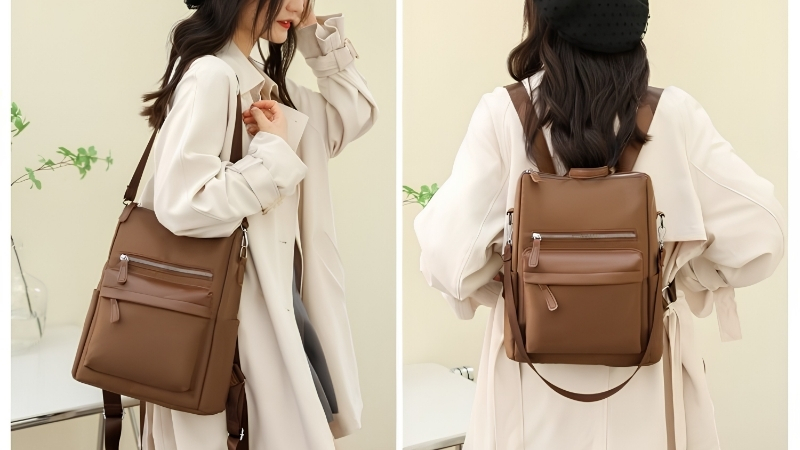
Torso Fit and Strap Geometry
Most of the discomfort people blame on weight is actually fit. Shoulder straps cut for a broader frame sit wide and slide outward, putting load on the outside of the shoulder instead of the top. Look for contoured or S-curved straps and a sternum strap that adjusts vertically rather than sitting fixed.
Torso length matters just as much. A pack whose body extends well past your lower back pulls the load backwards and away from your centre of gravity. If the base sits below your belt line when the straps are snug, the pack is too long regardless of what the capacity figure says.
Laptop Sleeve Size and Protection
Check the sleeve dimensions rather than the advertised screen size, because a 15-inch listing may not swallow a thicker 15-inch machine in a case. A suspended sleeve, one that stops short of the base, keeps the laptop off the ground when you set the bag down on hard flooring.
Padding thickness is worth a look too. Thin foam behind a laptop is fine for an office-to-office commute and inadequate for a crowded train where bags get knocked. A separate zipped laptop compartment also speeds up security checks if you travel for work with any regularity at all.
Organisation, Materials, and Presentability
Internal structure is what separates a work pack from a day pack. A dedicated water bottle pocket, a lined pocket for sunglasses or a phone, and a key clip stop the bottom of the bag turning into a bin. Too many compartments has the opposite effect and slows you down.
Material sets the tone. Coated ballistic nylon and neoprene handle rain and wipe clean; full-grain leather looks sharper but adds weight and needs conditioning. Whichever you pick, check that the zips are branded hardware rather than unmarked, because zips are the first component to fail on a daily-use bag.
Top Picks: Best Women Backpack for Work
The best women backpack for work in a corporate office is not the same one that suits a hospital shift or a studio, so these five span structured to soft-sided. Capacity and sleeve figures come from manufacturer listings and vary by size variant, so confirm the version before ordering.
| Model | Approx. Capacity | Laptop Fit | Material | Best For |
|---|---|---|---|---|
| Samsonite Mobile Solution Essential | ~20 L | Up to 15.6 in | Coated polyester | Structured office look |
| Dagne Dover Dakota | ~13-20 L by size | 13 to 16 in | Neoprene | Work plus gym |
| Bellroy Classic Backpack Compact | ~16 L | Up to 14 in | Recycled woven fabric | Minimal daily carry |
| Osprey Arcane Small Day | ~20 L | Up to 15 in | Recycled nylon | Walk-heavy commutes |
| LOVEVOOK Laptop Backpack | ~20 L | Up to 15.6 in | Water-resistant nylon | Budget option |
1. Samsonite Mobile Solution Essential – Structured Office Pick
This is the safe answer when the dress code leans formal. The panel keeps its shape whether full or half empty, so it never slumps against your back, and the dedicated laptop compartment opens flat for security screening. A rear trolley sleeve slides over a suitcase handle for travel days.
The structure that makes it look sharp also makes it heavier empty than a soft-sided pack, and the boxy shape is less forgiving on a crowded train. Colour options are conservative. If your priority is walking into a client meeting without your bag looking outdoorsy, it delivers exactly that.
2. Dagne Dover Dakota – Best for Work and Gym
The neoprene body is the whole point: it stretches around an awkward load, wipes clean, and does not crease when packed tight. Sizes run from small through large, so you can match capacity to whether you carry a 13-inch machine or a full change of clothes alongside a 16-inch laptop.
Neoprene absorbs some water in sustained rain rather than shedding it entirely, and light colours mark more easily than a coated nylon. The soft body also offers less impact protection than a padded shell. For a commute that ends at a gym or a studio, that trade is usually worth making.
3. Bellroy Classic Backpack Compact – Minimal Daily Carry
At roughly 16 litres this is deliberately small, which is exactly right if your working day is a laptop, a notebook, and lunch. The exterior stays clean and unbranded, the water bottle pocket sits flat when empty, and a weatherproof zip protects the main compartment in light rain.
Anyone who carries gym kit, a change of shoes, or a 16-inch laptop will find it too tight, and it lacks the internal dividers of a dedicated work bag. There is no trolley sleeve either. As a pack that looks the same at year three as day one, it is hard to fault.
4. Osprey Arcane Small Day – Best for Walk-Heavy Commutes
If your commute involves real distance on foot, this is where outdoor pack design pays off. The harness and back panel come from Osprey’s hiking experience, which means proper load transfer instead of two flat straps, and the recycled nylon shrugs off weather better than most office-focused bags.
It reads more casual than a structured pack, so it fits a relaxed office better than a formal one. Internal organisation is also simpler than office-specific competitors. For anyone walking two miles each way or cycling in, the comfort difference over a long week is genuinely noticeable.
5. LOVEVOOK Laptop Backpack – Budget Option
For a first work pack or a spare that lives in the car, this covers the basics at a fraction of the price. It takes a 15.6-inch laptop, includes a luggage strap and a USB charging pass-through, and the water-resistant nylon handles a walk from the car park in drizzle.
Hardware quality is the compromise. Zips and buckles are unbranded and are the parts most likely to fail first, and the shoulder straps use thinner foam than the premium options. As a low-risk starting point before committing to something expensive, it does the job honestly.
Tariffs, Back-to-School Demand, and Buying Timing
Backpack pricing has moved more than usual this year, and demand peaks in a narrow window. Both matter if you are choosing the best women backpack for work right now rather than in six months, so here is what is actually driving availability and cost.
Fabric Costs Have Already Risen
An Outdoor Industry Association survey found 84 percent of member businesses expect new tariffs to affect operations, with costs up roughly 7.7 percent overall. High-tenacity nylon, the material in most technical backpacks, has climbed 10 to 15 percent, and that feeds straight into shell fabrics and lining.
For bags in the $100 to $300 bracket, industry reporting points to movement of $20 to $50. Brands have also been unusually open that forward pricing is provisional while supply chains settle, which is a fair reason not to sit on a decision for months on a specific model.
Back-to-School Is Clearing Stock Now
Late August through September is the busiest backpack window of the year. Students and parents buy in the same fortnight, which thins out popular colours and mid-size variants fast, and restocks on specific colourways often take longer than a listing suggests they will.
If you need a pack for a new job or the start of a term, buying at the front of that window means choosing from full stock rather than whatever remains. Waiting until October to solve a problem that started in September rarely works out in your favour.
Where the Real Discounts Land
For a non-urgent upgrade, the calendar is predictable. Prime Big Deal Days in mid-October and the Black Friday through Cyber Monday stretch in late November carry the deepest cuts on bags and luggage, and early deals routinely appear in the days ahead of each event.
Work backpacks are also a common gift, so the best-reviewed models thin out before those windows close. Build a wishlist now and watch the price history, then buy early in the sale rather than holding out for a deeper cut on a colour that may already be gone.
Frequently Asked Questions
These are the questions that come up most often from people replacing a tote with the best women backpack for work. Short, practical answers below.
What size backpack do I need for work?
Between 15 and 22 litres suits most office routines: a laptop, a notebook, lunch and a bottle. Go to 25 litres or more only if you regularly carry gym kit or a change of shoes. Oversized packs encourage you to fill them, which is how shoulder pain starts.
Are backpacks acceptable in a formal office?
Increasingly yes, though the finish matters more than the format. A structured pack in a plain colour with minimal branding reads as professional; a bright technical pack with webbing loops does not. Leather and coated fabrics sit at the formal end, mesh and ripstop at the casual end.
How do I stop a backpack hurting my shoulders?
Tighten the shoulder straps until the pack sits high on your back rather than sagging, then fasten the sternum strap to stop them sliding outward. Keep the heaviest item closest to your spine. If discomfort continues with a light load, the torso length is probably wrong for you.
Is a water-resistant pack enough for rain?
For a walk between a car and an office, yes. For a longer exposed commute, water eventually enters through the zips rather than the fabric. Look for weatherproof or storm-flap zips on the laptop compartment, or carry a packable rain cover during the wettest months of the year.
See More:
Final Thoughts
The best women backpack for work is the one that fits your torso, protects your laptop, and matches the room you walk into, in that order. Start by checking strap geometry and sleeve dimensions against your own measurements rather than trusting a capacity number, then decide how much structure your dress code demands. Buying ahead of the back-to-school rush gets you the colour and size you actually wanted rather than what is left.






Write Your Review
No reviews yet. Be the first to share your experience!