Our Top Picks
 ESSENSON Outdoor Explorer Kit & Bug Catcher KitCompact10 x 7.8 x 6.5 inches0.71 poundsCheck on Amazon
A child’s first proper backpack changes how a family walk feels. Instead of handing finds to a parent every few minutes, a young explorer carries their own binoculars, bug kit, snacks and water bottle, and the whole outing slows down in the best way. The catch is sizing: an adult daypack cut down in name only will slide off small shoulders, dig in at the neck and end up carried by a parent anyway. The packs below fall into two honest groups — child-sized hiking backpacks built by outdoor brands, and explorer kits that pair a small carry bag with the tools of the trade — and every one of them is sized for children rather than simply decorated for them.
As an Amazon Associate we earn from qualifying purchases.
Quick Picks
| Product | Best for | Key spec |
|---|---|---|
| Deuter Junior 18 L | First real day hikes, ages 5 and up | 18 liters at 390 grams, Airstripes back system |
| Osprey Jet 18 | Day hikes with a water reservoir | 18 liters, reservoir sleeve fits a 1.5 liter reservoir |
| Deuter Fox 40 | Older kids on overnight trips | 40 plus 4 liters, back length adjusts 12.6 to 18.1 inches |
| ESSENSON Outdoor Explorer Kit | Backyard and park bug hunting | Backpack plus binoculars, compass, net and critter case |
| GIFTINBOX Bug Catcher Kit | Youngest explorers, ages 3 and up | Storage backpack with binoculars, hat and sunglasses |
How to Choose
Start with torso fit, not age on the box. Age ranges on listings are a starting point, but children of the same age vary a lot in height. Where a maker publishes a back length or body height range, measure your child and compare. The Deuter Fox 40, for example, lists a back length range of 12.6 to 18.1 inches and a body height range of 51.2 to 66.9 inches, which tells you far more than the words “ages 8 and up” alone.
Look for adjustable straps and a chest strap. Shoulder straps that adjust at both ends, plus a sternum or chest strap, keep a small pack centered instead of sliding toward one shoulder. A chest strap with a built-in whistle, as on the Osprey Jet 18, doubles as a simple safety feature a child can actually use.
Keep the empty weight low. A pack that weighs over a kilogram before anything goes inside is a real burden for a small child. The dedicated daypacks here range from 390 grams (Deuter Junior) to about 500 grams (Osprey Jet 18), and the explorer kits weigh less still because their bags are simple carry sacks rather than framed packs.
Match capacity to the outing. Five to eight liters is plenty for a preschooler’s treasures. School-age children on half-day hikes do well with 12 to 18 liters — room for a water bottle, a snack box, a light layer and their explorer tools. Reserve 30 liters and up for older children who genuinely carry their own sleeping kit on overnight trips.
Plan the explorer-kit storage. Binoculars, a bug viewer, a magnifying glass and a field notebook all compete for space. Kits that include their own backpack solve the storage question on day one. With a hiking pack, check the pocket count: external stretch pockets suit a water bottle, while a small lid or front pocket keeps a bug container upright and away from snacks.
Read the listing’s own safety notes. Makers state age guidance, and binocular straps, small parts and sun exposure all deserve a thought. Follow the age guidance printed on the listing you choose, keep neck straps supervised on the youngest children, and treat hats and shade as part of the kit rather than an afterthought.
1. Deuter Junior 18 L Children’s Backpack

Deuter describes the Junior as a first mountaineering backpack for children aged 5 and above, and the design follows the same pattern as its adult alpine packs, scaled down. The Airstripes back system is built to ventilate, and the soft-edge shoulder straps are shaped to avoid rubbing at the neck — the two details that decide whether a child keeps a pack on or hands it over.
At 18 liters there is honest room for a water bottle, a snack box, a rain layer and a small explorer kit, spread across five pockets and four compartments. The pack itself weighs 390 grams, so the load a child feels is mostly their own gear. The listing is upfront that the fabric is not water resistant, so a liner bag is a sensible addition for wet days.
Specs
- Capacity: 18 liters
- Weight: 390 grams
- Dimensions: 16.14 x 9.06 x 7.87 inches
- Back system: Airstripes, with airflow back panel
- Straps: adjustable shoulder straps with chest strap
- Pockets and compartments: 5 pockets, 4 compartments
- Materials: nylon and polyester, soft shell, zipper closure
- Maker’s positioning: children aged 5 and above
Best for: A child’s first real hiking pack for half-day and full-day family hikes.
Watch out for: The listing states the pack is not water resistant, and this size is quickly outgrown by taller children approaching their teens.
See the Deuter Junior on Amazon
2. Osprey Jet 18 Kids’ Hiking Backpack

The Jet 18 is Osprey’s child-sized daypack, and its listing leads with the features that matter on warm trails: a ventilated AirScape backpanel and a wide, easy-access opening that small hands can manage without emptying the pack onto the ground. Osprey’s listing describes the pack as ideal for ages 5 to 13, which covers most of the primary school years in one purchase.
Hydration is the Jet’s distinguishing feature. An internal reservoir sleeve is sized for a 1.5 liter Hydraulics reservoir, sold separately, so a child can sip through a hose instead of stopping to dig out a bottle. Exterior stretch mesh pockets hold the bottle anyway if you prefer one, and the adjustable sternum strap carries a safety whistle. At 499 grams it is light for a structured pack with this feature set.
Specs
- Capacity: 18 liters
- Weight: 499 grams
- Backpanel: AirScape ventilated design
- Hydration: reservoir sleeve sized for a 1.5 liter reservoir, sold separately
- Straps: shoulder straps with adjustable sternum strap and safety whistle
- Pockets: 3 pockets including exterior stretch mesh pockets, 1 main compartment
- Materials: nylon shell and lining, zipper closure, water resistant finish
- Maker’s positioning: ideal for ages 5 to 13
Best for: School-age children who hike regularly and drink more with a reservoir than a bottle.
Watch out for: The reservoir is not included, and the single main compartment means small explorer tools need their own pouch to stay organized.
See the Osprey Jet 18 on Amazon
3. Deuter Fox 40 Children’s Trekking Backpack

The Fox 40 is the step up for older children who are ready to carry real loads on overnight trips. Its headline feature is the VariQuick back length adjustment, which lets the pack grow with the child: the listing gives an adjustable back length of 12.6 to 18.1 inches, a body height range of 51.2 to 66.9 inches, and a recommended age of 8 and up. That adjustability is what separates a trekking pack from a big school bag.
Volume is listed at 40 plus 4 liters, with seven pockets and five compartments to divide clothing, sleeping gear and trail tools. At 1,260 grams the Fox is the heaviest pack here by a wide margin — appropriate for its job, since a framed trekking pack carries weight a soft daypack cannot — but it is far more pack than a six-year-old needs for a nature walk.
Specs
- Capacity: 40 plus 4 liters
- Weight: 1,260 grams
- Back length: adjustable 12.6 to 18.1 inches with the VariQuick system
- Body height range: 51.2 to 66.9 inches
- Pockets and compartments: 7 pockets, 5 compartments
- Materials: polyester shell
- Maker’s positioning: trekking pack for kids and teenagers, ages 8 and up
Best for: Older children and young teens carrying their own kit on overnight hikes and camps.
Watch out for: It is heavy and large for day walks, and the fit range starts at a body height of about 51 inches, so younger children will swim in it.
See the Deuter Fox 40 on Amazon
4. ESSENSON Outdoor Explorer Kit and Bug Catcher Kit
ESSENSON takes the other route: instead of a hiking pack alone, the kit pairs a backpack with the full set of explorer tools. The listing’s package contents run to binoculars, a compass, a butterfly net, a magnifying glass, a critter case, a whistle, tweezers, bug containers, a hat and an insect book, all of it gathered into the included backpack so nothing migrates to the bottom of a parent’s bag.
The binoculars are specified at 5x magnification with a 30 mm objective lens, rubber eyepieces, a neck string and a carrying case, and the magnifying glass is listed at 4x — enough for leaves, bark and beetles. The whole kit weighs 11.4 ounces, which even a small child can carry for a park outing. ESSENSON positions the set for ages 3 to 12, though the smallest children will use it as a supervised backyard set rather than trail gear.
Specs
- Included: backpack, binoculars, compass, butterfly net, magnifying glass, critter case, whistle, tweezers, bug containers, hat, insect book
- Binoculars: 5x magnification, 30 mm objective lens, rubber eyepieces, neck string and case
- Magnifying glass: 4x magnification
- Total weight: 11.4 ounces
- Package dimensions: 10 x 7.8 x 6.5 inches
- Model: EK-110
- Maker’s positioning: boys and girls aged 3 to 12
Best for: Park trips, garden bug hunts and nature-table play where the tools matter more than the pack.
Watch out for: The backpack is a simple carry bag rather than a padded hiking pack, and there is no dedicated water bottle pocket, so drinks ride inside with the tools.
See the ESSENSON Explorer Kit on Amazon
5. GIFTINBOX Bug Catcher Kit for Kids
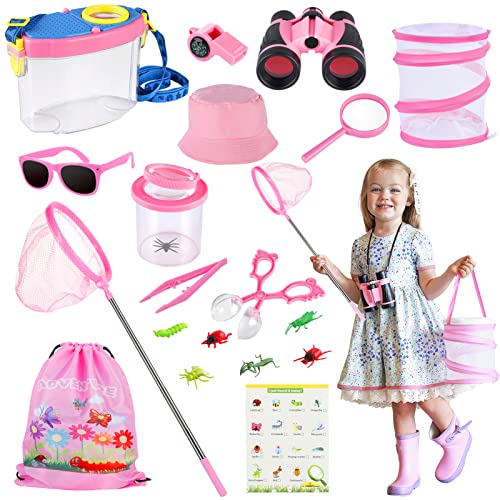
The GIFTINBOX set is built around the youngest explorers. Its storage backpack is described by the maker as lightweight and easy to carry, sized to hold the whole adventure kit: binoculars, a magnifying glass, a bug container with a magnifier in the lid, a wide-brim hat, sunglasses and a two-in-one compass whistle. The hat and sunglasses are a thoughtful inclusion — sun protection is part of exploring, and bundling it in means it actually gets worn.
The binoculars are listed at 5 x 30 magnification with flexible rubber eyepieces and a neck strap, and the magnifying glass at 3x. The bug container’s magnifier lid lets a child study a catch without handling it. GIFTINBOX gives a manufacturer recommended age of 3 years and up, with the set aimed at children up to about 12. The kit’s listed item weight is 1.72 pounds, most of it the tools rather than the bag.
Specs
- Included: storage backpack, binoculars, magnifying glass, bug container, wide-brim hat, sunglasses, compass whistle
- Binoculars: 5 x 30 magnification, flexible rubber eyepieces, neck strap included
- Magnifying glass: 3x magnification
- Bug container: magnifier built into the lid
- Item weight: 1.72 pounds
- Product dimensions: 8.6 x 7.8 x 3.9 inches
- Maker’s positioning: manufacturer recommended age 3 years and up
Best for: Preschool and early school-age children starting backyard and park exploring.
Watch out for: The backpack is a storage bag for the kit rather than a hiking pack with padded straps, and there is no roomy main compartment for a lunch box alongside the tools.
See the GIFTINBOX Bug Catcher Kit on Amazon
Which One Fits
For a first proper daypack that a child aged 5 or 6 will wear on family hikes, the Deuter Junior is the natural pick: light, ventilated and honestly sized. If your child drinks better from a hose and your walks run longer, the Osprey Jet 18 adds the reservoir sleeve and a safety whistle on the sternum strap.
The Deuter Fox 40 belongs to a different stage entirely — an older child carrying their own sleeping gear on an overnight trip, with a back system that adjusts as they grow. Choose it for camps and treks, not for Saturday nature walks.
The two kits answer a different question. If what your child actually wants is the binoculars, the net and the bug viewer — with a bag to keep them in — the ESSENSON kit packs the widest tool set, while the GIFTINBOX set suits the youngest children and folds sun protection into the bundle.
Common Mistakes
Buying a pack by age alone. Two eight-year-olds can differ by a head in height. Use the maker’s back length and body height figures where they are published, and measure before ordering.
Overloading small shoulders. A filled pack that is fine for an adult to lift can be a misery at knee height. Keep the total load light, put the water in the pack rather than in hands, and let adults carry the group gear.
Choosing a kit when you needed a pack — or the reverse. Explorer kits carry tools beautifully but their bags are simple sacks with thin straps. A hiking pack carries weight comfortably but arrives empty. Know which problem you are solving.
Ignoring the water question. None of the kits include a bottle, and only the Osprey includes a reservoir sleeve. Decide how your child will carry water before the first outing, not at the trailhead.
Skipping the listing’s safety guidance. Age recommendations, neck straps on binoculars and small loose parts all appear in listing details for a reason. Read them, and supervise the youngest explorers closely.
FAQ
What size backpack should a 5-year-old carry?
A small daypack in the 8 to 18 liter range is the usual fit for this age, and the empty weight matters as much as the volume. The Deuter Junior, at 18 liters and 390 grams, is positioned by its maker for children aged 5 and above. Measure your child’s back and compare it with any back length the listing publishes.
Are explorer kits better than a hiking backpack for kids?
They solve different jobs. An explorer kit such as the ESSENSON or GIFTINBOX sets bundles binoculars, a bug viewer and other tools with a simple carry bag, which is ideal for parks and gardens. A hiking backpack from Deuter or Osprey carries weight comfortably over distance but comes without tools. Many families end up with the kit’s tools riding inside the hiking pack.
How much weight should a child carry in an explorer backpack?
Listings do not set a load limit for these small packs, so the practical rule is to keep the total light enough that the child forgets the pack is there — water, a snack and their tools, with adults carrying everything else. If straps are leaving marks or your child keeps taking the pack off, it is too heavy or badly adjusted.
What should go in a kids explorer backpack?
Start with water and a snack, then the tools: binoculars, a magnifying glass, a bug container and a small notebook. Add a light layer for changing weather. Keep bug containers upright and separate from food, and leave anything sharp or fragile in an adult’s pack.
Conclusion
The right explorer backpack is the one your child will still be wearing at the end of the walk. Pick the Deuter Junior for a light, ventilated first hiking pack, the Osprey Jet 18 for reservoir hydration and its whistle strap, and the Deuter Fox 40 when overnight loads enter the picture. If the tools are the point, the ESSENSON kit packs the fullest set, and the GIFTINBOX kit wraps it up for the youngest adventurers. Match the size to the child in front of you, keep the load light, and the finds will take care of themselves.
FAQ
What size backpack should a 5-year-old carry?
Are explorer kits better than a hiking backpack for kids?
How much weight should a child carry in an explorer backpack?
What should go in a kids explorer backpack?
More from Amazon
Programs that pair well with the guide above. Offers and eligibility are set by Amazon and may change.
Free shipping on eligible items, Prime Video and more. Eligible new members can start with a free trial.
Start a Prime free trialA Prime membership for ages 18-24 with a trial period. Eligibility is set by Amazon.
See Prime for Young AdultsAudiobooks and podcasts to listen to on the go. Eligible new members can start with a free trial.
Try Audible freeAd-free music streaming. Eligible new subscribers can start with a free trial.
Try Music Unlimited freeAs an Amazon Associate we earn from qualifying purchases.