
Key takeaways
What's inside
Best water filtration bottle claims live or die on independent testing. LifeStraw publishes removal of 99.999999% of bacteria and 99.999% of parasites, tested against US EPA and NSF/ANSI drinking water protocols. Here is what those figures mean and where five bottles stop working. Certification is not the same as suitability.
As an Amazon Associate we earn from qualifying purchases at no extra cost to you.


As an Amazon Associate we earn from qualifying purchases at no extra cost to you.
By Jake Thompson, gear writer for Roger Bacon Outdoors.
🛒 Best Price Today on Amazon
Prime members get fast, free shipping on everything above, plus member-only deals. New members get a 30-day free trial — cancel anytime.
What Testing Actually Proves About a Water Filtration Bottle
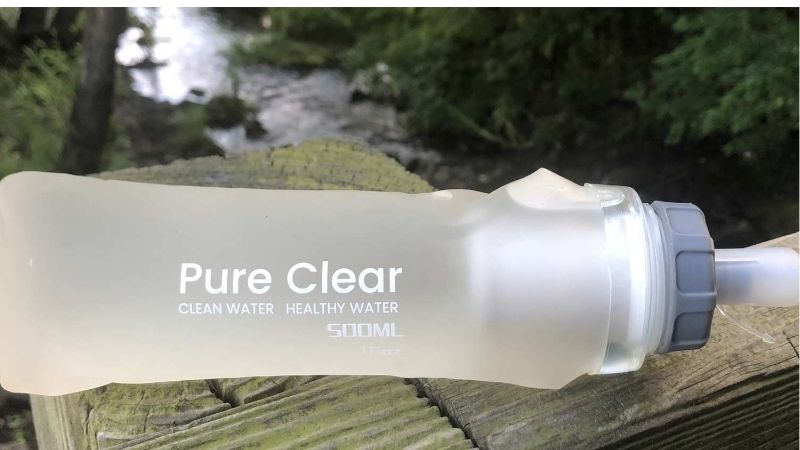
Every brand in this category quotes percentages with a lot of nines, and most buyers have no way to interpret them. Understanding what those figures measure, which protocols sit behind them and what they deliberately exclude is how you separate the best water filtration bottle from a confident label.
Reading the Removal Percentages
Those strings of nines are log reduction values written out as percentages. LifeStraw publishes 99.999999% for bacteria, which is an eight-log reduction, meaning one organism survives out of every hundred million present. For parasites the published figure is 99.999%, or five-log, and the same applies to microplastics.
Higher log values matter because bacterial counts in contaminated water can be enormous. A five-log reduction applied to a heavily loaded source still leaves measurable organisms behind, which is precisely why the standards demand more from bacteria removal than they do from protozoa, whose counts are typically far lower.
Which Protocols Sit Behind the Claims
LifeStraw states its filters are independently lab-tested against drinking water protocols established by the US EPA and NSF International/ANSI, and also references World Health Organization and Water Quality Association criteria. Those bodies are the recognised reference points against which any best water filtration bottle should be judged.
For purifiers the relevant benchmark is NSF protocol P231, which covers microbiological water purifiers. LifeSaver states its Liberty exceeds NSF P231 and WHO 2011 drinking water standards, and that is the specific claim to look for if virus removal is the reason you are buying.
What the Testing Deliberately Excludes
Microfiltration protocols address bacteria and protozoa, but not viruses. A 0.2 micron membrane cannot capture particles measuring around 0.02 microns, so no amount of certification changes that outcome. Certification confirms the filter does exactly what it claims, not that the claim covers the water source in front of you.
Dissolved contaminants are the other gap, and no best water filtration bottle closes it with a membrane alone. Hollow fibres do nothing for heavy metals, and activated carbon reduces chlorine and some organic compounds without being a lead filter. If metals concern you, look for explicit metal reduction claims.
Best Water Filtration Bottle Picks and Their Tested Limits
Five bottles compared on what testing supports rather than on marketing language. The best water filtration bottle for a Rocky Mountain creek is certified against different threats from one intended for questionable municipal taps abroad, so match the protocol to the water you will face.
| Model | Rating | Published removal | Standards referenced | Cartridge life |
|---|---|---|---|---|
| LifeStraw Go Series 22 oz | 0.2 micron + carbon | 99.999999% bacteria | US EPA, NSF/ANSI | 4,000 L membrane |
| LifeStraw Go Stainless | 0.2 micron + carbon | 99.999% parasites | US EPA, NSF/ANSI | 4,000 L membrane |
| Grayl GeoPress | Purifier | Viruses, bacteria, protozoa | Purifier-class claims | approx. 250 L |
| LifeSaver Liberty | 0.015 micron ultrafiltration | 99.99% viruses and bacteria | Exceeds NSF P231, WHO 2011 | 2,000 L |
| Katadyn BeFree 0.6L | 0.1 micron hollow fibre | Bacteria and protozoa | Microfilter class | Flow-limited |
LifeStraw Go Series 22 oz – Best Documented Microfilter
A 0.2 micron membrane microfilter paired with an activated carbon capsule, removing 99.999999% of bacteria including E. coli and salmonella, 99.999% of parasites including giardia and cryptosporidium, and 99.999% of microplastics. Testing is against US EPA and NSF/ANSI drinking water protocols.
The membrane is rated for up to 1,000 gallons and stops flow entirely at end of life, which removes any guesswork. The documented limit is viral contamination, which this bottle does not address, so it belongs in North American and European backcountry rather than higher-risk regions.
LifeStraw Go Stainless – Same Testing, Insulated Body
Filtration is identical to the plastic Go bottles: the same 0.2 micron membrane and carbon capsule, the same published removal rates and the same EPA and NSF/ANSI testing basis. What changes is the body, which adds double-wall vacuum insulation in 18 and 24 ounce sizes.
Choose it when temperature retention matters to you and carried weight does not. The trade-offs are extra mass, a higher price and less impact tolerance on rock than a plastic body, with no change whatsoever to the filtration performance or to the cartridge replacement schedule behind it.
Grayl GeoPress – Broadest Contaminant Coverage
A 710 millilitre press purifier that removes viruses alongside bacteria and protozoa, and additionally reduces chemicals, heavy metals, pesticides and microplastics. Operation is a single press stroke lasting roughly eight seconds, after which you drink normally from a sealed, watertight bottle.
The cartridge is rated at about 250 litres, one sixteenth of a LifeStraw membrane, so cost per litre is far higher. It also needs drying between trips to prevent odours, and it is bulkier than a hollow-fibre bottle, which is the physical price of the wider contaminant coverage.
LifeSaver Liberty – Strongest Certification Claim
Ultrafiltration at 0.015 microns, roughly 15 nanometres, removing 99.99% of viruses, bacteria, parasites and microplastics, with performance stated to exceed NSF protocol P231 and WHO 2011 standards. The 400 millilitre bottle uses an inline hand pump delivering about 1.2 litres per minute.
Cartridge life is 2,000 litres, eight times a Grayl, and a failsafe stops the flow entirely once the filter is spent so you cannot drink unpurified water by mistake. Costs are weight at 425 grams, a small 400 millilitre capacity, and a carbon disc rated at only 100 litres that handles metals and taste.
Katadyn BeFree 0.6L – Finest Microfilter Pore Size
The EZ-Clean hollow-fibre membrane is rated at 0.1 microns, half the pore size of the LifeStraw Go, in a collapsible HydraPak flask weighing around 63 grams. Flow reaches roughly 2 litres per minute, making it the fastest bottle in this comparison by a wide margin.
Finer pore size does not mean virus protection, since viruses are an order of magnitude smaller again. There is no carbon stage in the standard version, and independent reviewers consistently report flow degrading well before the rated capacity is reached, so it makes sense to plan around roughly two thirds of the published figure.
Consumable Costs, Tariffs and When to Buy
Certification tells you what a bottle does; economics tell you what owning it costs across several years. Two factors are moving prices right now, and both argue for deciding sooner rather than waiting for a discount that current supply conditions make unlikely to appear before autumn.
Filter Media Sits Inside the Tariff Exposure
Industry survey data indicates 84% of outdoor businesses expect to be affected by new tariffs, with costs rising roughly 7.7% overall and specialised plastics reported up 10 to 15%. Hollow-fibre membranes, cartridge housings and stainless bodies all fall within that exposure.
Manufacturers have said openly that published prices are only estimates while supply chains settle down. In a category defined by repeat cartridge purchases, an increase on consumables compounds across several years in a way that a single rise on the bottle itself never manages to do.
Late Summer Thins the Range
Filtering bottles sell alongside backpacks and rain gear in the weeks before term starts, and replacement cartridges routinely go out of stock before the bottles they belong to do. Ordering consumables at the same time as the bottle avoids ending up with a system you own but cannot legitimately use.
Keeping one spare carbon capsule on hand is cheap insurance and stops a two-month consumable dictating when the bottle is usable. It also removes the temptation to keep drinking through a spent carbon stage, which remains safe but tastes increasingly of whatever the local supply is treated with.
Compare Cost per Litre, Not Sticker Price
With inflation near 4.2% and an estimated tariff burden of about $1,600 per US household in 2026, running costs deserve scrutiny. A 4,000 litre membrane, a 2,000 litre ultrafiltration cartridge and a 250 litre purifier element produce very different long-term arithmetic.
Against bottled water every option here wins comfortably, and by a wider margin than most buyers expect. LifeStraw calculates one membrane as the equivalent of 8,000 single-use plastic bottles, while LifeSaver publishes a running cost of around three cents per litre for the Liberty across a full cartridge.
Frequently Asked Questions
These four questions come up whenever buyers start reading test data rather than product copy. All answers assume the filter is used as designed, cleaned regularly and stored dry, since maintenance affects real-world results more than any difference between certification bodies.
Is a certified best water filtration bottle safe everywhere?
No. Certification confirms the filter performs as claimed against specific organisms, not that those organisms are the only threat present. A 0.2 micron microfilter certified to EPA and NSF protocols still passes viruses, which is why destination matters as much as the certificate does.
What does 99.999999% actually mean?
It is eight-log reduction: one organism passes for every hundred million present. Five-log, written 99.999%, allows one in a hundred thousand. The difference sounds trivial but matters enormously on heavily contaminated water, which is why bacteria standards are stricter than protozoa standards.
Does NSF P231 apply to ordinary filters?
No, P231 is the protocol for microbiological water purifiers, which means virus removal is part of the test. Standard hollow-fibre microfilters are assessed against bacteria and protozoa criteria instead, so seeing P231 referenced is a reliable signal that you are looking at a purifier.
Do any of these remove lead?
Not the plain microfilters. LifeSaver’s activated carbon disc states reduction of heavy metals including lead, nickel and cadmium, and Grayl claims heavy metal reduction on its purifier cartridges. Membranes alone do nothing for dissolved metals regardless of how fine the pore rating is.
See More:
- Best Water Filtering Bottle: 5 Picks by What They Remove
- Best Water Bottle Filter: Micron Ratings and Cartridge Life
- Best Water Bottle Purifier: Virus Protection and 5 Picks
- What Bottle Water Is the Best? Types, TDS and Label Rules
Final Thoughts
The best water filtration bottle is the one certified against the threats you will actually meet. LifeStraw’s Go range is the best-documented microfilter, the LifeSaver Liberty carries the strongest purifier certification, and the BeFree offers the finest microfilter pore size and fastest flow.





Write Your Review
No reviews yet. Be the first to share your experience!