Camp stove review time is the moment your camp kitchen comes together, because the right burner boils water fast, simmers without scorching, and matches how you travel. This guide compares five top stoves by heat output, weight, fuel type, and wind resistance, from car-camping two-burners to ultralight canister stoves.
As an Amazon Associate we earn from qualifying purchases.
Our top picks
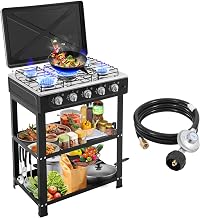
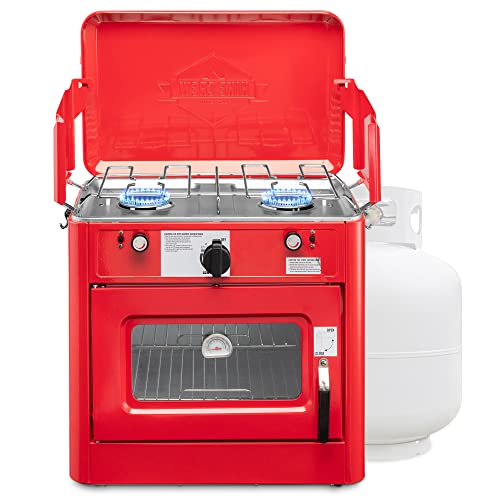
 Coleman Triton 2-Burner Propane Stove
- Warranty Description: 3-Year Limited Warranty
- Fuel Type: Propane
- Power Source: Gas Powered


 Gas One GS-3400P Propane or Butane Stove
- Warranty Description: 1 Year
- Fuel Type: Liquefied Petroleum Gas
- Power Source: Gas Powered

 ODSD 2 Burner Camping Stove with Windshield
- Fuel Type: Propane
- Power Source: Gas Powered
- Maximum Energy Output: 20000 British Thermal Units

As an Amazon Associate we earn from qualifying purchases at no extra cost to you. Ratings are shown as listed on Amazon.
By Jake Thompson
How We Chose Stoves for This Camp Stove Review
The best stove for you depends on whether you cook at the car or on the trail. This camp stove review weighs the factors that actually matter in the field, so think about your group size, your menu, and how far you carry your kitchen before you choose.
Heat Output and Simmer Control
Heat output is measured in BTU, which reflects raw power. Big two-burner stoves push around 10,000 to 20,000 BTU per burner for fast boiling and big pans, but efficiency matters as much as power. A good heat exchanger boils faster on fewer BTU than an open burner.
Simmer control is the other half of the story. Cheap stoves often blast or barely flicker with nothing in between, which scorches sauces. The best stoves adjust smoothly from a rolling boil down to a gentle simmer, letting you actually cook rather than just heat water.
Fuel Type and Availability
Fuel shapes your whole setup. Propane cylinders are cheap and sold at gas stations everywhere, making them ideal for car camping. Isobutane canisters are lighter and screw onto compact backpacking stoves, while dual-fuel stoves run on both propane and butane for flexibility.
Availability matters on longer trips. Canisters are easy to find at outdoor shops but scarce in remote towns, and you cannot fly with fuel. Plan where you will resupply, and pick a fuel type that you can reliably buy near your trailhead rather than one that leaves you stranded.
Weight and Packed Size
Weight sorts stoves into categories. Two-burner car-camping stoves run roughly nine to twelve pounds, which is fine when they ride in the trunk. Backpacking canister stoves weigh only a couple of ounces and fold to the size of a matchbox, disappearing into any pack.
Packed size follows weight. Compact folding two-burner systems shrink to save van and trunk space, while a bare canister stove needs almost none. Match the stove’s bulk to your vehicle or pack, since a kitchen you resent carrying is one you will eventually leave behind.
Wind Resistance and Stability
Wind steals heat and wastes fuel, so built-in wind panels are a real advantage on exposed stoves. Backpacking stoves that lack a screen struggle in a breeze, so many hikers add a separate windscreen or shelter the flame with their body when conditions turn blustery.
Stability keeps dinner off the ground. Wide, sturdy pot supports handle big pans on a two-burner stove, while a narrow canister-top stove can feel tippy under a heavy pot. Consider a remote-canister or a base that spreads the load if you cook in larger pots on the trail.
Top Picks From This Camp Stove Review
These five stoves cover every style of cooking outdoors. Timing helps too: it is back-to-school and pre-fall-sale season, prices on metal-bodied gear have been volatile amid ongoing tariff uncertainty, and retailers are clearing inventory, so a good deal on the right stove is often worth grabbing rather than waiting for a price drop that may not come.
| Stove | Type | Fuel | Best For |
|---|---|---|---|
| Camp Chef Everest 2X | 2-burner tabletop | Propane | Best overall car camping |
| Coleman Classic | 2-burner tabletop | Propane | Budget car camping |
| Jetboil Genesis Basecamp | 2-burner system | Propane | Compact / vanlife |
| MSR PocketRocket 2 | Canister-top | Isobutane | Backpacking |
| Gas One GS-3400P | Single burner | Propane / Butane | Budget single-burner |
Camp Chef Everest 2X – Best Overall
The Camp Chef Everest 2X is the standout of this camp stove review for car campers. Its two 20,000-BTU burners boil water fast and power large pans, a built-in ignition saves you from a lost lighter, and a solid windscreen keeps it cooking even when the weather turns breezy.
At around twelve pounds it is strictly a trunk stove, and that much power is overkill for boiling a single pot. But if you want a stove that fries, simmers, and boils flawlessly across every test, the Everest 2X earns its place as the best all-around two-burner available.
Coleman Classic – Best Budget
The Coleman Classic has been in production since the 1970s for one reason: it works, costs little, and lasts for decades. Two adjustable 10,000-BTU burners run off cheap propane, fold-up wind panels shield the flames, and the surface fits a skillet and a saucepan side by side.
Its simmer control is a step below premium stoves, and the wind panels only help up to a moderate breeze. But at a rock-bottom price with legendary reliability, it remains the default budget pick that campers keep buying and using year after year without complaint.
Jetboil Genesis Basecamp – Best Compact System
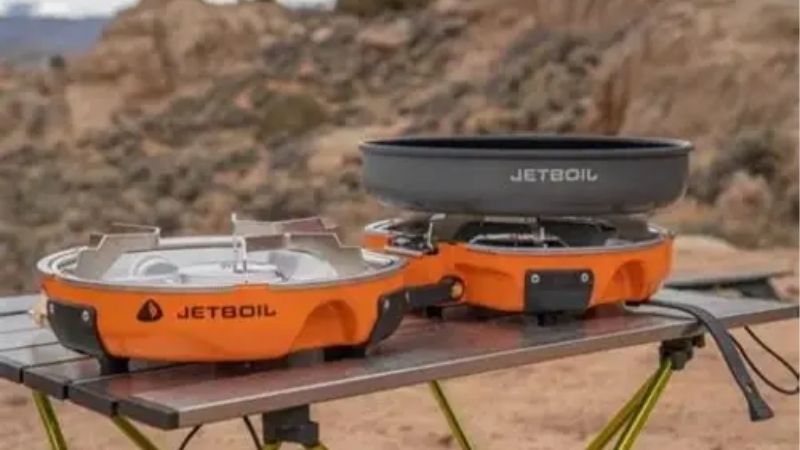
The Jetboil Genesis Basecamp folds two 10,000-BTU burners together into a clamshell that packs remarkably small, which makes it a favorite for vanlife and tight kits. At roughly nine pounds it is light for a two-burner, and it can daisy-chain to other Jetboil stoves for extra cooking.
It costs more than a basic stove and its burners are less powerful than the Everest, so big boils take a touch longer. For campers who value compact packing and an expandable system, though, this all-in-one setup is a genuinely clever and space-saving solution.
MSR PocketRocket 2 – Best for Backpacking
The MSR PocketRocket 2 is the benchmark backpacking stove in this camp stove review. At just 73 grams it disappears into any pack, screws onto a standard isobutane canister, folds to the size of a matchbox, and boils a liter of water in about three and a half minutes.
It has no built-in igniter or windscreen, so bring a lighter and shelter the flame in wind, and it can feel tippy under a large pot. For fast, reliable, ultralight cooking on the trail, though, its simplicity and bombproof track record are exactly what most hikers want.
Gas One GS-3400P – Best Budget Single-Burner
The Gas One GS-3400P is a light, affordable single burner that punches above its price. It runs on both propane and butane for fuel flexibility, offers surprisingly good simmer control, and works well for solo campers, small kitchens, or as a backup burner when you need more heat.
It is a tabletop stove rather than a trail stove, and it lacks the polish and wind protection of premium models. But for campers who want a versatile, dual-fuel burner without spending much, it delivers reliable performance at a price that is genuinely hard to argue with.
Frequently Asked Questions
Here are the questions campers ask most after reading a camp stove review like this one.
How many BTU do I need in a camp stove?
More BTU means faster boiling, but efficiency matters just as much. Around 10,000 BTU per burner handles most car-camping cooking, while 20,000 BTU speeds up big pots and windy conditions. For backpacking, a compact canister stove with a good pot boils quickly on far fewer BTU.
Propane or isobutane: which fuel is better?
Propane is cheap, sold everywhere, and ideal for heavier car-camping stoves. Isobutane is lighter and screws onto compact backpacking stoves, making it the trail choice. If you camp both ways, some stoves and adapters accept both, but match your primary fuel to how you travel most.
Can I use a camp stove in the wind?
Yes, but wind steals heat and burns extra fuel. Stoves with built-in wind panels cope better, and for open backpacking stoves you can add a windscreen or shelter the flame with your body or a rock. Never fully enclose a canister stove, which can dangerously overheat the fuel.
Is a two-burner stove worth it over a single?
For groups and real meals, yes. A second burner lets you cook a main and a side at once, which matters when feeding a family. Solo hikers and minimalist campers rarely need it, so a single burner or a canister stove saves weight, space, and money for those trips.
See More:
Final Thoughts
This camp stove review shows the best burner is the one that fits how you cook outdoors. Car campers should reach for the Camp Chef Everest 2X or budget-friendly Coleman Classic, van travelers the Jetboil Genesis, and backpackers the MSR PocketRocket 2, with the Gas One covering budget single-burner duty. Match power and fuel to your trips.