Key takeaways
What's inside
Camping cooler review season always raises the same question: how much cooler do you actually need? This roundup compares five field-tested ice chests across capacity, ice retention, weight, and portability, from a premium rotomolded box to a grab-and-go soft cooler, so you can match the right one to your trips without wasting ice or money.
As an Amazon Associate we earn from qualifying purchases at no extra cost to you. Product prices and availability are accurate as of the date shown and are subject to change.
As an Amazon Associate we earn from qualifying purchases at no extra cost to you. Product prices and availability are accurate as of the date shown and are subject to change.




By Jake Thompson
How to Choose a Camping Cooler
Before comparing models, think about your typical outing. A weekend car camper has very different needs than someone packing a lunch for a day at the lake. This camping cooler review starts with the four factors that decide whether a cooler fits your trips or just wastes trunk space.
Capacity and Size
Capacity is usually listed in quarts or can count, but real usable space matters more. Thick, insulated walls mean a cooler holds less than its outside size suggests. Plan for roughly a two-to-one ratio of ice to food for long trips, and size up if you tend to overpack.
Think about your group and duration. A solo day trip needs only a small personal cooler, while a family weekend calls for 45 quarts or more. Buying too big wastes ice and space, while too small means a second cooler or a soggy, warm mess by afternoon.
Ice Retention and Insulation
Ice life separates budget and premium coolers. Rotomolded models with thick walls and a tight gasket can hold ice for a week or more, while thinner injection-molded coolers keep it a few days. Match the retention to your trip length so you are not buying more than you need.
Real-world ice life depends on how you use it. Pre-chilling the cooler, packing it full, limiting how often you open it, and keeping it in the shade all stretch ice dramatically. Even a modest cooler performs well with good habits, while a premium box underperforms if abused.
Portability and Durability
A loaded cooler gets heavy fast, so portability counts. Soft coolers and small hard models carry easily by hand, mid-size boxes need two people when full, and wheeled coolers save your back over long distances from car to campsite across grass, sand, or gravel.
Durability decides how long it lasts. Rotomolded coolers shrug off drops and years of sun, tough soft coolers resist tears and leaks, and budget boxes trade ruggedness for a low price. That longevity is why durability features so heavily in this camping cooler review, weighed against how hard you plan to use it.
Top Picks: A Camping Cooler for Every Style
With those factors in mind, this camping cooler review lines up five strong options, each a clear winner for a different kind of trip. The table sums up the key numbers, and the reviews below dig into who each cooler suits and the trade-offs you should expect.
| Cooler | Type | Capacity | Ice Life | Best For |
|---|---|---|---|---|
| Yeti Tundra 45 | Rotomolded hard | ~54 cans | Up to ~10 days | Premium multi-day |
| RTIC 45 | Rotomolded hard | ~45 qt | ~5-7 days | Value performance |
| Coleman Xtreme 5 | Injection hard | ~50 qt | Up to ~5 days | Budget car camping |
| Yeti Hopper Flip 12 | Soft | ~12 cans | 1-2 days | Grab-and-go day trips |
| Yeti Roadie 48 | Wheeled hard | ~48 qt | Multi-day | Rolling over terrain |
Yeti Tundra 45 – Best Premium
The Yeti Tundra 45 tops many a camping cooler review, and it is the benchmark for serious ice retention. Its rotomolded build wraps thick insulation around a tight freezer-style gasket, holding solid ice for the better part of a week or more, and it swallows around 54 cans while shrugging off years of hard, sun-baked use.
It is heavy at roughly 25 pounds empty and carries a steep price, so it is overkill for casual day trips. But if you camp for days at a stretch and want a cooler that may outlast your vehicle, it earns the splurge.
RTIC 45 – Best Value
The RTIC 45 delivers most of the premium experience for noticeably less money. It is rotomolded with thick insulation, holds ice for several days, and matches the burly build and lockable lid of pricier boxes, making it the value pick for campers who want performance without the top-tier cost.
It runs heavier than a Yeti of similar size and is not certified bear-resistant, so it is not ideal for backcountry bear country. For most weekend campers watching their budget, though, the performance-per-dollar is excellent.
Coleman Xtreme 5 – Best Budget
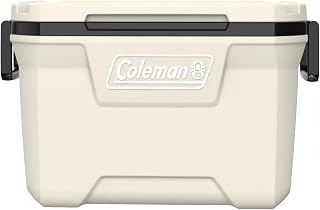
In almost any camping cooler review, the Coleman Xtreme 5 remains the budget favorite for good reason. This injection-molded cooler keeps ice for up to five days in good conditions, comes in a wide range of sizes, weighs far less than a rotomolded box, and costs a small fraction of the premium options.
Its thinner walls and lighter latches cannot match a rotomolded cooler in extreme heat or rough handling. But for family weekends, lake days, and backyard use, it offers more than enough performance for the price and stays easy to carry.
Yeti Hopper Flip 12 – Best Soft Cooler
When you want grab-and-go convenience, the Yeti Hopper Flip 12 is a leakproof soft cooler built to travel. It holds around a dozen cans with ice, seals watertight against spills, and its tough, tapered body carries easily by the handle for a picnic, a paddle, or a short hike to the water.
Soft coolers hold ice a day or two at most, and this one costs far more than a basic lunch cooler. For day trips where portability beats capacity, though, its durability and watertight seal are worth the premium.
Yeti Roadie 48 – Best Wheeled
For hauling a load over rough ground, the wheeled Yeti Roadie 48 saves your back. Puncture-resistant wheels roll over sand, gravel, and roots, a periscoping handle pulls it along easily, and it still delivers strong multi-day ice retention in a tough, rotomolded body built for real abuse.
It is expensive and, like all wheeled coolers, heavier and bulkier than a comparable non-wheeled box. But if you regularly move a full cooler any real distance from the car, the effortless rolling quickly justifies the cost.
Frequently Asked Questions
A few questions come up again and again in any camping cooler review. Here are quick, practical answers to help you finalize your choice.
How big a cooler do I need for camping?
For a weekend, plan on roughly a quart of capacity per person per day, plus room for ice. A couple can manage with a 25-to-35-quart cooler, while a family or a longer trip wants 45 quarts or more. When in doubt, size up slightly rather than running out of cold space.
How do I make ice last longer?
Pre-chill the cooler and its contents, pack it full to minimize air, and use block ice or frozen bottles alongside cubes. Keep it in the shade, limit how often you open the lid, and drain melt only if it turns lukewarm. Good habits often double a cooler’s real ice life.
Are expensive rotomolded coolers worth it?
If you camp for several days, in heat, or far from ice, the extra retention and durability of a rotomolded cooler pay off. For occasional day trips and short weekends near town, a quality budget cooler keeps food cold for far less money and is much easier to carry.
Should I get a hard or soft cooler?
Hard coolers hold more, keep ice longer, and take abuse, making them best for multi-day trips and big groups. Soft coolers are lighter, more portable, and easier to store, making them ideal for day trips, lunches, and short outings where you value convenience over capacity.
See More:
- Best camp chair
- Lightweight camp chair
- Camping table review
- Backpacking cookware set
- Camp stove review
Final Thoughts
This camping cooler review shows there is no single best cooler, only the right one for your trips. Multi-day campers will love the Yeti Tundra, value hunters the RTIC, and budget shoppers the Coleman Xtreme, while the Hopper Flip and wheeled Roadie solve portability in different ways. Match capacity and ice life to how you camp, and cold drinks are guaranteed.