
Key takeaways
What's inside
Best inflatable tent decisions come down to a straight trade: air beams pitch far faster than poles but add weight and packed bulk. These five span a 5.5 pound two-person shelter to a six-person canvas hot tent. Hydrostatic head ratings vary widely, and only some of them include the pump you need to put the tent up.
As an Amazon Associate we earn from qualifying purchases at no extra cost to you. Product prices and availability are accurate as of the date shown and are subject to change.


As an Amazon Associate we earn from qualifying purchases at no extra cost to you. Product prices and availability are accurate as of the date shown and are subject to change.
By Jake Thompson, gear writer for Roger Bacon Outdoors.
🛒 Best Price Today on Amazon
Prime members get fast, free shipping on everything above, plus member-only deals. New members get a 30-day free trial — cancel anytime.
What Separates the Best Inflatable Tent From a Gimmick
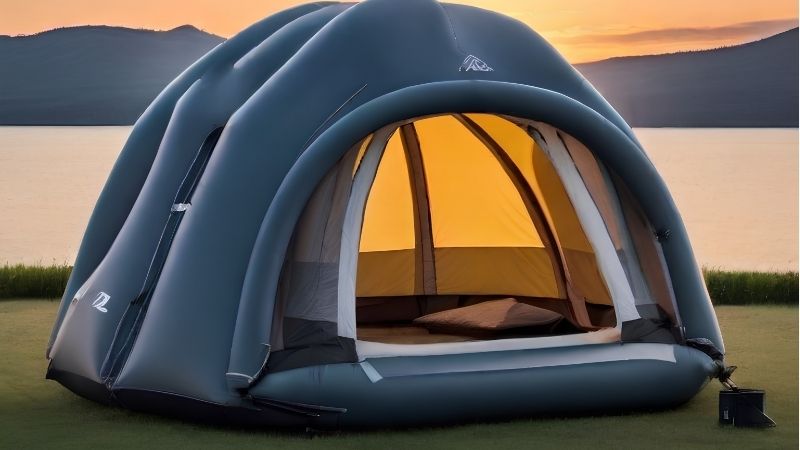
Air beams exist for one reason: one person can pitch a large tent alone in a fraction of the time poles take. Whether the best inflatable tent justifies its weight penalty depends on three specifications that rarely appear on the front of the box but decide everything about living with the shelter.
Beam Design and What Happens After a Puncture
The obvious fear with an air tent is a burst beam, and the better designs answer it directly. Heimplanet’s patented Multi Chamber Safety System inflates the whole frame through one valve, after which the chambers separate, so damage to one leaves the structure standing and the rest inflated.
That matters more than it sounds. A single-chamber design fails completely when punctured, while a multi-chamber frame degrades rather than collapses, letting you finish the night and repair the bladder in daylight. Every air tent should still be carried with its repair kit regardless of the system.
Hydrostatic Head and Fabric
Hydrostatic head measures the water pressure a fabric resists before leaking, quoted in millimetres, and it is where the best inflatable tent separates from a summer-only one. Heimplanet rates both the flysheet and the floor of its tents at 5,000mm, as does Crua across its airframe range.
Fabric choice follows from that. Heimplanet uses ripstop polyester for the fly with a ripstop nylon inner, and its lighter models run 40 denier high-tenacity polyester with a double ripstop weave. Heavier canvas air tents trade packability for insulation and the ability to run a stove jack.
Packed Size, Weight and Whether a Pump Is Included
Air tents pack larger than pole tents of equivalent capacity because deflated beams are bulky. Heimplanet’s Cave packs to 16 x 13 x 9 inches at 10.6 pounds for a two to three person shelter, and the smaller Fistral to roughly 38 x 20 x 20 centimetres at 5.5 pounds.
Pump inclusion is the detail that catches buyers out most often. Heimplanet sells its Mini Pump and Large Stand Pump separately, so the listed price is not the price of a tent you can pitch on arrival. Crua and most canvas air tents ship with a hand pump in the box.
Best Inflatable Tent Picks From 5.5 Pounds Upward
Five air tents covering solo trips through six-person family camping, all available through Amazon US. The best inflatable tent for a weekend by the car is not the one for winter basecamp, so start from group size and whether you need a stove. Specifications are manufacturer-published.
| Model | Capacity | Weight | Key specification | Pump included |
|---|---|---|---|---|
| Heimplanet Fistral | 1-2 person | 5.5 lb / 2.5 kg | 2.9 m2 base, 5,000mm | No, adapter only |
| Heimplanet The Cave | 2-3 person | 10.6 lb | 54 sq ft, geodesic IDG frame | No |
| Heimplanet Backdoor | 4 person | 13.5 lb | 97 sq ft total, 62.4 sq ft inner | No |
| Crua Core 6 Person | 6 person | Family weight | 5,000mm, modular to 12+ | Yes |
| RBM Outdoors Canvas Air Tent | 2-6 person | Canvas weight | Stove jack, air beam frame | Yes, hand pump |
Heimplanet Fistral – Lightest Air Tent Here
Two and a half kilograms, or 5.5 pounds, for a one to two person geodesic shelter with a 2.9 square metre base area, packing to roughly 38 x 20 x 20 centimetres. Both the flysheet and the floor carry a 5,000mm hydrostatic head, and the frame uses double-walled air struts.
Inner height is 112 centimetres against a total height of 132, so this is a sitting tent rather than a standing one. The box includes pegs, guy ropes, a repair kit, a gear loft and a pump adapter, but not the pump itself, which is a separate purchase you should not forget.
Heimplanet The Cave – Best Storm Performance
The Cave is Heimplanet’s original and still its most recognisable design: a geodesic dome with ten crossing points formed by the Inflatable Diamond Grid, giving 54 square feet of ground area at 10.6 pounds and packing to 16 x 13 x 9 inches. Setup takes under a minute with a pump.
The star-shaped roof creates five separate run-offs for rain, and two separable chambers provide emergency stability if one is damaged. The drawbacks are price, which sits near the top of the category, and a weight that puts it firmly in car camping rather than backpacking territory.
Heimplanet Backdoor – Most Space Per Pound
A four-person geodesic dome on interconnected beams in a hexagonal arrangement, offering 97 square feet in total with 62.4 square feet of inner space and a 4.1 foot ceiling, all at 13.5 pounds. That is remarkably light for a four-person tent of any construction type.
Heimplanet claims its largest models handle wind speeds far beyond ordinary camping conditions, and the multi-chamber system applies here too. The real limits are the 4.1 foot ceiling, which means nobody stands up inside, and again a pump that must be bought separately.
Crua Core 6 Person – Best Modular Family Option
Crua’s Airframe Pole Technology replaces poles entirely, and the Core is the six-person hub of the Clan system with a 5,000mm waterproof rating and a large porch for gear. It is the only tent here designed to be expanded rather than replaced as your group grows.
Connecting Duo or Duo Maxx tents to the sides pushes total sleeping capacity past twelve people, which suits families who camp with friends. The trade-off is that those add-on tents are separate purchases, so the modular appeal only pays off if you commit to the ecosystem.
RBM Outdoors Canvas Air Tent – Only Stove-Ready Option
An inflatable canvas tent for two to six people with an air beam frame, a stove jack and a hand pump supplied in the box. Canvas plus a stove jack changes what the tent is for: this is the shoulder-season and winter option rather than a summer weekend shelter.
Canvas is heavy, slow to dry and needs proper storage, so it is the least portable choice here by a wide margin. In exchange you get breathability, condensation performance and warmth that no synthetic air tent matches once a stove is running inside it.
End of Season, Tariffs and When Air Tents Get Cheap
Timing affects what the best inflatable tent costs more than in most categories, because air tents are expensive, seasonal and bulky to warehouse. Two factors matter: how tariffs have moved coated-fabric costs this year, and why September is when retailers discount tents hardest.
Coated Fabrics Sit Inside the Tariff Exposure
Industry survey data indicates 84% of outdoor businesses expect to be affected by new tariffs, with costs rising roughly 7.7% overall. High-tenacity nylon is reported up 10 to 15%, and polyurethane-coated flysheets and the TPU bladders inside air beams sit squarely within that exposure.
Aluminium and steel duties reach pegs, stove jack fittings and pump components as well. Manufacturers have said openly that published prices are estimates while supply chains settle, which weakens the case for waiting on a specific model to fall in price later in the year.
September Is the Discount Window
Tents are the clearest seasonal category in camping retail. Demand collapses once schools return, and retailers holding bulky stock into winter discount heavily to clear it, which makes September and October the cheapest reliable window for a large family air tent.
The catch is choice. Clearance stock is whatever did not sell, so the model and colour you researched may not be among it. If a specific tent matters, buy it in season; if price matters more, wait and stay flexible about which tent you end up owning.
Big-Ticket Items Reward Patience
With inflation near 4.2% and an estimated tariff burden of about $1,600 per US household in 2026, a large family tent is a purchase worth planning. Black Friday and Cyber Monday, falling on 27 to 30 November, deliver the deepest discounts of the year on this kind of item.
Against that, buying at the end of a season means storing an untested tent for months. Pitch it in the garden on arrival regardless of when you buy, because discovering a leaking bladder or a missing pump adapter in April is considerably worse than discovering it in October.
Frequently Asked Questions
These four questions cover what buyers ask before moving from poles to air beams. All answers assume normal three-season camping on a pitched and guyed tent, since inflatable structures depend on correct pegging just as much as pole tents do.
Is the best inflatable tent actually faster to pitch?
Substantially, and the gap widens with size. Heimplanet states The Cave goes up in under a minute once you connect a pump, because a single valve inflates the entire frame. A comparable geodesic pole tent takes several minutes and is genuinely awkward for one person in wind.
What happens if a beam punctures?
It depends entirely on the design. Multi-chamber systems keep the remaining chambers inflated so the tent holds its shape, while single-chamber frames lose structure completely. Carry the repair kit that ships with the tent, since most bladders are user-replaceable rather than a warranty job.
Are air tents heavier than pole tents?
Usually, and they pack larger. The Cave weighs 10.6 pounds for two to three people, where a comparable pole dome sits nearer six. The Backdoor is the exception at 13.5 pounds for four, but even that packs bulkier than poles because deflated beams do not compress like aluminium.
Do I need a special pump?
You need one with the correct valve fitting, and Heimplanet does not include one. It sells a Mini Pump for light packing and a Large Stand Pump for speed, while Crua and canvas air tents generally supply a hand pump. Check the listing before assuming a pump is in the box.
See More:
- Best Four Man Tent: 5 Picks by Floor Area, Peak and Weight
- Best Hammock for Every Job: 5 Types Compared by Purpose
- Best Rated Hammock: 5 Picks by Weight, Fabric and Capacity
Final Thoughts
The best inflatable tent is the one whose weight you will tolerate for the pitching speed you gain. The Fistral is the lightest, The Cave the best in storms, the Backdoor the most space per pound, the Crua Core the most expandable, and the canvas option the only stove-ready one.




Write Your Review
No reviews yet. Be the first to share your experience!