Key takeaways
Mountain hiking with trekking poles is not a luxury — it is a load-management decision. On steep descents, poles shift force from your knees and ankles into your arms, reducing joint stress on every step. On loose scree or mud, a planted pole gives you a third contact point that keeps you upright when your boots cannot find purchase. The wrong pole, however, becomes dead weight: it bends under your body weight, slips in the wrist strap, or collapses at a lock mechanism that fails after two seasons. That failure is not theoretical; it appears repeatedly in owner feedback across every budget pole line.
What separates a good mountain pole from a mediocre one comes down to three things: the shaft material and its strength-to-weight ratio, the lock system’s reliability under repeated adjustment, and the grip’s ability to stay comfortable when your hands are sweating at altitude. This roundup compares eight trekking pole options available in 2026 for mountain hiking, drawing on published specifications and recurring patterns in owner reviews. Prices range from thirty dollars to sixty-five, and the gap between them is not trivial — it is the gap between aluminum and carbon fiber, between a basic foam grip and engineered cork.
Our top picks
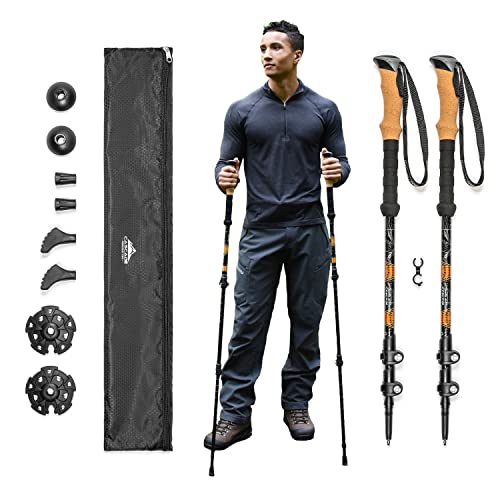
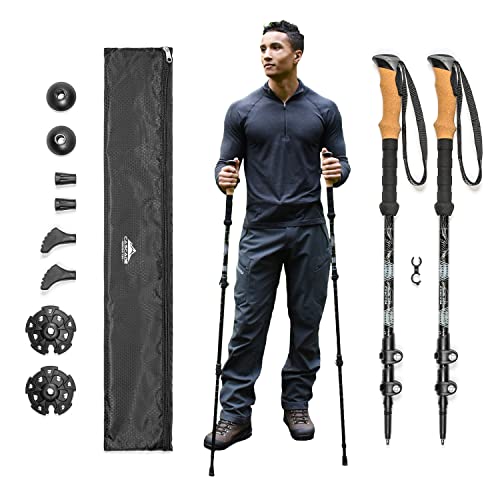
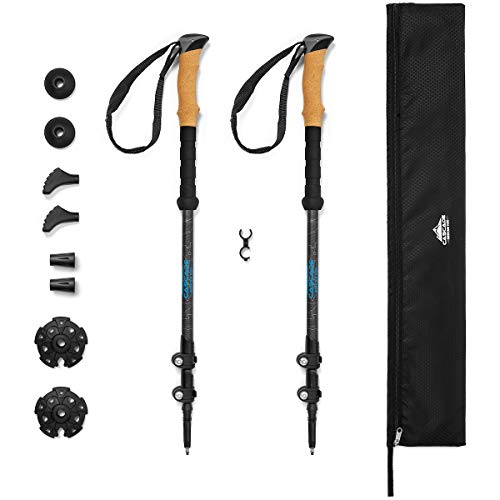
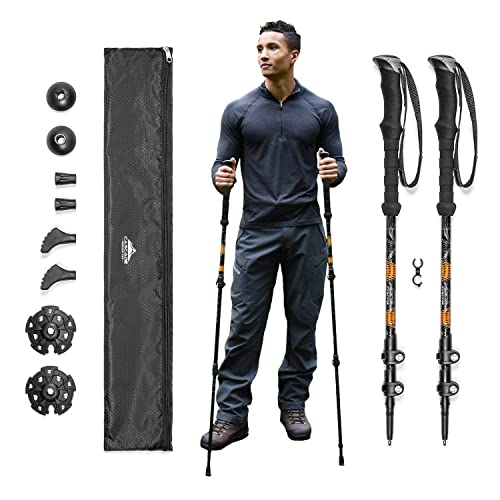

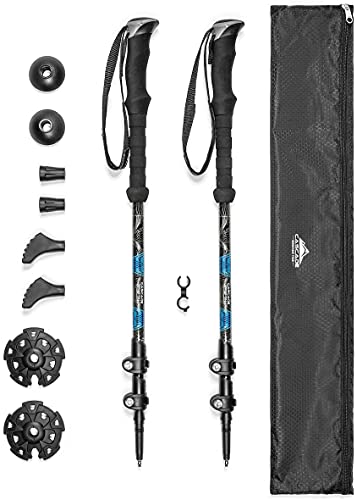
 Trekology Trek-Z Cork Grip Collapsible Lightweight Hiking
- Warranty Description: 1 Year
- Maximum Height Recommendation: 195 Centimeters
- Extended Length: 130 Centimeters

As an Amazon Associate we earn from qualifying purchases at no extra cost to you. Ratings are shown as listed on Amazon.
Quick Picks
| Product | Best for | Price |
|---|---|---|
| CMT 6061 Aluminum Cork Grip | Budget buyers who want cork comfort | under $30 |
| CMT Lightweight Aluminum + Tip Kit | Buyers who want extra tips in the box | under $30 |
| CMT Carbon Fiber Grey | Ultralight hikers on rocky terrain | under $70 |
| CMT Aluminum Expandable Orange | Hikers needing longer shaft length | under $30 |
| CMT Carbon Fiber Green | Color-conscious light-weight seekers | under $70 |
| Trekology Trek-Z Cork Grip | Travel hikers who need collapsibility | under $50 |
| CMT Blue Cork | Cork grip at a mid-range price | under $50 |
| CMT Carbon Fiber Blue | Carbon fiber with high-visibility color | under $70 |
How We Picked
We evaluated each option against four criteria that directly affect mountain performance: shaft material and its known behavior under lateral load on rocky or uneven terrain; lock system type (adjustable versus quick-adjustable) and how owners report long-term durability; grip material and its comfort during extended sweating conditions; and price relative to the feature set. We weighted owner-reported failure points — stripped locks, bent shafts, grip deterioration — as a consistent signal across review platforms rather than relying on single reviews.
The 8 Best Mountain Hiking With Trekking Poles in 2026
1. CMT 6061 Aluminum Cork Grip (Orange)
This is the most feature-complete option under thirty dollars. The aircraft-grade 6061 aluminum shaft expands to 54 inches, making it suitable for taller hikers without needing a dedicated long model. The cork grip molds to your hand over time, and the EVA extended grip below it lets you change hand position on steep switchbacks without re-gripping the top. Owners consistently praise the value, but note that the adjustable locks require periodic re-tightening. Skip this one if you demand a lock system that you never think about; the aluminum shaft also transmits more vibration than carbon fiber on long descents.
2. CMT Lightweight Aluminum + Tip Kit
A variant in the same price tier that trades the cork grip for a lighter aluminum shaft with an extended down grip and a bundled tip kit. The tip kit is the headline feature — extra baskets and carbide tips mean you are covered across snow, mud, and rock without a separate purchase. The down grip extension is useful for cross-traversing hillsides where you need a shorter effective pole length on the uphill side. The trade-off is grip quality: without cork or the same EVA combo found in the first model, your hands will fatigue faster on long summer hikes. Skip this if grip comfort is your priority over accessory inclusion.
3. CMT Carbon Fiber Grey
Carbon fiber cuts weight significantly compared to every aluminum option on this list, and that difference accumulates over thousands of steps in a mountain day. The quick adjustable lock system is the key upgrade here — it engages faster and holds more securely under load than the basic adjustable locks on the aluminum models. For under $70, you are paying roughly double for roughly one-third less weight and better lock reliability. The grey finish is low-glare, which some hikers prefer in bright alpine settings. Skip this if your knees are fine and you are hiking gentle trails — the weight saving matters most when every gram counts on high-mileage mountain days.
4. CMT Aluminum Expandable Orange
Essentially the same platform as the first entry but with a standard foam or rubber grip instead of cork. It expands to 54 inches and uses adjustable locks. The price stays for under $30, making it the cheapest 54-inch option here. For hikers who wear gloves almost always or who dislike the feel of cork, this is the logical pick. The downside is identical to other budget aluminum poles: the locks need maintenance, and the shaft will flex more noticeably under heavy lateral load on technical terrain. Skip this if you are over six feet tall with long arms — the 54-inch expansion may still feel short.
5. CMT Carbon Fiber Green
Spec-for-spec identical to the Grey model above; only the color changes. The green finish offers moderate visibility on trail without the high-glare effect of orange, which some hikers find distracting in low-angle light. The carbon fiber shaft and quick adjustable locks deliver the same weight and lock advantages as the other carbon models. If you want a visible pole that does not look like a safety marker, this is your option. Skip it if color is irrelevant to you and the Grey version is available — the performance is indistinguishable.
6. Trekology Trek-Z Cork Grip Collapsible
The Trek-Z solves a problem none of the Cascade options address: packing volume. Its collapsible Z-shape folds into a bundle small enough to fit in a carry-on or the bottom of a daypack, making it the pick for travel hikers or anyone who needs poles stowed on a bus or plane. The cork grip and lightweight construction are competitive with the fixed-length Cascade models for under $50. The compromise is that collapsible poles have more joints, which means more potential failure points under high load. Skip this if you are doing serious multi-day mountain trips with heavy packs; the fixed-length carbon or aluminum poles are structurally simpler.
7. CMT Blue Cork
A mid-position option for under $50 that combines the blue colorway with a cork grip. It sits between the basic aluminum models and the carbon fiber tier. Owners report a comfortable grip and adequate shaft rigidity for moderate mountain terrain. The price premium over the under-$30 aluminum models buys you the cork comfort and a distinct aesthetic, but the shaft material and lock system remain in the aluminum category. Skip this if you are already considering carbon fiber — spending fifteen more dollars gets you a genuine material upgrade in shaft and lock rather than a grip and color change.
8. CMT Carbon Fiber Blue
Same carbon fiber construction and quick adjustable locks as the Grey and Green models, in blue. The high-visibility blue is a functional choice: it is easier for a partner to spot in fog, rain, or dense brush. For under $70 it carries the same price premium as the other carbon options. For hikers who value visibility without resorting to orange, this delivers the lightest shaft on this list with the most visible color. Skip it if you already own a pack with bright accents that make your position obvious — the visibility argument weakens when your pack does the work.
Buying Guide
Shaft Material: Aluminum vs. Carbon Fiber
Aluminum (including 6061 aircraft-grade) is more forgiving under impact — it bends before it breaks, which means a rock strike dent is still usable. Carbon fiber is lighter and stiffer, reducing the effort per step and transmitting less vibration, but it can crack or shatter when subjected to a sharp lateral force (a ski tip, a rock fall, or a fall where the pole catches under you). For mountain hiking with trekking poles on rocky terrain, aluminum offers better damage tolerance; carbon fiber offers better fatigue resistance over long days. Choose based on whether you prioritize weight savings or durability under abuse.
Lock Systems: Adjustable vs. Quick-Adjustable
Adjustable locks (twist-style or clamp-style) require you to tighten and loosen the collar by hand, and they are prone to gradual loosening during a hike. Quick-adjustable locks — found on the carbon fiber models here — engage with a lever action that locks faster and holds more consistently. Owner feedback across multiple platforms consistently identifies lock failure as the top durability complaint on budget poles. If you adjust your pole length on the trail (switching between level ground and steep climbs), the quick-adjustable system saves time and reduces the risk of a lock slipping mid-step.
Grip Material: Cork, Foam, and Extended Grip
Cork is the premium choice for sweaty hands — it absorbs moisture and maintains friction even when wet. Foam (EVA) is lighter and cheaper but can compress over time, reducing comfort on long hikes. The extended grip below the main handle (found on the first two Cascade models) lets you shift hand position without releasing the pole, which is genuinely useful on side-hills and steep switchbacks. If your hands sweat heavily or you hike in humid mountain environments, cork is worth the price difference over foam alone.
Our Verdict
Top pick: The CMT Carbon Fiber (Grey, Green, or Blue) is the best overall choice for mountain hiking with trekking poles when budget allows. The weight reduction and lock reliability justify the under-$70 price for anyone covering significant mileage on varied terrain.
Budget pick: The CMT 6061 Aluminum Cork Grip delivers the most complete feature set for under $30 — cork comfort, extended grip, 54-inch reach, and an adjustable lock that, while not perfect, holds well for the price.
Alternative winner: If you travel by air or need to stow poles in a small bag, the Trekology Trek-Z is the clear choice. No other option on this list collapses to that footprint, and the under-$50 price is reasonable given the engineering required to achieve it.
FAQ
Do trekking poles help with mountain hiking?
Yes. On descents, poles transfer load away from your knees and into your upper body, reducing joint stress by distributing force across more muscle groups. On ascents, they provide propulsive push-off that reduces the effort required from your quadriceps, which matters most on sustained climbs where fatigue accumulates.
Are carbon fiber poles worth it over aluminum?
For mountain hiking with trekking poles over long distances, the weight and vibration advantages of carbon fiber reduce cumulative arm and shoulder fatigue. For shorter day hikes or rough terrain where impacts are common, aluminum’s bend-before-break behavior makes it the more resilient choice at a lower price.
How long should trekking poles be for mountain hiking?
On level ground, hold the grip with your elbow at a 90-degree angle. For steep mountain ascents, shorten your poles to push off more effectively. For descents, lengthen them so you can plant the tip ahead of your body. The 54-inch maximum on the aluminum models here accommodates hikers up to approximately six feet three inches tall.
Can I use trekking poles as a shelter pole?
Many ultralight shelters and tarps are designed to use trekking poles as structural supports, which is a practical reason to carry them on a multi-day mountain trip. Carbon fiber poles offer a better strength-to-weight ratio for this use, though the lateral force from wind loading is a scenario where aluminum’s ductility (bending without breaking) can be a safety advantage.