Key takeaways
Best trekking poles take real strain off your knees and add stability on rough ground. This roundup compares five field-tested pairs across weight, shaft material, locking mechanism, and grip, from a bombproof aluminum workhorse to a featherweight folding carbon set, so you can match the right poles to your body, pack, and the terrain you hike.
As an Amazon Associate we earn from qualifying purchases.
Our top picks
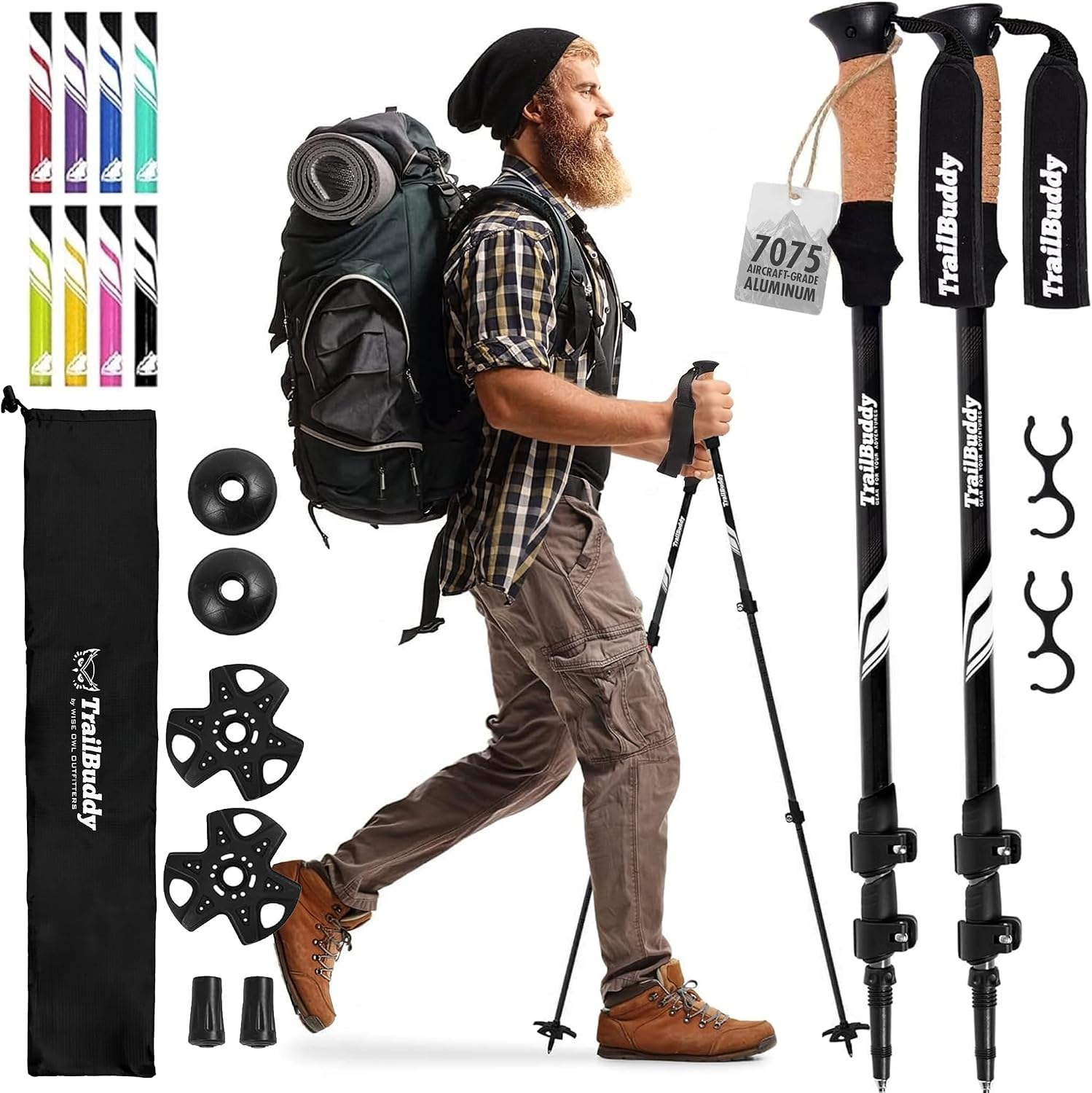 TrailBuddy Trekking Poles
- Hand Orientation: Ambidextrous
- Extended Length: 54 Inches
- Folded Size: 24.5


 Premium Foldable Hiking Poles by USA Brand
- Warranty Description: 1 Year Manufacturing
- Maximum Height Recommendation: 55 Inches
- Extended Length: 120 Centimeters


As an Amazon Associate we earn from qualifying purchases at no extra cost to you. Ratings are shown as listed on Amazon.
By Jake Thompson
How to Choose Trekking Poles
Before comparing models, think about how and where you hike. A thru-hiker counting grams needs different poles than a weekend day-hiker who wants durability above all. Finding the best trekking poles for you comes down to four features that decide whether they help or just weigh down your pack.
Shaft Material
Shafts come in aluminum or carbon fiber. Aluminum is heavier but tough, bending rather than snapping under load, which makes it reassuring for rugged or remote trips. Carbon is lighter and absorbs more trail shock, but it can crack suddenly if pinched between rocks, so weigh durability against weight savings.
The terrain shapes the choice. On rocky bedrock, thick carbon shafts damp vibration best, while aluminum shines where a broken pole would strand you far from help. Match the material to your priorities: minimum weight for fast trips, or maximum reliability for hard, off-grid miles.
Locking Mechanism
Locks hold your poles at the length you set. External lever locks, like Black Diamond’s FlickLock and Leki’s Speedlock, clamp reliably and adjust easily even in the cold or with gloves. Internal twist locks are lighter and cleaner but can slip when dirty or wet, which is a real annoyance mid-hike.
Folding poles use a different system entirely, joining segments with an internal cord for the smallest packed size. Whatever the design, a lock that holds firmly under a loaded descent is essential, since a pole that collapses under your weight is worse than no pole at all.
Grip and Adjustability
Grips shape all-day comfort. Cork molds to your hand, wicks sweat, and stays cool, making it the favorite for long hikes. EVA foam is soft and light but absorbs moisture, while rubber suits cold weather but can chafe bare skin. An extended lower grip lets you choke down on steep climbs.
Adjustability decides fit and packability. Telescoping poles adjust over a wide range and pack down moderately, folding poles collapse tiny but adjust little, and fixed poles are lightest but must be sized when you buy. The best trekking poles balance the fit and pack size your trips demand.
Top Picks: The Best Trekking Poles Right Now
With those factors in mind, here are five of the best trekking poles on the market, each a clear winner for a different kind of hiker. The table sums up the key numbers, and the reviews below explain who each pair suits and the trade-offs to weigh before you buy.
| Pole | Material | Weight/Pair | Lock | Best For |
|---|---|---|---|---|
| Black Diamond Trail Back | Aluminum | ~1 lb 2 oz | Lever (FlickLock) | Overall durability |
| Cascade Mountain Tech Carbon | Carbon | ~15-17 oz | Lever quick lock | Budget |
| Black Diamond Distance Carbon Z | Carbon | ~9-13 oz | Folding (Z-pole) | Ultralight |
| Leki Khumbu Lite | Aluminum | ~1 lb 2 oz | Lever (Speedlock) | Premium comfort |
| REI Co-op Traverse | Aluminum | ~1 lb 3 oz | Lever | Value premium |
Black Diamond Trail Back – Best Overall
For most hikers, the best trekking poles are a durable, no-nonsense pair like the Black Diamond Trail Back. Its aluminum shafts bend rather than snap under abuse, the proven FlickLock lever locks hold firmly under load, and a comfortable grip plus a fair price make it a reliable everyday choice.
It is not the lightest pair here, and the grip is simpler than premium cork models. But for a tough, affordable pole that will not fail you on a loaded descent, it is very hard to beat as an all-rounder.
Cascade Mountain Tech Carbon – Best Budget
The Cascade Mountain Tech Carbon Fiber poles are the value champion. They pair carbon shafts with cork grips, tungsten carbide tips, and a wide 26-to-54-inch adjustment range, plus a full accessory kit of baskets and tip covers, at a price that undercuts premium brands dramatically.
The quick locks feel less refined than top-tier levers, and long-term durability trails premium poles. But for a cheap way to try poles or equip a whole family, their feature-per-dollar value is genuinely hard to argue with.
Black Diamond Distance Carbon Z – Best Ultralight
When every gram counts, the Black Diamond Distance Carbon Z is the benchmark. Its folding Z-pole design collapses to a tiny packed size, the carbon shafts drop the pair to as little as around nine ounces, and the fixed or adjustable versions suit fast-packers, trail runners, and thru-hikers alike.
Fixed-length models must be sized when you buy, and the thin carbon is less forgiving of abuse than aluminum. But for minimum weight and maximum packability, no other pole here disappears into a pack so completely.
Leki Khumbu Lite – Best Premium
The Leki Khumbu Lite brings German engineering to an accessible aluminum price. Its Speedlock lever holds as reliably as any lock in wet or dirty conditions, and the ergonomic Aergon grip is angled to encourage a natural wrist position, easing strain on long days over rough terrain.
It costs more than budget poles and, like all aluminum, weighs more than carbon. But for hikers who want a comfortable, bombproof pole from a brand with decades of trail pedigree, it is a standout premium choice.
REI Co-op Traverse – Best Value Premium
The REI Co-op Traverse delivers much of the premium experience for a mid-range price. It offers a comfortable grip, reliable lever locks, and a durable aluminum build, making it a well-rounded pole that suits day hikers and backpackers who want quality without paying top carbon prices.
It is heavier than carbon poles and less refined than the priciest models. But for hikers seeking a dependable, comfortable pair at a sensible price, it hits a genuine sweet spot between budget and premium.
Frequently Asked Questions
A few questions come up again and again when hikers shop for the best trekking poles. Here are quick, practical answers to help you finalize your choice.
Do I really need two poles or just one?
Two poles give the most balance, stability, and knee relief, and they distribute effort evenly on climbs and descents. A single pole or staff can help on gentle terrain or if you carry something in one hand. For most hikers and any real weight or grade, a matched pair is the better choice.
Are carbon poles worth it over aluminum?
Carbon poles are lighter and absorb more shock, which matters on long trips and rocky ground. Aluminum is heavier but bends instead of snapping, making it more reliable for rugged or remote use. Choose carbon to save weight, aluminum for durability, and match the shaft to your priorities.
How much should I spend on trekking poles?
Budget carbon poles around $60 to $70 perform surprisingly close to premium pairs for occasional hikers. Regular hikers benefit from $100 to $150 poles with better locks and grips, while dedicated backpackers may spend more for ultralight or ultra-durable models. Match the spend to how often and how hard you hike.
Can trekking poles help my knees?
Yes. Poles transfer a meaningful share of the load off your knees and legs, especially on descents where impact is highest. They also improve balance on uneven ground, reducing falls. Many hikers with knee issues find that a good pair lets them go farther and recover faster after a trip.
Final Thoughts
The best trekking poles are the pair that matches your terrain, your budget, and how much weight you will carry. The Black Diamond Trail Back leads for durable all-round use, the Cascade Carbon for budget value, and the Distance Carbon Z for ultralight trips, while the Leki Khumbu Lite and REI Traverse cover premium comfort and value. Weigh your priorities, then pick the poles you will hike with for years.