Key takeaways
- Pros: Excellent deck-to-weight balance, secure binding on wet boots
- Con: 22-inch size reaches its flotation ceiling in very deep or wet snow
Deep snow is where most snowshoes get exposed. A pair that feels fine on packed trails at the trailhead can turn into a struggle the moment you hit a waist-deep drift or a soft, untracked slope after a fresh dump. The real question is not which snowshoes look good on a product page, but which ones keep you above the surface when the snow is wet, heavy, and genuinely deep.
We compared the best snowshoes for deep snow hiking across packed trails, unbroken powder fields, steep sidehills, and postholing situations to see which frames actually deliver flotation without punishing your legs. The short version: deck size matters, but so does binding retention on wet snow, frame geometry on side slopes, and how the shoe behaves when you stop moving and stand still. Here are our top picks.
Our top picks




As an Amazon Associate we earn from qualifying purchases at no extra cost to you. Ratings are shown as listed on Amazon.
Quick Picks
| Product | Best for | Price |
|---|---|---|
| MSR Evo Trail | All-around flotation on moderate budgets | under $200 |
| Tubbs Flex TRK | Value-focused trail snowshoeing | under $150 |
| Yukon Charlie’s Sherpa | Beginners learning flat and gentle terrain | under $150 |
| MSR Revo Trail | Premium performance on varied snowpacks | under $250 |
| Retrospec Drifter | Budget standalone pair with solid features | under $70 |
| Retrospec Drifter Bundle | Value with included poles | under $90 |
| Franklin Sports Arctic Trails | Entry-level pricing for casual outings | under $50 |
| G2 with Poles | Size flexibility across multiple conditions | under $150 |
How We Picked
We evaluated each pair on four criteria that directly govern performance in deep snow: flotation-to-weight ratio (how well the deck keeps you above soft surfaces without adding fatigue), binding security on wet and packed snow (because a binding that loosens mid-stride is a dealbreaker), frame geometry for sidehill stability (steep slopes punish flat-bottomed shoes), and overall durability under repeated abuse in wet conditions. Price was considered as a value multiplier, not a standalone factor.
The 8 Best Snowshoes For Deep Snow Hiking in 2026
MSR Evo Trail Snowshoes, 22 Inch
The Evo Trail remains the benchmark for hikers who want serious flotation without paying premium-tier prices. At 22 inches, it handles moderately deep snow well, and the Parrot Trash binding system grips boots reliably even when everything is wet. The frame is durable aluminum with a low-profile profile that sheds snow rather than plowing it.
- Pros: Excellent deck-to-weight balance, secure binding on wet boots
- Con: 22-inch size reaches its flotation ceiling in very deep or wet snow
Skip this if you regularly break through waist-deep powder or haul heavy packs through postholing conditions. You will want a longer deck.
Tubbs Flex TRK
The Flex TRK carves a niche as the best value snowshoe for people who encounter deep snow occasionally rather than on every outing. Its flexing frame absorbs uneven terrain surprisingly well, and the pivot point under the ball of the foot feels natural. For under $110, the build quality is hard to argue with.
- Pros: Outstanding price-to-performance ratio, natural walking gait
- Con: Flexing frame transfers less energy on steep climbs compared to rigid designs
Skip this if your main goal is steep uphill travel in consolidated snow. A rigid frame with heel lifts will serve you better there.
Yukon Charlie’s Sherpa Snowshoe
The Sherpa earns its reputation as a beginner-friendly option that does not feel toy-like. Multiple size options mean you can match deck length to your body weight and pack load, which is exactly what new snowshoers need to understand. The bindings are straightforward and forgiving.
- Pros: Size options reduce fit uncertainty, all-around forgiving ride
- Con: Lacks the aggressive crampon teeth needed for firm sidehill traction
Skip this if your routes include icy slopes or steep transitions where you need bite on hardpack.
MSR Revo Trail
For under $250, the Revo Trail is the premium choice in this roundup, and it earns that positioning through refined engineering. The deck profile is optimized for efficient roll-over on deep snow while maintaining a manageable weight. The Ergo binding system adjusts with gloves on, which matters when conditions turn brutal.
- Pros: Top-tier flotation-to-weight ratio, best-in-class binding comfort
- Con: Premium pricing puts it out of reach for casual users
Skip this if you only snowshoe a few times per season on flat or gentle terrain. The Evo Trail gives you most of the performance at a lower cost.
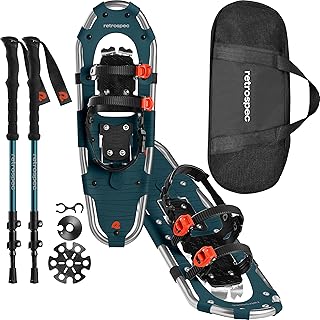
Retrospec Drifter Snowshoes
The Drifter packs surprising features into a sub-$70 price tag: a lightweight aluminum frame, double ratchet bindings, and heel lifts. On moderate snow, these shoes float well and the heel lifts reduce calf fatigue on gentle grades. It is the rare budget option that does not immediately compromise on the features that matter.
- Pros: Double ratchet bindings, heel lifts at a budget price
- Con: Aluminum frame flexes noticeably when loaded with a heavy pack
Skip this if you routinely carry more than 30 pounds in deep snow. Frame deflection under load will cost you flotation when you need it most.
Retrospec Drifter Snowshoes & Trekking Poles Bundle
This bundle adds adjustable poles to the Drifter platform at a combined price that undercuts buying them separately. For someone outfitting a full kit from scratch, the convenience and savings are real. The poles themselves are functional without being exceptional, and the snowshoe portion carries all the same strengths and limitations as the standalone Drifter.
- Pros: Complete kit at a low combined price, same solid Drifter platform
- Con: Poles are adequate rather than durable, likely to need upgrading
Skip this if you already own poles. The standalone Drifter gives you the same snowshoe for less money.
Franklin Sports Arctic Trails Snowshoes
For under $50, the Arctic Trails is the cheapest viable snowshoe in this roundup. It gets you above the snow on casual outings, and the lightweight aluminum frame keeps the pair manageable to carry. For someone who wants to try snowshoeing before committing real money, this is the lowest-risk entry point available.
- Pros: Lowest price in the category, light enough for casual use
- Con: Minimal traction elements, bindings loosen faster than premium options
Skip this if you encounter deep, wet snow regularly. The flotation and binding security will frustrate you on anything beyond easy terrain.
G2 Light Weight Snowshoes with Trekking Poles
The G2 stands out for offering four size options (21 through 36 inches), which means you can match deck length precisely to your load and conditions. The EVA padded bindings feel comfortable over long distances, and the heel lifts and toe box add functional polish. Included poles round out a complete package.
- Pros: Four size options ensure optimal flotation for different weights, padded bindings
- Con: Less brand recognition means harder to find replacement parts or resale value
Skip this if you want a name with an established service history or long-term parts availability.
Buying Guide
Deck Size and Flotation
Flotation is determined primarily by surface area, which means longer and wider decks keep you above deep snow. Match your deck to your total weight (body plus gear). If you regularly break through at the trailhead, your deck is too small. A rough guide: 21-22 inches suits most users on moderate snow, while 25-36 inch options handle deep, unconsolidated conditions with a loaded pack.
Binding System and Boot Retention
Deep snow is wet snow, and wet snow means bindings that slip. Double ratchet and strap-based systems outperform simple pin-and-tongue designs here. Look for bindings that can be adjusted with gloves on and that distribute pressure evenly across the boot. A binding that holds your boot rigidly will feel harsh on flats but keeps you connected when the terrain turns steep.
Frame Geometry and Sidehill Performance
Flat-bottomed snowshoes slide sideways on cross slopes. Aggressive side rails and crampon teeth bite into firm snow and reduce side-slip. If your routes include any traversing across a hill rather than straight uphill, prioritize frames with pronounced edge features. Heel lifts reduce calf strain on grades but add complexity that can fail in very cold conditions.
Our Verdict
The MSR Revo Trail is our top pick for hikers who want the best snowshoes for deep snow hiking without compromise. Its combination of flotation, binding quality, and frame efficiency is unmatched in this group. For budget buyers, the Retrospec Drifter for under $70 delivers features that cost three times more elsewhere. If you only need a snowshoe for occasional trail use with moderate pack weight, the MSR Evo Trail hits a better price-performance sweet spot and avoids paying for premium features you will not exploit.
FAQ
Do I need different snowshoes for wet snow versus powder?
Not fundamentally, but wet snow is heavier and denser, so it demands more flotation from the same deck area. Powder is lighter and less punishing to walk through. A pair sized correctly for your total weight in wet conditions will handle powder with ease.
How do I know if my snowshoes are the right size?
Stand still on untracked snow. If your boot sinks below the deck surface, the shoe is too small for your current weight and load. This is the simplest real-world flotation test that matters.
Are snowshoes with trekking pole bundles worth it?
For a complete first kit, yes. The combined price is usually lower than buying separately. For experienced users who already own poles they prefer, the bundle adds cost without adding value.
Can I use snowshoes for backcountry skiing?
Snowshoes are designed for walking, not gliding. They lack the narrow profile and kick-and-glide efficiency needed for ski travel. Use them for trail breaking or sidehill walking alongside your ski touring setup, but not as a ski substitute.