
Best portable air cooler searches spike every summer, but the right unit depends on where you will use it. Battery-powered mini air conditioners cool tents off-grid, while evaporative coolers work best in dry heat. This roundup compares five options by BTU output, weight, and runtime, plus how tariffs are shaping 2026 prices.
Our top picks


As an Amazon Associate we earn from qualifying purchases at no extra cost to you.
As an Amazon Associate we earn from qualifying purchases.
🛒 Best Price Today on Amazon
Prime members get fast, free shipping on everything above, plus member-only deals. New members get a 30-day free trial — cancel anytime.
How to Choose the Best Portable Air Cooler
Choosing the best portable air cooler comes down to your climate and power situation first, then cooling output, portability, and noise. Because these units rely on imported compressors and lithium batteries, 2025-2026 tariffs are nudging prices upward, so buying the right type once really matters
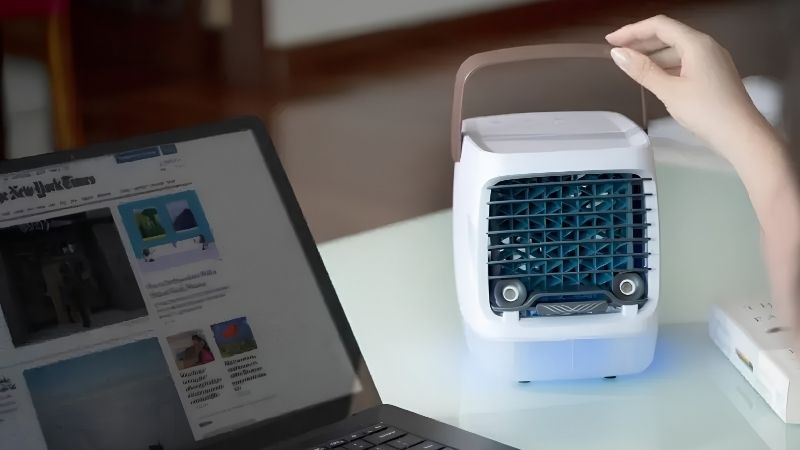
.Cooling Type: Air Conditioner vs Evaporative
Two very different technologies hide behind portable coolers. Compressor air conditioners actively refrigerate and lower temperature in any humidity, but draw more power and weigh more. Evaporative (swamp) coolers pass air over water, using little power but only working well in dry heat.
For humid regions or sealed tents, choose a compressor unit. For dry Southwest climates and open patios, an evaporative cooler delivers wide, cheap cooling. Matching the type to your weather is the single most important decision you will make here.
Sealing the space you cool makes any unit work harder for you. Close tent doors, drop RV shades, and block sun before running the cooler. A small, insulated space cools faster and holds temperature longer, which stretches battery runtime and lets a modest BTU unit punch above its weight.
Power Source and Runtime
Off-grid users need battery or solar power, while base campers with a generator or hookup can run plug-in units. Battery air conditioners typically deliver 3-8 hours per charge, so plan spare batteries or a power station for overnight cooling.
Check watt draw against your power bank’s output and capacity in watt-hours. A 2,300 BTU unit sipping around 240W is far easier to run off solar than a 4,000-plus BTU model that needs steady wall power all night.
If you already own a portable power station, size your cooler to it rather than the other way around. A 500-1000Wh station pairs well with a low-draw unit like the Zero Breeze, while a bigger AC needs a larger battery or generator to run through a full, hot night.
Cooling Power (BTU) and Coverage Area
BTU rating and rated square footage tell you how much space a unit can cool. Personal evaporative coolers only chill the air right in front of you, while 2,300-5,100 BTU units can take the edge off a small tent or room.
Bigger is not always better off-grid, since higher BTU means higher power draw. Size the cooling to the smallest space you actually need to cool, such as a sleeping area rather than an entire open shelter.
Rated square footage assumes decent insulation, so real-world coverage in a thin tent is lower. Plan for a unit rated a little above your space, then run it in eco mode. That combination cools reliably while sipping less power than blasting an undersized unit at full output.
Portability and Noise
Weight ranges from under 2 lb for a personal cooler to about 50 lb for a plug-in AC. Battery compressor units land in between at roughly 16-32 lb, carry-friendly but not featherweight, so factor in how far you will haul it.
Noise matters for sleeping. Compressor units run around 44-56 dB, similar to a quiet fan, while evaporative coolers vary with fan speed. Look for an eco or sleep mode if quiet nights are a priority at camp.
Think about setup, not just weight. Dual-hose units need window or tent-port routing and a spot for condensate, while personal coolers just need a flat surface and water. The easier a unit is to set up at dusk, the more likely you are to actually use it every night.
Top Picks for the Best Portable Air Cooler
These five picks for the best portable air cooler span personal, patio, and off-grid needs. The table compares cooling type, output, weight, and power source, and each review below notes who it suits along with one honest limitation.
| Model | Type | Cooling | Weight | Power |
|---|---|---|---|---|
| EcoFlow Wave 2 | Compressor AC | 5,100 BTU | ~32 lb | Battery/AC/solar |
| Zero Breeze Mark 2 | Compressor AC | 2,300 BTU | 16.5 lb | Battery/solar/car |
| Evapolar evaCHILL | Evaporative | Personal | ~1.7 lb | USB |
| Hessaire MC18M | Evaporative | Patio-scale | ~28 lb | AC (plug-in) |
| BLACK+DECKER AC | Compressor AC | Room-scale | ~50 lb | AC (plug-in) |
EcoFlow Wave 2 — Best for Tents and RVs
The EcoFlow Wave 2 is a compressor-based portable AC pushing about 5,100 BTU of cooling (and 6,100 BTU of heat), enough to noticeably drop the temperature in a small tent, RV, or room up to roughly 86 sq ft. With the add-on battery it runs up to eight hours in eco mode and recharges via wall, car, or solar. Check Price on Amazon
It weighs about 32 lb (14.5 kg) and hits 44-56 dB, so it is not truly pocketable and can be audible at full blast. As a genuine off-grid air conditioner, though, it is the most capable pick here for cooling a real sleeping space.
Zero Breeze Mark 2 — Best Ultra-Portable AC
At just 16.5 lb, the Zero Breeze Mark 2 is the most carry-friendly compressor AC on this list, delivering 2,300 BTU while drawing only about 240W. Its detachable 840Wh battery lasts roughly 3-5 hours and charges from solar, car, or wall, making it built for camping and van life. Check Price on Amazon
Coverage is limited to a small 25-40 sq ft space and battery runtime is short for all-night use without spares. For a compact, solar-friendly tent cooler, however, it is purpose-built and genuinely portable.
Evapolar evaCHILL — Best Personal Cooler
The evaCHILL is a tiny evaporative cooler weighing under 2 lb that runs off USB power and cools the air right in front of you. It is ideal for a desk, a camp chair, or a small tent vestibule in dry conditions, using water and a replaceable cartridge rather than a compressor. Check Price on Amazon
Because it is evaporative, it does little in humid climates and only cools your immediate personal space, not a room. As a quiet, low-power personal cooler, it fills a niche the big compressor units simply cannot.
Hessaire MC18M — Best for Dry-Climate Patios
The Hessaire MC18M is an evaporative swamp cooler that moves a large volume of air and can cool a patio, garage, or open shelter in dry heat. It plugs into AC power, holds several gallons of water, and covers a far larger area than personal units. Check Price on Amazon
It needs a power outlet, only works in low humidity, and is bulky to move around. For dry Southwest patios and open-air base camps with power, though, it delivers big cooling for the money.
BLACK+DECKER Portable AC — Best for Base Camp Power
This plug-in compressor unit brings true air-conditioning power to a base camp with shore power, an RV hookup, or a cabin, cooling a small room quickly. It rolls on casters and vents through a window kit, so it suits stationary setups rather than backcountry trips. Check Price on Amazon
It weighs around 50 lb and requires constant AC power, so it is not portable in the backpacking sense. Where an outlet is available, however, it is the most affordable way to get room-filling cooling.
Frequently Asked Questions
Still weighing options for the best portable air cooler? These answers cover the questions campers ask most about cooling types, runtime, and prices.
What is the best portable air cooler for tent camping?
For off-grid tents, a battery compressor AC like the Zero Breeze Mark 2 or EcoFlow Wave 2 actually lowers the temperature, unlike a fan. Evaporative coolers only help in dry climates, so match the cooling type to your typical weather before you buy.
Do evaporative coolers work in humid weather?
Not well. Evaporative (swamp) coolers add moisture to cool the air, so they lose effectiveness above roughly 50% humidity. In humid regions, a compressor-based portable AC is the far better choice for meaningful cooling.
How long will a battery portable cooler run?
Expect 3-5 hours from a single onboard battery on units like the Zero Breeze, or up to eight hours in eco mode on the EcoFlow Wave 2 with its add-on pack. Extra batteries or a solar generator extend runtime for overnight use.
Are portable air coolers getting more expensive?
Yes. These units rely on imported compressors, electronics, and lithium batteries, all exposed to 2025-2026 tariffs. Buying during summer clearance or a major sale event is the simplest way to offset the steadily rising prices.
See More:
Final Thoughts on the Best Portable Air Cooler
The best portable air cooler for you comes down to climate and power. In dry heat, an evaporative unit like the Hessaire cools a wide area cheaply; for humid nights or off-grid tents, a compressor model like the EcoFlow Wave 2 or Zero Breeze Mark 2 is worth the weight. With prices climbing under new tariffs, buying the right type on sale is the smartest move.




Write Your Review
No reviews yet. Be the first to share your experience!