
Key takeaways
Best rated swamp cooler lists rarely explain what the rating measures. Owner satisfaction over several seasons tracks pump reliability, pad media quality and how easily the unit is serviced far more closely than headline airflow. These five evaporative coolers are judged on those durability factors first.
Our top picks


As an Amazon Associate we earn from qualifying purchases at no extra cost to you.
As an Amazon Associate we earn from qualifying purchases.
By Jake Thompson, gear writer for Roger Bacon Outdoors.
🛒 Best Price Today on Amazon
Prime members get fast, free shipping on everything above, plus member-only deals. New members get a 30-day free trial — cancel anytime.
What the Best Rated Swamp Cooler Actually Gets Rated On
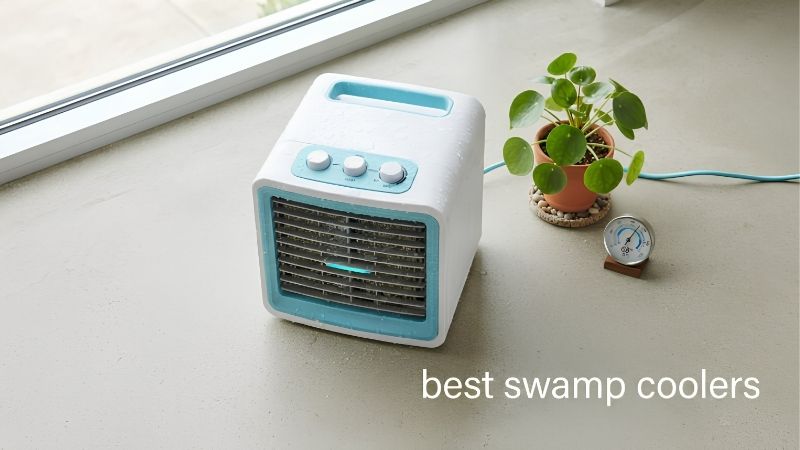
Airflow is the number on the box, but it is not what makes a best rated swamp cooler still work in year four. Three things do: the motor and pump driving it, the cabinet holding it together, and whether you can buy replacement pads and parts once hard water takes its toll on the media.
Motor and Pump Are the Failure Points
Evaporative coolers are simple machines with two moving systems, a fan motor and a small water pump, and the pump is almost always what fails first. Mineral scale from hard water clogs the distribution lines and the impeller, which is why weekly draining is specified in every manual in the category.
Motor construction separates the tiers. The Honeywell CO60PM uses a ball-bearing motor turning metal fan blades, which is a step above the sleeve-bearing arrangements common at the budget end. Ball bearings tolerate continuous running and outdoor dust far better across multiple summers of heavy use.
Cabinet Material and Frame Construction
Most portable units are moulded plastic. Hessaire uses lightweight ABS resin on the MC18M and polypropylene on the larger MC37M, both chosen to keep weight down and reduce vibration noise. Plastic resists corrosion from constant water contact, which is exactly the environment these cabinets live in.
Metal-framed units such as the 41-inch Uthfy trade weight for rigidity, which helps on rough shop floors and in wind. The trade-off is corrosion risk over years of standing water, so if you buy a metal-framed unit, drying it out fully before winter storage stops being optional.
Serviceability and Spare Parts
Rigid media is a consumable. Hessaire’s high-density XeL50 media provides around 80% more evaporation surface than standard-density pads according to the company, and Honeywell runs honeycomb media across three sides on its larger units. Both need rinsing and eventual replacement, especially in hard-water areas.
That makes parts availability a rating factor in itself, and it is often what separates a best rated swamp cooler from a cheaper rival. Established brands stock replacement pads, pumps and covers years after purchase; newer marketplace brands frequently do not. A unit that cannot be repaired in year three is not cheaper.
Best Rated Swamp Cooler Picks Judged on Durability
Five units, ranked here on construction and serviceability rather than airflow alone. Specifications are manufacturer-published. The best rated swamp cooler for a working shop is not the same machine as the one for a bedroom, so read the construction notes alongside the coverage figures below.
| Model | Airflow | Tank | Construction notes | Rated coverage |
|---|---|---|---|---|
| Honeywell CO60PM | 1,540 CFM | 15.9 gal | Ball-bearing motor, metal blades, copper inlet | approx. 850 sq ft |
| Hessaire MC37M | 3,100 CFM | 10.3 gal | Polypropylene body, 3-panel intake | 950 sq ft |
| Hessaire MC18M | 1,300 CFM | 4.8 gal | ABS resin, XeL50 rigid media, 16 lb | 500 sq ft |
| Honeywell CL30XC | 806 CFM | 7.9 gal | Detachable tank, washable carbon filter | approx. 320 sq ft indoors |
| Uthfy 41-inch | 4,800 CFM | 10.6 gal | Metal frame, 110-degree oscillation | Large open areas |
Honeywell CO60PM – Best Built for Continuous Running
This is the most robustly specified unit here. A ball-bearing motor drives metal fan blades, honeycomb media covers three sides, and a copper continuous water outlet with overflow protection feeds a 15.9-gallon tank. The service manual rates 1,540 CFM across roughly 850 square feet with 36 feet of throw.
Two cautions. Honeywell’s marketing pages quote considerably higher airflow and coverage than the manual, so plan around the lower figures. It is also heavy and bulky to reposition, and owners in dry states report the garage turning clammy after long unattended runs, which is the mechanism working correctly.
Hessaire MC37M – Best Serviceable Large Unit
The MC37M pairs 3,100 CFM with a 10.3-gallon reservoir and 950 square feet of rated coverage in a polypropylene cabinet. A three-panel intake feeds high-density media, oscillating louvers spread the air, and a hose connection permits unattended running through an entire working day.
Hessaire has been in air movement since 1996 and stocks pads, pumps and covers for its current range, which is the practical reason this one rates well over time. Downsides are ordinary rather than serious: the casters ship inside and need fitting, and control is by simple rotary dial only.
Hessaire MC18M – Most Durable Compact
Sixteen pounds, 20 x 10 x 28 inches, 1,300 CFM and a 4.8-gallon tank rated to 500 square feet. The ABS resin cabinet is deliberately lightweight and less brittle than older designs, and the XeL50 rigid media is the same high-density type used in the larger Hessaire units.
Two fan speeds on manual dials means fewer electronics to fail, which helps longevity but rules out timers and remote operation. The small tank empties in three to four hours of steady use, so a hose connection turns it from an afternoon appliance into a genuinely unattended one.
Honeywell CL30XC – Best Indoor Build
Designed for interior use, this one runs 806 CFM on 288 watts with a 7.9-gallon detachable tank, rated at roughly 320 square feet with cross-ventilation. A washable carbon dust filter, low water alarm, energy-saving timer and remote make it the most maintainable option for a room you occupy daily.
The detachable tank is the genuine durability advantage, since it can be lifted out, emptied and scrubbed properly rather than rinsed in place. Against that, indoor operation demands an open window, and the ice compartment provides a brief improvement rather than any sustained cooling benefit.
Uthfy 41-Inch – Most Rigid Frame
A metal frame, listed 4,800 CFM, a 10.6-gallon tank, three speeds and 110-degree oscillation make this the structural choice for yards, factory floors and large open shops where the smaller plastic units get knocked around or simply cannot move enough air to be felt at distance.
Long-term support is the weak spot. Replacement media and pump availability from newer marketplace brands is less certain across a five-year ownership window than with Hessaire or Honeywell. A metal frame also needs drying properly before storage, since standing water and steel are a poor combination.
Warranty Value, Tariffs and Peak-Season Pricing
Durability arguments carry more weight when replacement costs are rising, which is the situation facing anyone shopping for a best rated swamp cooler this season. Import duties have moved component pricing across the category, and late July sits at the annual peak for demand and backorders alike.
Component Costs Have Risen
Industry survey data indicates 84% of outdoor businesses expect to be affected by new tariffs, with costs up roughly 7.7% overall. Aluminium and steel duties land directly on frames, motors and fan assemblies, while specialised plastics and foams are reported up 10 to 15% over the same period.
Manufacturers have said openly that published prices are provisional while supply chains settle. In a category where the durable option already carries a premium, that narrows the gap: the cheap unit is less cheap than it was, and the repairable one looks better on a five-year view.
Peak Demand Means Backorders
Both Hessaire units above have shown as backordered at specialist retailers during the hottest weeks of summer, and that pattern repeats annually. When the unit you researched is unavailable, the temptation is to take whatever ships tomorrow, which is how people end up with the wrong capacity.
If you need cooling now, buy the correct size while it is in stock. If you can wait, September and October clearance is historically the cheapest window for this category, and availability recovers sharply once the weather turns and demand collapses across the whole market.
Repairability Is Worth More Than It Was
With inflation near 4.2% and an estimated tariff burden of about $1,600 per US household in 2026, buying a unit you can keep running matters more than shaving twenty dollars off the purchase. Replacement pads and a spare pump cost a fraction of a new cooler and extend service life by years.
Running cost reinforces the same conclusion. A 288-watt evaporative cooler draws far less than a window air conditioner covering similar floor area, and in a dry climate where the technology genuinely works, that difference compounds across every summer you keep the machine alive.
Frequently Asked Questions
These four questions come up most often once buyers start comparing durability rather than airflow. All assume a climate dry enough for evaporative cooling to function, since humidity determines outcomes far more than any construction difference between the models listed above.
What makes the best rated swamp cooler last longest?
Weekly draining and refilling to limit mineral scale, running the fan without water for about 30 minutes before storage so the media dries fully, and periodic rinsing of the pads. Hard water is the primary enemy, and the pump is almost always the first component to fail because of it.
How often do pads need replacing?
In soft-water areas rigid media can last several seasons with regular rinsing. In hard-water regions expect replacement every season or two. Budget for pads as a consumable in the same way you would filters for any other appliance, and check that your chosen brand actually stocks them.
Are metal-framed units more durable than plastic?
Structurally yes, but not automatically in this application. Plastic cabinets resist corrosion in constant water contact, which is the everyday condition inside a swamp cooler. Metal frames are more rigid and survive rough handling better, provided they are dried thoroughly before winter storage each year.
Does a bigger tank mean longer running?
Not proportionally, because larger tanks usually sit under larger fans that evaporate water faster. Most portables run three to four hours per fill regardless of size. The feature that genuinely solves refilling is a garden hose connection with a float valve, offered on several Hessaire and Honeywell models.
See More:
- Swamp Cooler Best Picks: 5 Top Evaporative Units Compared
- Best Rated Evaporative Cooler: 5 Picks Sized by CFM and Room
- Evaporative Cooler Best Uses: Where These Units Work Well
- Evaporative Air Cooler Best Features: 5 Top Units Compared
Final Thoughts
The best rated swamp cooler is the one still running in season four, which makes motor type, cabinet material and parts availability count for more than the airflow figure on the carton. The CO60PM is the most robustly built, the MC37M the most serviceable, the CL30XC the best indoors. Buy the right size, then maintain it.



Write Your Review
No reviews yet. Be the first to share your experience!