Key takeaways
- Inflatable walls: Fastest to install and inexpensive, but susceptible to punctures, UV degradation, and movement if the ground is uneven.
- Steel frames: A strong value for family pools. Powder coating and galvanization help resist rust, but scratches and trapped water can eventually expose the metal.
- Resin frames: Resistant to rust and often comfortable to touch, though joints and plastic components can crack after impact, freezing, or prolonged sun exposure.
- Rigid steel walls: The most substantial option short of an in-ground pool, but installation and liner replacement require more planning.
The best above ground pools for families are usually 18-foot round or 24-by-12-foot rectangular steel-frame pools: they offer enough room for several swimmers without the cost, maintenance, and installation demands of a permanent pool.
For most households, choose a corrosion-resistant steel-frame pool with a three-ply liner, a 1,500–2,500-gallon-per-hour filter pump, a removable entry ladder, and a cover. Smaller 12–15-foot pools suit younger children and tighter yards, while larger 24-foot models are better for families who expect to swim regularly rather than simply cool off.

INTEX Ultra XTR 18ft x 52in Round Above Ground Swimming Pool Set w/ Pump
Included for 'Best Above-Ground Pools for Families' as a relevant option in this category; details come from the product listing.
View on Amazon
INTEX Prism Frame 15ft x 48in Round Above Ground Swimming Pool Set w/Pump
Included for 'Best Above-Ground Pools for Families' as a relevant option in this category; details come from the product listing.
View on Amazon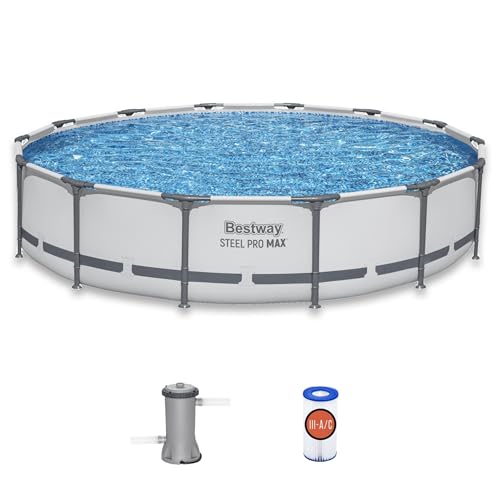
Bestway Steel Pro MAX 14' x 33" Round Above Ground Pool Set with Pump
Included for 'Best Above-Ground Pools for Families' as a relevant option in this category; details come from the product listing.
View on Amazon
Bestway: Power Steel - Rectangular Swimming Pool Set - 24' x 12' x 52", Above Ground, Tritech Construction, Filter Pump, Ladder & Cover, 7937 Gal.
Included for 'Best Above-Ground Pools for Families' because the listing specifies Rectangular Swimming Pool Set and 24' x 12' x 52", details this guide uses to compare options.
View on AmazonBest family above-ground pools by situation
| Family situation | Best pool type | Recommended size | Why it fits | Main compromise |
|---|---|---|---|---|
| Small yard or occasional use | Metal-frame round pool | 12–15 ft diameter, 30–36 in deep | Lower water volume, simpler setup, easier covering | Limited swimming space for adults |
| Two adults and children | Steel-frame round pool | 18 ft diameter, 48 in deep | Good balance of play area, price, and maintenance | Needs a level footprint of roughly 22 ft across |
| Frequent family swimming | Rectangular steel-frame pool | 24 x 12 ft, 48–52 in deep | More usable length and better separation for games | More water, leveling work, and cleaning |
| Very young children | Shallow inflatable or low-frame pool | 8–12 ft diameter, 20–30 in deep | Less water and easier entry under constant supervision | More vulnerable to punctures and outgrown quickly |
| Longest expected service life | Resin or galvanized steel wall pool | 18–24 ft round or equivalent | Rigid structure and better resistance to frame fatigue | Higher purchase cost and more involved installation |
Our top picks for different families
Best overall: an 18-foot steel-frame pool
An 18-foot round pool is the practical default for many families. It provides approximately 250 square feet of surface area and commonly holds around 6,000–8,000 gallons, depending on the water depth and fill line. That is enough for children to play and adults to cool off, although it is not large enough for several people to swim lengths.
Look for a powder-coated or galvanized steel frame, reinforced leg joints, a 48-inch wall height, and a pump rated around 1,500–2,500 gallons per hour. Intex Ultra XTR pools and Bestway Power Steel pools are established examples of this general category. Exact accessories and dimensions vary by model year, so check the included pump, ladder, cover, and liner before buying.
Best for frequent use: a 24-by-12-foot rectangular steel-frame pool
A rectangular pool makes better use of a long, narrow yard and gives families more distinct areas for play and relaxation. A 24-by-12-foot model has 288 square feet of surface area, roughly 15% more than an 18-foot round pool. Its straight sides also make it easier to place loungers, an exterior safety barrier, or a solar cover along the edge.
Expect approximately 8,000–12,000 gallons of water, depending on depth and the manufacturer’s maximum fill line. Choose a model with a stronger pump, ideally about 2,000–3,000 gallons per hour, and budget extra time for vacuuming the longer floor. A weak filter can leave dead spots where debris and algae accumulate.
Best for a tight budget: a 12- to 15-foot metal-frame pool
Small round pools generally cost less to fill, cover, heat, and maintain. They can be a sensible choice when the pool will be used mainly on hot afternoons rather than every day. The trade-off is family capacity: two or three children may have plenty of room, but several adults will make the pool feel crowded.
Many small pools use cartridge filtration and include a pump around 530–1,500 gallons per hour. These systems are adequate when the pool is covered between uses, but they require more frequent cartridge cleaning than a larger, higher-flow system.
Best for durability: a rigid-wall steel or resin pool
Rigid-wall pools use panels rather than a flexible liner supported entirely by a frame. Galvanized steel panels provide strength and a more permanent appearance; resin components resist rust and remain cooler to the touch than dark metal in direct sun. These pools can last longer than basic seasonal frame pools when installed correctly, but the ground preparation is less forgiving.
A rigid-wall pool may require a sand or compacted-base foundation, retaining hardware, and more assembly time. Do not treat it as a quick weekend purchase unless the site is already level and suitable. The liner is still a replaceable wear item, even when the wall structure remains sound.
What to compare before choosing
Size and usable capacity
Advertised diameter does not equal open swimming space. An 18-foot pool has a 9-foot radius, but the ladder, support legs, curved walls, and required clearance reduce usable room. As a rough planning rule, allow at least 3 feet of clear ground outside the pool and more on the ladder side. For an 18-foot round pool, plan on a level area approximately 22–24 feet wide.
Water volume also affects operating cost. A typical 18-foot pool holding 7,000 gallons uses about 58,400 pounds of water. That weight is why a pool should never be installed on a deck, balcony, sloped lawn, or improvised platform. Verify the manufacturer’s site requirements before filling.
Wall and frame materials
- Inflatable walls: Fastest to install and inexpensive, but susceptible to punctures, UV degradation, and movement if the ground is uneven.
- Steel frames: A strong value for family pools. Powder coating and galvanization help resist rust, but scratches and trapped water can eventually expose the metal.
- Resin frames: Resistant to rust and often comfortable to touch, though joints and plastic components can crack after impact, freezing, or prolonged sun exposure.
- Rigid steel walls: The most substantial option short of an in-ground pool, but installation and liner replacement require more planning.
Filter systems
Cartridge filters are common, compact, and easy to operate. Remove the cartridge, rinse it with a hose, and replace it when the pleats remain dirty or the flow stays weak after cleaning. Keep at least one spare cartridge so filtration is not interrupted.
Sand filters usually cost more initially but tolerate heavy family use and require less frequent element replacement. They are cleaned by backwashing, which uses additional water and needs a suitable discharge area. Whichever system you choose, compare the pump’s actual flow rate with the pool volume rather than choosing solely by horsepower.
A useful target is one complete turnover of the pool’s water every eight hours or less. For a 7,200-gallon pool, that requires an average of at least 900 gallons per hour. Because real flow drops through hoses, filters, and bends, a pump advertised at 1,500 gallons per hour gives more useful margin than one rated exactly at 900.
Safety features
Prioritize a locking or removable ladder, a fitted cover that cannot be mistaken for a load-bearing surface, stable frame connections, and a clear entry and exit area. A pool cover reduces debris but is not automatically a child-safety barrier; follow its load and installation instructions.
Pool alarms and perimeter fencing can add layers of protection, but they do not replace direct supervision. Keep chairs, toys, and ladders away from the pool when it is not in use. Local rules may require fencing, gates, electrical protection, or specific distances from property lines, so check them before installation.
Setup time and maintenance reality
A small inflatable pool may be ready in 30–90 minutes, excluding filling. A metal-frame pool commonly takes two adults 2–4 hours to assemble, followed by several hours of filling. Larger rectangular or rigid-wall pools can take a full day or longer, particularly when leveling the site.
The ground preparation is the step most likely to determine success. Remove grass, roots, stones, and sharp objects. Level by removing high spots rather than piling loose soil under the pool. A pool placed on an uneven base can develop liner stress, leaning walls, poor water circulation, or frame failure.
A manageable weekly routine
- Skim leaves and inspect the water each day the pool is used heavily.
- Test sanitizer and pH several times per week, especially after storms or large gatherings.
- Run the pump long enough to complete at least one turnover daily; increase runtime during hot weather or heavy use.
- Brush the walls and floor weekly, then vacuum settled debris.
- Clean the cartridge when pressure rises or return flow weakens.
- Check frame joints, ladder feet, hoses, and liner seams every week.
The first components commonly to wear are filter cartridges, flexible hoses, ladder caps, pump seals, and the liner around high-contact fittings. Store the pool dry and protected from rodents during the off-season, and never drag a folded liner across concrete or gravel.
Bottom line
Choose an 18-foot steel-frame pool for the best all-around family balance, a 24-by-12-foot rectangular model if frequent swimming and yard shape justify the extra work, and a 12- to 15-foot pool when budget or space is the limiting factor. Spend as much attention on a level installation area, adequate filtration, safe access control, and a realistic maintenance routine as on the pool itself; those decisions have more effect on ownership satisfaction than a small difference in wall height or included accessories.