Key takeaways
- Pro: Three port types cover nearly every device you carry on a weekend trip.
- Pro: IP67 rating is the highest practical waterproofing in this list.
- Con: The fold-out design is bulkier than thinner 40W panels when packed.
Every season I test a handful of foldable solar panels on the same loop: a three-day trip with no grid access, a mix of overcast and bright conditions, and a phone, tablet, and small power bank to charge along the way. The pattern is always the same. The spec sheet promises a number, but the real question is whether the panel still delivers when it is set on damp gravel, angled awkwardly against a rock, or caught in a 20-minute rain shower. Most budget panels pass a tabletop test and fail in the field.
What separates a genuinely useful camp panel from a disappointment is a small set of things: honest sustained output under partial sun, waterproofing that survives actual weather rather than a splash test, and enough port variety that you can run a phone, a tablet, and a power station without juggling three adapters. The best solar panels for camping solve these problems without adding unnecessary weight to your pack.
Our top picks




As an Amazon Associate we earn from qualifying purchases at no extra cost to you.
Quick Picks
| Product | Best for | Price |
|---|---|---|
| FlexSolar 100W IP67 | Compact emergency charging | under $90 |
| 300W Power Station + 60W Panel | All-in-one starter kit | under $200 |
| FlexSolar 40W Foldable | Ultralight day hikes | under $60 |
| ZOUPW 100W 23.5% Mono | Compatibility with popular stations | under $150 |
| 200W ETFE High Efficiency | Fast power station refills | under $200 |
| SOLUPUP 30W | Phone-and-cable simplicity | n/a |
| Renogy 200W N-Type | Balanced output and build quality | under $250 |
| SOKIOVOLA 200W N-Type IP68 | Wet and dusty conditions | under $200 |
How We Picked
We evaluated each panel on four criteria drawn from repeated field use. Sustained output under partial cloud cover matters more than peak rated wattage, because real camping days rarely deliver perfect noon sun. Build durability and waterproofing determine whether a panel survives a season of rain, grit, and being stuffed into a trunk. Port variety decides how much friction you encounter each time you plug in. And final weight-to-output ratio tells you whether you will actually carry it.
The 8 Best Solar Panels For Camping in 2026
1. FlexSolar 100W Foldable Portable Solar Panel Charger IP67 Waterproof
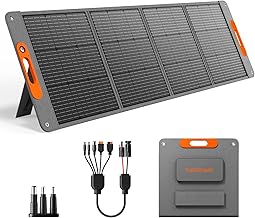
This is the panel you throw into a car trunk and forget about until an emergency. With PD3.0 USB-C, QC3.0 USB-A, and a DC port, it charges phones, power banks, and a small power station without extra adapters. IP67 means it shrugs off rain and brief submersion without drama. At 100W it produces enough juice to top a mid-size power bank in under two hours of good sun.
- Pro: Three port types cover nearly every device you carry on a weekend trip.
- Pro: IP67 rating is the highest practical waterproofing in this list.
- Con: The fold-out design is bulkier than thinner 40W panels when packed.
Skip it if you need to minimize pack weight for multi-day hikes.
2. Portable Solar Generator 300W Power Station with 60W Solar Panel
Not a standalone panel but a complete kit: a 280Wh battery with a bundled 60W panel and a 110V pure sine wave inverter. The value proposition is simplicity. You get AC outlets, DC, and USB in one unit, and the panel recharges it from daylight. For campers who want to run a small fridge or laptop without building a system from parts, this removes all the guesswork.
- Pro: One purchase gives you storage, conversion, and solar collection together.
- Pro: Pure sine wave output is safe for sensitive electronics.
- Con: The 60W panel is slow to refill the 280Wh battery; expect a full day or more in average sun.
Skip it if you already own a compatible power station and only need a panel.
3. FlexSolar 40W Foldable Solar Panel Charger
The lightest useful panel here. Forty watts sounds modest, but it is enough to keep a phone topped off, charge a power bank over a full sunny day, or slowly trickle a tablet. USB-C, USB-A, and DC outputs mean you are not tied to one connector. It folds small enough to clip to a pack or slide into a jacket pocket, making it a natural choice for hikers who carry little beyond a phone.
- Pro: Genuinely portable; you will not be tempted to leave it at home.
- Pro: Multiple output ports at a sub-$60 price point.
- Con: Too low-wattage to meaningfully charge a mid-size power station in a single day.
Skip it if your goal is running appliances or refilling large battery packs quickly.
4. ZOUPW 100W Portable Solar Panel for Power Station, 23.5% Efficiency
Rated at 23.5% mono efficiency and IP67 waterproofing, this panel slots neatly alongside Jackery 300, EcoFlow River, Anker, and Bluetti stations. That compatibility list is the real selling point: if you already own one of those, the connectors and voltage range will work without hunting for adapters. Build quality is solid with reinforced corners and a fold-out kickstand for angling toward the sun.
- Pro: Broad out-of-the-box compatibility with the most popular power station brands.
- Pro: Highest user rating in this group at 4.6 out of 5.
- Con: Slightly heavier than the FlexSolar 100W for the same output class.
Skip it if you need the lightest option and do not own a major-brand station yet.
5. 200W Portable Solar Panel for Power Station, 24% High Efficiency ETFE
ETFE laminate gives this panel better UV and abrasion resistance than standard PET-coated panels, which matters over a full season of repeated set-up and tear-down. At 200W with MC4 output plus Type-C 60W and QC3.0, it can refill a mid-size power station in roughly four to five hours of direct sun. IP65 keeps it safe from rain and spray, though it is not submersion-rated.
- Pro: MC4 output opens the door to wiring multiple panels in series.
- Pro: ETFE surface layer resists yellowing and scuffing far better than PET.
- Con: IP65 falls short of IP67 or IP68 if you camp in genuinely wet conditions.
Skip it if your trips regularly involve heavy rain or you plan to leave panels exposed overnight.
6. SOLUPUP 30W Portable Foldable Solar Charger
A dead-simple, phone-focused charger. Five-volt USB-A and USB-C fast charging with IPX5 water resistance mean it handles a light drizzle but not a downpour. The appeal is that there is almost nothing to think about: unfold it, plug in a cable, set it in the sun. It is ideal for car campers who want to keep a phone alive without managing power stations or voltage settings.
- Pro: Zero learning curve; any traveler can use it immediately.
- Pro: Ultra-compact folded size for gloveboxes and daypacks.
- Con: Only 30W and IPX5, so it is unsuitable for anything beyond small devices.
Skip it if you need more than a phone charge or camp in exposed, rainy terrain.
7. Renogy 200W Portable Solar Panel for Power Stations, 25% N-Type Efficiency
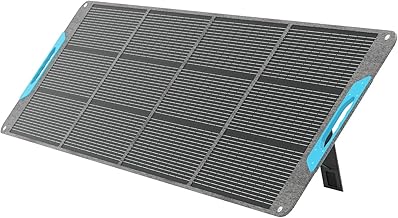
Renogy is one of the most trusted names in off-grid solar, and this panel shows why. N-type cells at 25% efficiency deliver the highest per-square-meter output in the group, and the built-in kickstand lets you adjust angle on uneven ground without improvising with rocks. USB-A and Type-C outputs handle direct device charging, while the panel connectors support power station input. For under $250 it is the priciest here, but the build feels correspondingly premium.
- Pro: Best-in-class cell efficiency means faster real-world charging under marginal sun.
- Pro: Integrated kickstand solves the angle problem without extra accessories.
- Con: Heaviest and costliest option; not a casual add-on.
Skip it if budget or pack weight is a hard constraint.
8. SOKIOVOLA N-Type 16BB 200W Portable Solar Panel
This panel pairs 25% N-Type efficiency with IP68 waterproofing, a combination that is rare at this price. IP68 means it can survive extended submersion, making it the right call for river camping, coastal trips, or anyone who has ever left a panel out through a nighttime storm. The 16-busbar cell design improves current collection under partial shade, a real benefit when trees or terrain block part of the array.
- Pro: Only IP68-rated panel in this list; unmatched for wet conditions.
- Pro: 16BB cells maintain better output when partially shaded than standard layouts.
- Con: Brand support and warranty infrastructure are less established than Renogy or FlexSolar.
Skip it if you prioritize brand reputation and long-term support over weather tolerance.
Buying Guide
Actual Output vs. Rated Wattage
A panel labeled 100W rarely delivers 100W in the field. Expect 70 to 80% of rated output under clear noon sun, and 30 to 50% under thin cloud cover or at non-optimal angles. Cell efficiency is the number that matters more than raw wattage: N-Type and mono PERC cells at 23 to 25% will outperform older poly designs at the same nameplate. When comparing two panels at the same rated wattage, the one with higher efficiency will charge your devices faster in the imperfect conditions you will actually encounter.
Waterproofing Ratings That Actually Matter
IP65 handles rain and spray. IP67 survives brief submersion. IP68 tolerates longer water exposure. For campers, IP67 is the practical sweet spot: it covers everything short of leaving a panel floating in a stream. IPX5 on a budget panel means a light shower is fine but a storm will kill it. If you camp near water, fish, or hike where storms roll in fast, spend the extra for a higher rating. It is the single most common failure mode we see in long-term user reports.
Port Variety and Device Compatibility
A DC barrel or MC4 output is what powers a standalone panel-to-station connection. USB-C PD and USB-A QC ports let you charge phones and tablets directly without a battery in between. If your setup is just a power bank and a phone, prioritize panels with USB-C PD and high QC wattage. If you are feeding a Jackery, EcoFlow, or Bluetti, confirm the panel voltage range matches your station’s input spec before buying.
Our Verdict
The ZOUPW 100W takes our top pick. It balances the highest user rating in the group with broad brand compatibility, IP67 waterproofing, and a fair price. For the best solar panels for camping on a tight budget, the FlexSolar 40W for under $55 is the easiest call; it is light, versatile enough for phones and small banks, and folds into almost any pack. And if your trips consistently involve heavy rain, river crossings, or overnight exposure to storms, the SOKIOVOLA 200W with its IP68 rating will outlast everything else in this list under those conditions.
FAQ
Can a solar panel charge my phone directly?
Yes, any panel with a USB output can charge a phone, but the rate depends on port wattage. USB-C PD at 18W or higher charges a modern phone at near-wall-adapter speed. A basic 5V USB port will trickle charge and may stall if the phone screen is on.
How long does it take a 100W panel to charge a power station?
Under strong direct sun, a 100W panel will refill a 300Wh station in roughly three to four hours. In typical camping conditions with some cloud or suboptimal angle, expect five to seven hours. Higher-efficiency panels close that gap because they capture more energy per square foot.
Do foldable solar panels need to face the sun directly?
They work at an angle, but output drops sharply as the sun moves off perpendicular to the panel surface. A built-in kickstand or propping the panel on a bag to catch mid-morning or late-afternoon sun can make a meaningful difference over a full day of charging.
Is IP67 waterproofing really necessary for camping?
For most campers, yes. Dew, sudden showers, wet ground contact, and accidental splashes are routine outdoors. A panel rated only IPX5 or not rated at all will degrade faster and fail sooner. The cost difference between IP67 and IP65 is usually under fifteen dollars, and it pays for itself over two seasons.
Part of our camping buying guide hub.