
Best portable gas grill for camping turns a bare campsite into an open-air kitchen, searing burgers without the mess of charcoal or the wait for coals. The best portable gas grill for camping balances real BTU output with a packable footprint, so you get even heat, fast push-button starts, and enough cooking area to feed the site from the trunk.
Our top picks


As an Amazon Associate we earn from qualifying purchases at no extra cost to you.
As an Amazon Associate we earn from qualifying purchases.
🛒 Best Price Today on Amazon
Prime members get fast, free shipping on everything above, plus member-only deals. New members get a 30-day free trial — cancel anytime.
Start 30-Day Prime Free Trial →See Today’s Amazon DealsHow to Choose the Right Best Portable Gas Grill for Camping
Picking the best portable gas grill for camping comes down to matching heat, capacity, and portability to how you camp. A solo car-camper and a tailgating crew of eight want very different grills, so the four factors below help you buy the right size and power the first time.
Power and BTU Output
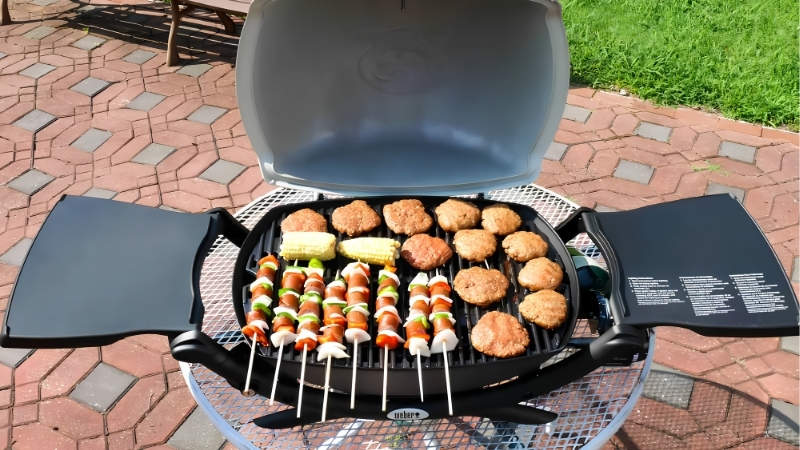
BTU rating tells you how much heat a grill can produce, but more isn’t always better. A compact single-burner like the Weber Q1200 puts out 8,500 BTU across 189 square inches and sears beautifully, while the three-burner Coleman RoadTrip 285 pushes 20,000 BTU for a big crowd.
What matters more is how evenly that heat spreads. The Weber Traveler proves the point, delivering steady, consistent temperatures on just 13,000 BTU thanks to a U-shaped burner, outcooking higher-BTU rivals with hot spots.
Cooking Area and Capacity
Measure cooking space in burgers, not square inches alone. Around 145 square inches handles six burgers for a couple, 225 to 285 square inches feeds a family or small group, and 320 square inches covers a full campsite crew without cooking in shifts.
Be honest about your typical group. A grab-and-go grill like the 146-square-inch Cuisinart Grillster is perfect for two, but frustrating if you regularly cook for six, so size up if your camp meals are a group affair.
Portability and Setup
Portability splits into tabletop and stand-up designs. Tabletop grills are lighter and pack small but need a picnic table or tailgate, while stand-up models like the RoadTrip series bring their own folding legs and wheels at the cost of extra weight.
Setup speed matters at camp after a long drive. Push-button electronic ignition, like Weber’s igniter or Coleman’s InstaStart, lights the burner on the first press with no matches, so you’re cooking within minutes of arriving.
Timing Your Purchase in 2026
There is a real reason to buy sooner this year. Grill bodies, grates, and burners are built from steel, cast iron, and aluminum, and new tariffs on those metals have pushed costs up across the category, with an industry survey pointing to roughly a 7.7% average increase. Most brands now describe future pricing as an estimate rather than a promise.
Demand adds pressure on top of price. Portable grills sell hardest through grilling season and into fall tailgating, so early-season inventory is deepest and the model and color you want are far more likely to be in stock before the summer rush thins the shelves.
The smart play is to lock your pick before the next round of increases and the seasonal run on stock. Buying a proven grill now, rather than waiting and gambling on price and availability, is the surest way to have it ready for your very first trip of the season.
Top Picks for the Best Portable Gas Grill for Camping
These six grills span grab-and-go tabletops to wheeled stand-up units, so the best portable gas grill for camping in your setup is here somewhere. Each pick names a genuine drawback so you know the trade-off before you buy.
| Product | BTU | Cooking Area | Type | Best For |
|---|---|---|---|---|
| Weber Q1200 | 8,500 | 189 sq in | Tabletop | Best overall |
| Coleman RoadTrip 285 | 20,000 | 285 sq in | Stand-up | Groups |
| Cuisinart Grillster | 8,000 | 146 sq in | Tabletop | Grab-and-go |
| Weber Traveler | 13,000 | 320 sq in | Folding cart | Even cooking |
| Char-Broil Grill2Go X200 | ~9,500 | ~200 sq in | Tabletop | Rugged trips |
| Coleman RoadTrip 225 | 11,000 | 225 sq in | Stand-up | Compact wheels |
Weber Q1200 (Best Overall)
The Q1200 is the pick for most campers. Its porcelain-enameled cast-iron grates deliver even heat and real sear marks, the electronic ignition lights on the first push, a built-in thermometer takes the guesswork out, and it runs off a simple 1-pound propane canister. It’s compact enough to slot into most trunks.
The catch is that it’s a tabletop grill with no legs, so you need a table or tailgate, and its single burner limits two-zone cooking. For a couple or small family that wants big-grill results, though, nothing here matches it, and it doubles as a compact patio grill between camping trips.
Coleman RoadTrip 285 (Best for Groups)
When you’re feeding a crowd, the RoadTrip 285 is built for it: three independent burners, 20,000 total BTU, and 285 square inches on a stand that folds out to full height with wheels for easy rolling around camp. The three-burner layout gives you real temperature control across the surface.
It’s heavy and bulky, and the cast-iron grate can cause food to stick even when preheated. For group camping and tailgating where power and capacity rule, that heft is a fair trade.
Cuisinart Grillster (Best Grab-and-Go)
The Grillster is the definition of spontaneous grilling. At just 10 pounds with zero assembly, you connect a propane canister and cook within five minutes, and its 8,000 BTU burner clears 600 degrees for a proper sear on its 146-square-inch grate that fits about six burgers.
That small surface is the limitation; it handles two but not six, and like other tabletops it needs a surface to sit on. For minimalist or last-minute outings, it’s a standout.
Weber Traveler (Best for Even Cooking)
The Traveler shows that BTU isn’t everything. Its U-shaped burner and 13,000 BTU heat 320 square inches quickly and hold a steady, even temperature across the whole surface, and the porcelain-enameled cast-iron grate wipes clean easily. It folds down onto a wheeled cart for transport.
It sits at the premium end of the price range and is a genuine two-handed lift when folded. For campers who prioritize consistent, hassle-free cooking, it earns the spend.
Char-Broil Grill2Go X200 (Best for Rugged Trips)
The Grill2Go X200 uses TRU-Infrared technology and a cast-aluminum firebox to fight flare-ups and cook evenly on roughly 200 square inches, all in a durable, lidded package around 20 pounds that runs off a 1-pound canister and shrugs off rough handling.
Infrared cooking has a slight learning curve and the surface is on the smaller side for big groups. For campers who want a tough, flare-resistant grill that travels well, even on rough back-country roads, it’s a reliable choice.
Coleman RoadTrip 225 (Best Compact Stand-Up)
The RoadTrip 225 brings stand-up convenience in a smaller package: 11,000 BTU across 225 square inches, InstaStart push-button ignition, a porcelain-coated grate, and a collapsible stand with wheels, running up to two hours on high from a single 16.4-ounce canister.
Its single burner offers less heat control than the three-burner 285, and it’s still a stand-up unit to transport. For a solo camper or couple who wants legs and wheels without the extra bulk, it hits the mark nicely.
Frequently Asked Questions
Quick answers to the questions campers ask most when choosing the best portable gas grill for camping.
Is a gas or charcoal grill better for camping?
Gas is faster to set up, easier to control, and cleaner, with no coals to light or ash to dispose of, which makes it the better choice when you move campsites often or cook quickly. Charcoal delivers a smokier flavor many enthusiasts prefer, but it’s slower and messier for on-the-go camp cooking.
How many BTU do I need in a camping grill?
Look for at least 8,000 BTU for effective grilling; that’s enough to sear on a compact tabletop model. Larger stand-up grills reach 20,000 BTU for feeding groups. Even heat distribution matters as much as raw BTU, so a well-designed 13,000-BTU grill can outcook a hotter one with hot spots.
Can I use a gas grill at campgrounds during a fire ban?
Usually yes. Most campgrounds permit propane gas grills even when open fires and charcoal are banned, because a gas flame can be shut off instantly. Rules vary by location and severity, though, so always confirm local fire restrictions before your trip rather than assuming your grill is allowed.
How long does a 1-pound propane tank last?
A standard 1-pound propane canister typically powers a portable grill for two to four hours depending on BTU output and how high you cook. That’s plenty for several rounds of burgers or a family dinner. For longer trips, pack spares or use an adapter hose to run a larger refillable tank for uninterrupted cooking.
See More:
- best wine cooler drinks
- best cooler for boat
- best cooler for boating
- best lunch box cooler
- best cooler for boats
Final Thoughts
The best portable gas grill for camping matches BTU power and cooking area to your group while staying packable enough to travel, from the do-it-all Weber Q1200 to the crowd-feeding RoadTrip 285. With metal-driven prices climbing and grilling season demand ahead, choosing a proven grill now is the surest way to have hot, even meals ready at your very first campsite.





Write Your Review
No reviews yet. Be the first to share your experience!