
Key takeaways
Best image stabilization binoculars differ less in optics than in the engineering that steadies the view, and understanding that tech is the key to buying well. The best image stabilization binoculars use one of three systems, optical prism, gyro gimbal, or sensor-driven OIS, each with its own strengths in correction and battery draw.
As an Amazon Associate we earn from qualifying purchases.
🛒 Best Price Today on Amazon
Prime members get fast, free shipping on everything above, plus member-only deals. New members get a 30-day free trial — cancel anytime.
Start 30-Day Prime Free Trial →See Today’s Amazon DealsHow to Choose the Right Best Image Stabilization Binoculars
Choosing the best image stabilization binoculars is really about choosing a stabilization technology and how it fits your use. The four factors below explain the systems, what correction angle means, and how power and reliability differ, so you buy the mechanism that suits your viewing, not just a brand name.
The Three Stabilization Systems
Canon’s optical Vari-Angle Prism uses gyro sensors and microprocessors to flex a fluid-filled prism, canceling shake smoothly and precisely; it’s the most refined system and feels the most natural in the hand for general use.
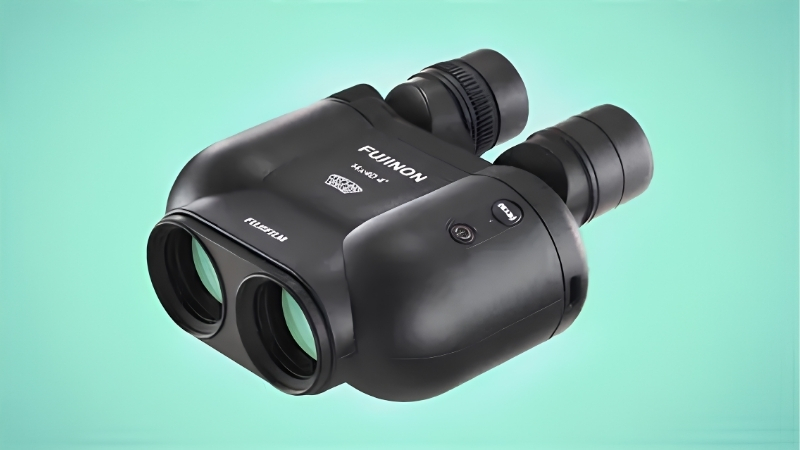
Fujinon takes a mechanical route with a dual-gimbaled prism driven by piezo gyro sensors, delivering the widest correction of any consumer system. Sig Sauer and Kite use sensor-driven optical image stabilization that responds fast and sips less power, a middle path between the two.
Correction Angle Explained
Correction angle is how much movement a system can cancel, and it’s where the technologies diverge most. Fujinon’s gimbal manages a class-leading 5 to 6 degrees, ideal for a pitching boat, while Canon’s high-end optical system corrects a tighter but very smooth range around 0.7 degrees.
More degrees isn’t always better in practice. Kite’s APC corrects about 2 degrees but responds so fast and smoothly that reviewers judged its real-world steadiness comparable to Canon’s premium system, proving that response speed matters as much as raw correction angle. That nuance is why spec-sheet degrees alone never tell the full stabilization story.
Power System and Reliability
Every system needs power, and how it’s fed shapes the experience. Optical OIS units like Kite’s APC and Sig’s Zulu6 run an efficient 40 to 60 hours on two AA cells, while gyro Fujinons draw more, needing four AA for about 8 to 10 hours of heavy correction.
Charging is evolving. Fujinon’s newer Techno-Stabi TS-L series adds USB-C charging with around 30 hours of runtime, a welcome modern touch, while cold weather still cuts every system’s endurance, so lithium cells and spares remain essential in winter. Plan your power around the coldest day you’ll face, not the mildest.
Timing Your Purchase in 2026
There is a real reason to buy sooner this year. Image stabilization binoculars are dense with imported electronics, gyro sensors, microprocessors, and precision optics, exactly the components most exposed to new tariffs. The wider outdoor category has risen roughly 7.7% on average, with technical parts climbing more.
Because supply chains and tariffs remain in flux, nearly every brand now calls future pricing an estimate rather than a firm number. On optics that already run into the hundreds or thousands, even a modest percentage increase is meaningful, so securing the system you want now can beat the next adjustment.
Sale timing helps as well. These pricey optics see their best discounts around October deal events and late-November sales, when demand and inventory align in the buyer’s favor. Watching those windows, instead of paying full price at peak season, is the smartest way to land advanced stabilization technology for less.
Top Picks for the Best Image Stabilization Binoculars
Grouped by the technology inside, these best image stabilization binoculars let you buy the mechanism that fits your viewing. Each entry names a genuine drawback so the trade-off is clear before you commit.
| Product | System | Correction | Power | Best For |
|---|---|---|---|---|
| Canon 10×42 L IS WP | Optical prism | Smooth, precise | 1 AA | Refined optics |
| Canon 10×30 IS II | Optical prism | Smooth | 1 AA, 9-12 hr | Everyday value |
| Fujinon Techno-Stabi TS-X 1440 | Gyro gimbal | ±5-6° | 4 AA, 8-10 hr | Widest correction |
| Fujinon Techno-Stabi TS-L 2040 | Gyro gimbal | ±5-6° | USB-C, ~30 hr | Modern charging |
| Kite APC 12×42 | Optical OIS | ±2° fast | 2 AA, ~60 hr | Efficient power |
| Sig Sauer Zulu6 16×42 | Optical OIS | Fast response | 2 AA, ~40 hr | Long-range |
Canon 10×42 L IS WP (Most Refined System)
The Canon 10×42 L IS WP showcases optical stabilization at its best. Its Vari-Angle Prism, driven by gyro sensors and microprocessors, cancels shake so smoothly the view feels natural rather than artificially locked, and L-series glass with full waterproofing makes it a technology showcase.
That refinement comes at 853 grams and a premium price, with battery life that suffers badly in deep cold. For viewers who want the most natural-feeling optical stabilization, it’s the standout, and the smoothness shows most when panning slowly across a landscape or tracking a soaring bird.
Canon 10×30 IS II (Best Everyday System)
The 10×30 IS II brings the same proven Vari-Angle Prism technology to a lighter, cheaper body. It delivers edge-to-edge sharpness with smooth optical correction, runs 9 to 12 hours on a single AA, and is easy to recommend as a first stabilized pair.
It has no water resistance, limiting it to fair weather. For a proven optical system at an accessible price, though, it’s the everyday benchmark, and the pair most people should try first before deciding they need more.
Fujinon Techno-Stabi TS-X 1440 (Widest Correction)
The Fujinon TS-X 1440 demonstrates gyro-gimbal stabilization’s greatest strength: a class-leading 5 to 6 degrees of correction that no optical system approaches. On a heaving deck it holds subjects rock-steady, and its IPX7 body handles the harshest marine conditions.
The mechanical system is power-hungry, needing four AA cells for only 8 to 10 hours, and it’s heavy. For the widest correction angle available, though, it’s unrivaled, keeping a distant subject centred on a pitching deck rather than bouncing away.
Fujinon Techno-Stabi TS-L 2040 (Best Modern Charging)
The newer TS-L 2040 modernizes the gyro approach with USB-C charging, around 30 hours of runtime, ED glass, and IPX7 sealing in a lighter roughly 850-gram body, with early reviews calling it optically competitive with Canon’s 18×50 IS.
It’s a premium purchase and still substantial to hold at 20x. For viewers who want wide gyro correction plus convenient rechargeable power, it’s a compelling step forward.
Kite APC 12×42 (Best Efficient Power)
The Kite APC proves response speed can rival raw correction. Its optical OIS corrects about 2 degrees but reacts so fast and smoothly that reviewers rated its steadiness alongside Canon’s premium system, all while running an exceptional 60 hours on two AA with IPX7 sealing.
It lacks the optical prestige of Canon’s L-series and sits at a mid-to-premium price. For efficient, long-running stabilization, it’s a technology bargain.
Sig Sauer Zulu6 16×42 (Best for Long-Range)
The Zulu6 16×42 pairs fast optical image stabilization with real reach, taming 16x for handheld long-range glassing. It’s IPX7 waterproof, delivers about 40 hours on two AA, and its efficient system makes high magnification genuinely usable in the field.
The narrow exit pupil at 16x dims low-light views and it’s premium-priced. For long-range observation with responsive stabilization, it’s a strong pick, and its efficient system outlasts most gyro rivals over a long day in the field.
Frequently Asked Questions
Quick answers to the questions buyers ask most about the best image stabilization binoculars and how they work.
What are the types of binocular image stabilization?
There are three main systems. Canon’s optical Vari-Angle Prism uses gyro sensors to flex a fluid prism for smooth correction; Fujinon’s gyro gimbal mechanically steadies the prism for the widest correction angle; and Sig and Kite use sensor-driven optical image stabilization that responds fast and draws less power. Each suits different priorities.
Does a higher correction angle mean better stabilization?
Not always. Fujinon’s 5 to 6 degrees is unmatched for boats, but response speed matters as much as raw range. Kite’s APC corrects only about 2 degrees yet reviewers judged its real-world steadiness comparable to Canon’s premium system because it reacts so fast and smoothly. Match correction angle to how much movement you face.
How does stabilization affect battery life?
Significantly, and it varies by system. Efficient optical OIS units like Kite’s APC run around 60 hours on two AA, while power-hungry gyro Fujinons manage only 8 to 10 on four cells. Newer models add USB-C charging with about 30 hours. Cold weather cuts all of these, so carry lithium spares.
Is optical or gyro stabilization better?
It depends on use. Optical prism systems feel the most natural and are lighter and more efficient, ideal for general viewing and long days. Gyro gimbal systems offer far wider correction for extreme motion like rough seas, at the cost of weight and battery life. Choose optical for versatility, gyro for marine use.
See More:
- best wine cooler drinks
- best cooler for boat
- best cooler for boating
- best lunch box cooler
- best cooler for boats
Final Thoughts
The best image stabilization binoculars come down to the technology that fits your viewing: smooth optical prisms like Canon’s for versatility, wide-correction gyro gimbals like Fujinon’s for marine use, or fast, efficient OIS from Kite and Sig for long days. With imported-electronics prices climbing on tariffs, choosing the right stabilization system now is the smartest long-term buy.
Our top picks


As an Amazon Associate we earn from qualifying purchases at no extra cost to you.




Write Your Review
No reviews yet. Be the first to share your experience!