Key takeaways
- Pros: Unmatched coverage area; thick cushioning that resists packing out even under repeated heavy drops.
- Cons: Notoriously difficult to pack into a tight spot between two boulders due to its sheer size.
Bouldering without a crash pad is a gamble you eventually lose. The ground does not forgive, and the difference between a bruised ankle and a fractured calcaneus often comes down to the four inches of foam beneath you. We spent weeks testing best bouldering crash pads across indoor gym sessions, outdoor rock trips, and everything in between, evaluating how they absorb impact, how they pack into a tight landing zone on uneven terrain, and how they hold up after repeated hauling.
What separates a great pad from a mediocre one is rarely obvious on a spec sheet. Dense open-cell foam that feels firm on day one can pack out flat by day thirty, turning what was once reliable protection into a thin carpet. Cheap vinyl covers crack after a single winter. A pad that looks enormous in the product photo can fold into a shape that refuses to conform to a sloping slab. We compared for all of it — coverage, cushioning longevity, portability, and real-world durability.
Our top picks




As an Amazon Associate we earn from qualifying purchases at no extra cost to you.
Quick Picks
| Product | Best For | Price |
|---|---|---|
| Meister Boulder Beast XL | Maximum coverage | $349 |
| VEVOR Bi-Fold (4×3 ft) | Tight budget | under $150 |
| Metolius Session Pad II | All-around outdoor bouldering | under $250 |
| Tri-Fold Supplemental Pad | Fill-in coverage for gaps | under $300 |
| VEVOR Tri-Fold (6×4 ft) | Not recommended | under $300 |
| Metolius Session II (Rust/Black) | Versatile indoor/outdoor use | under $250 |
| Escape Climbing Crash Pad Couch | Gym comfort and van life | under $150 |
| Asana Focus Crash Pad | Dual-density foam performance | under $200 |
How We Picked
We evaluated every pad on four criteria: landing area coverage relative to fold configuration (can it wrap around a boulder or fill a tight gap?), cushioning quality measured by foam density and layering consistency over repeated impacts, portability via weight, strap ergonomics, and packed size, and build durability including stitching, fabric abrasion resistance, and zipper quality. A pad that excels at one but fails at another was ranked lower than a balanced option.
The 8 Best Bouldering Crash Pads in 2026
Meister Boulder Beast XL Tri-Fold
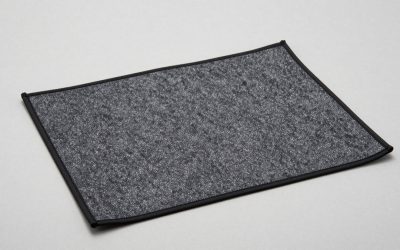
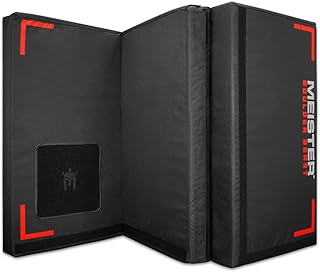
This is the pad you bring when the landing zone is sketchy and you need every square inch you can get. The oversized 72 by 44 inch deck covers more ground than anything else we compared, and the 5-inch multi-layer cushioning swallowed falls from height without bottoming out. The built-in shoe cleaning carpet is a small luxury that adds up over a long session.
- Pros: Unmatched coverage area; thick cushioning that resists packing out even under repeated heavy drops.
- Cons: Notoriously difficult to pack into a tight spot between two boulders due to its sheer size.
Skip it if your projects have constrained landings where a smaller pad can fold into a gap. The Beast XL is a slab crusher, not a precision tool.
VEVOR Bouldering Crash Pad (Bi-Fold)
At just over $120, this is the cheapest functional landing pad we compared, and it fills a niche for beginners who are unsure whether bouldering will become a long-term habit. The 4 by 3 foot coverage is adequate for low-volume indoor walls or short outdoor hops.
- Pros: Exceptional value for a starter pad; lightweight enough to carry to a local gym without a dedicated pack.
- Cons: Cushioning thins noticeably after moderate use, and the fabric shows wear at fold points quickly.
If you are climbing hard moves over anything above waist height outdoors, this pad does not inspire confidence. It is a training tool, not a safety system for serious beta.
Metolius Session Pad II
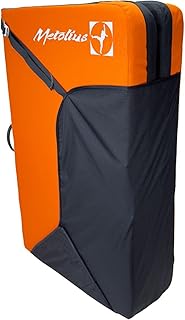
Metolius has built its reputation on outdoor bouldering gear, and the Session II is the pad they are known for. It folds into a manageable package while still delivering generous coverage, and the multi-density foam construction handles both flat-ground and sloped landings well. This is the pad most likely to appear in a crag bag on any given weekend.
- Pros: Proven design refined over multiple iterations; excellent balance between portability and coverage.
- Cons: Price is standard for its class, meaning you are paying a small premium over lesser-known brands with comparable specs.
No major skip conditions apply unless your budget is under $150, in which case the bi-fold VEVOR serves as a temporary stand-in.
Tri-Fold Supplemental Crash Pad
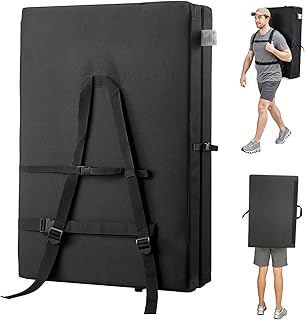
Marketed explicitly as a supplemental pad, this tri-fold at 39 by 24 by 12 inches folded is designed to fill gaps between your main pad and an obstacle. It does that job well. The adjustable backpack straps make it easy to carry on top of a larger pad already on your back.
- Pros: Niche function executed cleanly; folds compact enough to stash in a gap that a full-size pad cannot reach.
- Cons: Not sufficient as a standalone pad for most outdoor projects — it is genuinely supplemental.
Do not buy this as your only pad. Pair it with a main session pad and it becomes one of the most practical additions to your kit.
VEVOR Tri-Fold (6×4 ft)
We include this listing for honesty’s sake. The coverage area on paper looks competitive, but at a one-out-of-five aggregate rating, buyer reports point to serious quality control problems: zipper failures, inconsistent foam density, and straps that detach under load. The $259 price places it in premium territory where these defects are unacceptable.
- Pros: Large listed dimensions.
- Cons: Widespread reliability complaints; poor foam consistency across units.
Skip this entirely. The money buys better options from brands with verified quality control. A crash pad that fails under you is worse than no pad at all.
Metolius Session II (Rust/Black, One Size)
This is the same core platform as the standard Session Pad II above, and it shares its strengths — proven geometry, reliable cushioning, and Metolius build quality. The Rust/Black colorway is a low-visibility choice that resists looking dirty after a summer of sandbag landings.
- Pros: Durable exterior fabric that hides dirt and abrasion marks well; solid suspension system.
- Cons: One-size-only option limits flexibility for climbers who want a smaller profile for tight outdoor pockets.
Choose the standard listing if you want additional color options; pick this one if you want the stealthiest-looking pad on the crag.
Escape Climbing Crash Pad Couch
This is not a landing pad in the traditional sense. The Escape Climbing frame converts your existing crash pad into a lounge couch, which makes it a comfort and recovery tool rather than a safety tool. For gym sessions where you are projecting one route for two hours, or for van life setups where floor space is precious, it changes the experience entirely.
- Pros: Transforms a pad you already own into a seated rest area; compact frame stores easily.
- Cons: Zero protection value on its own — it is an accessory, not a crash pad substitute.
Do not buy this expecting a bouldering pad. Buy it as a comfort upgrade once you already own a reliable landing system.
Asana Focus Crash Pad
The dual-density foam layering with open-cell and closed-cell construction is the headline feature here, and it delivers on what you would expect: firm base support with a softer top layer for initial impact absorption. The deluxe suspension system distributes weight effectively when hauling, and the metal cam buckles feel noticeably more robust than plastic alternatives at this price.
- Pros: Dual-density foam is a rare feature in this price bracket; metal hardware elevates perceived durability.
- Cons: Slightly heavier than the Metolius Session, which matters on long approaches.
The 2026 market is full of single-density pads that feel good on day one and flat by month three. The Asana Focus is a smart buy for anyone who wants foam engineering over brand recognition at a sub-$200 price.
Buying Guide
Foam Construction and Density
Single-density foam is the default at lower price points, and it is fine for short falls on flat ground. Multi-density and dual-density constructions layer a firmer core beneath a softer top, which means the pad absorbs the initial shock while the base prevents bottoming out. Closed-cell foam resists water absorption and packing out over time; open-cell foam is softer on impact but compresses faster. If you climb outdoors regularly, prioritize a pad with at least one closed-cell layer.
Coverage Area and Fold Geometry
A larger landing surface is not always better. A bi-fold pad wraps more easily around irregular rock features, while a tri-fold can create a stepped configuration for sloping ground. The real question is whether the pad’s unfolded dimensions and fold points let you place it so the landing zone is continuous, with no gaps at the edges. Always imagine the specific landing you will face before buying on square footage alone.
Portability and Strap Systems
Adjustable backpack straps are essential for any outdoor use. Look for padded shoulder straps and a hip belt, because a 20-pound pad carried for 45 minutes up a trail becomes unbearable without weight distribution. For gym use or car-to-boulder approaches, a simple handle and lighter construction matter more than full pack ergonomics.
Our Verdict
The Meister Boulder Beast XL earns our top pick for anyone whose primary concern is maximum landing coverage on big problems. Its 5-inch cushioning and enormous footprint make it the safest bet in the category. For budget-conscious climbers, the VEVOR Bi-Fold for under $150 is a legitimate entry point for lowball training, but do not mistake it for outdoor protection. If you want a single pad that handles gym sessions, short approaches, and moderate outdoor projects without compromise, the Metolius Session Pad II remains the smartest all-rounder available, and its track record over multiple generations gives it a reliability edge no upstart can match.
FAQ
How thick should a bouldering crash pad be?
Most reputable pads range from four to six inches of total foam. For falls from above hip height or onto uneven ground, five inches of multi-density construction is the practical minimum. Four inches can suffice for gym walls where volumes and ledges already reduce the effective fall distance.
Can I stack two crash pads for extra protection?
Yes, and this is common on highball problems where a single pad cannot absorb the impact without bottoming out. Stacking creates a softer landing but increases the height of the pad surface, which can make the fall angle onto the pad less forgiving. Secure both pads to prevent shifting on impact.
Do crash pads work on uneven or sloping ground?
They work best on flat or gently sloped surfaces. On steeply angled ground, a pad will slide or leave gaps at the edges. A supplemental pad like the Tri-Fold listed above fills those gaps effectively, and some climbers use rocks or gear to pin the pad’s corners in place.
How often do crash pads need replacing?
With regular use, expect to replace a pad every three to five seasons depending on foam quality and how often it gets compressed by heavy loads or left in hot vehicles. Pack-out is the real failure mode — once the foam no longer springs back, the pad has lost its protective capacity regardless of how good the fabric looks.