What's inside
Backpacking cookware set choices can make or break camp dinner, since the right kit boils water fast, nests small, and does not weigh you down. This guide compares five proven sets by weight, capacity, material, and packed size, so you can cook real meals on the trail without hauling a kitchen you do not need.
As an Amazon Associate we earn from qualifying purchases.
By Jake Thompson
How to Choose a Backpacking Cookware Set
The best backpacking cookware set balances weight, capacity, and cooking quality for your group size and menu. A solo hiker rehydrating meals needs very little, while a base-camp cook feeding four wants pots, a skillet, and a way to clean up. Weigh these four factors first.
Weight and Material
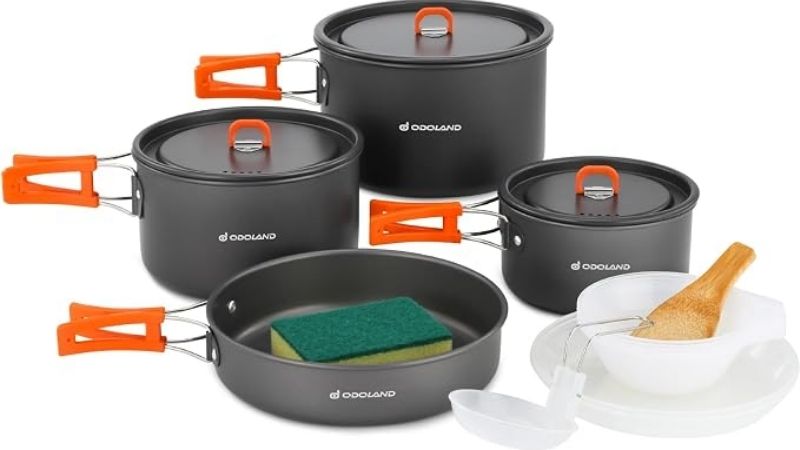
Material drives both weight and price. Titanium is lightest and toughest but pricey and prone to hot spots, aluminum is light and heats evenly, and stainless steel is durable but heavy. Most hikers land on anodized or hard-coated aluminum for the best all-around balance.
Weight adds up fast once you include pots, a lid, and a mug. A minimalist solo pot can weigh well under six ounces, while a four-person set climbs past two pounds. Match the material and total weight to how far you carry it and how many mouths you feed at camp.
Capacity and Group Size
Size the set to your crew. A one-liter pot handles solo boiling, a set with a two-to-three-liter pot suits two to three people, and a family kit needs multiple pots plus plates and mugs. Buying too big means carrying dead weight, while too small means cooking in shifts.
Think about your menu, too. If you only rehydrate freeze-dried meals, a single pot to boil water is enough. If you actually cook, a skillet and a second pot let you simmer sauces and fry eggs, which a bare-bones backpacking cookware set simply cannot manage.
Packed Size and Nesting
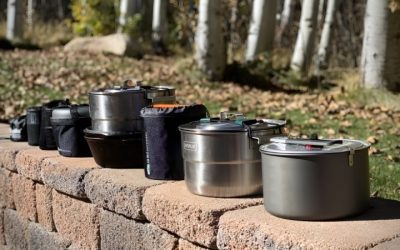
Good kits nest into one tidy bundle, often stashing a canister stove and fuel inside the main pot. That saves space and protects the cookware from scratches in your pack. Collapsible silicone pots take this further, flattening to a fraction of a rigid pot’s height.
Check that lids, cups, and utensils actually stack together rather than rattling loose. A welded stuff sack that doubles as a washbasin is a bonus, and a strainer lid saves you from packing an extra tool. The tighter a set packs, the more likely it comes along.
Cooking Performance and Cleanup
Boil time and heat control separate a great backpacking cookware set from a merely light one. Heat exchangers and tight lids speed boiling and save fuel, while thicker pots distribute heat for actual cooking rather than just scorching one spot in the middle.
Cleanup matters in the backcountry. Nonstick and ceramic coatings wipe clean with little water but scratch if you use metal utensils, while bare metal is tougher but sticks more. Pick the surface that matches your cooking style and how carefully you handle your gear.
Top Picks: The Best Backpacking Cookware Sets
These five sets span solo ultralight pots to full four-person kits. The table sums up who each one serves, and the reviews that follow cover the real strengths and honest drawbacks so you can match a set to your group and your cooking ambitions.
| Set | Serves | Highlights |
|---|---|---|
| GSI Outdoors Pinnacle Camper | 4 | 3L + 2L pots, 9″ skillet, plates, mugs, washbasin |
| MSR Ceramic 2-Pot Set | 2-3 | Two nonstick ceramic pots, lid, gripper, fast boil |
| Sea to Summit X-Pot 2.8L | 2 | Collapsible silicone pot, aluminum base, packs flat |
| GSI Halulite Microdualist | 2 | 1.4L pot, strainer lid, 2 bowls, 2 mugs, 2 sporks |
| Snow Peak Personal Cooker 3 | 1-2 | Two pots + pan-lid, stainless with aluminum core |
GSI Outdoors Pinnacle Camper – Best for Groups
The GSI Outdoors Pinnacle Camper is the four-person backpacking cookware set for people who cook real meals at camp. It packs a three-liter and a two-liter pot, a nine-inch ceramic-coated skillet, plates, mugs, and a stuff sack that doubles as a washbasin, all nesting neatly together.
It is one of the heaviest kits here, so it favors car camping and base camps over long-mileage trips, and the coating needs gentle utensils. But for shared dinners around the fire, its large nonstick surfaces and complete, well-organized contents make cooking genuinely enjoyable.
MSR Ceramic 2-Pot Set – Best All-Around
The MSR Ceramic 2-Pot Set is the do-it-all kit for two or three people. Its wafer-thin aluminum keeps weight low while offering the highest capacity-to-weight ratio in this group, and the nonstick ceramic coating cleans easily and boils water quickly.
The thin aluminum dents more easily than thicker pots, and it ships without a stuff sack for protection. Even so, for hikers who want light weight, generous capacity, and easy cleanup in one versatile kit, it hits the sweet spot better than almost anything else on the market.
Sea to Summit X-Pot 2.8L – Best for Small Packs
The Sea to Summit X-Pot solves the space problem with silicone walls and a hard-anodized aluminum base that conducts heat. The 2.8-liter pot collapses to a fraction of its height, making it a smart pick for two people who are serious about saving room in a tight pack.
At around eleven ounces it is a bit heavy for solo ultralight trips, and its small base limits open-fire cooking, so it works best on a backpacking stove. As a collapsible pot that also serves as a measuring cup, wash basin, and water carrier, though, its versatility is hard to beat.
GSI Halulite Microdualist – Best 2-Person Value
The GSI Halulite Microdualist packs a complete two-person kitchen into one bundle. You get a 1.4-liter pot with a strainer lid, two insulated bowls with sip-lids, two mugs, and two folding sporks, and the welded sack doubles as a sink, so nothing gets left behind on the trail.
The aluminum pot is basic and the coating asks for gentle handling, so it is not a gourmet skillet setup. But for backpacking pairs who want everything they need to eat and drink in a light, affordable, self-contained package, this backpacking cookware set is a standout value.
Snow Peak Personal Cooker 3 – Best for Durability
The Snow Peak Personal Cooker 3 is the durable pick for solo hikers and pairs. Its thin stainless steel with an aluminum core boils about a liter of water in just over three minutes, and the two pots plus a pan-lid nest compactly into a genuinely long-lasting little system.
Stainless is heavier than aluminum, so this is not the lightest option, and it costs more than budget kits. But if you want cookware that shrugs off dents and abuse for years of hard use, its build quality makes the modest weight penalty an easy trade for many campers.
Frequently Asked Questions
These are the questions backpackers ask most before buying a cookware set.
What size backpacking cookware set do I need?
Match the pot volume to your group. Roughly a one-liter pot per person is a good rule for cooking, so a solo hiker can use a one-liter pot, a pair wants about two liters, and a group of four needs multiple pots. If you only boil water, you can size down considerably.
Is titanium or aluminum better for backpacking?
Titanium is lighter and tougher but expensive and prone to hot spots, which makes it ideal for boiling water rather than careful cooking. Anodized aluminum heats more evenly and costs less, so it suits hikers who actually cook. Most people are well served by a quality aluminum set.
How do I clean cookware on the trail?
Wipe out food scraps first, then use a little water and a small scrubber, and pack out any food waste rather than dumping it near water. Nonstick and ceramic coatings clean with minimal water but need soft tools. A pot that doubles as a washbasin makes cleanup much easier.
Can I use one pot over a campfire?
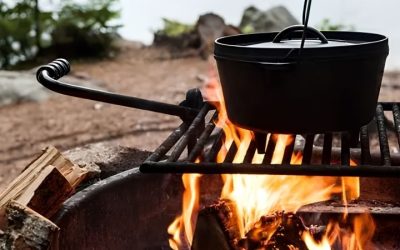
Bare aluminum, stainless, and titanium pots can handle a fire, though soot will blacken the outside. Avoid open flames with nonstick or ceramic coatings and collapsible silicone pots, which can be damaged by direct fire. For fire cooking, choose a simple, coating-free metal pot.
See More:
Final Thoughts
The right backpacking cookware set depends on your group and how much you love to cook. Groups should grab the GSI Pinnacle Camper, most hikers the MSR Ceramic 2-Pot, and space-savers the Sea to Summit X-Pot, while the Halulite and Snow Peak cover value and durability. Buy for your real trail menu, not the biggest kit.