Our Top Picks
 BOG DeathGrip Aluminum Tripod with Durable Aluminum Frame7"-59"33 x 8 x 6 inches8.5 poundsCheck on Amazon
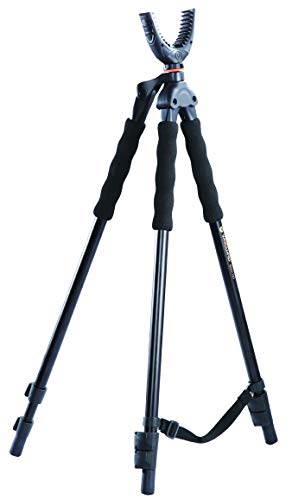

Offhand shots wobble. Knees, backpacks and fence posts help, but none of them put the rifle at the same height twice, and none of them hold it while you wait. A shooting stick solves both problems: it is a freestanding support, with one, two or three legs, that cradles or clamps the fore-end of a rifle so the shot starts from a steady, repeatable position. Unlike a rifle-attached bipod, a shooting stick is not mounted to the gun, so it can be planted, moved or left behind in seconds, and most models double as a rest for binoculars, a spotting scope or a camera.
This roundup covers five freestanding field supports for hunting: a trigger-adjust tripod built for spot-and-stalk speed, a clamping tripod that holds a rifle hands-free in a blind, a convertible stick that works as a tripod, bipod or monopod, a tall lightweight tripod with a ball-bearing yoke, and a featherweight monopod made for seated turkey hunting. Every pick is a current, verifiable product from an established maker.
As an Amazon Associate, we earn from qualifying purchases.
Quick answer
For most deer and predator hunters, the Primos Trigger Stick Gen 3 Tall Tripod is the fastest support to deploy, adjusting from 24 to 62 inches with one hand. For hands-free waiting in a blind, choose the BOG DeathGrip. On a budget, the Vanguard Quest T62U converts between tripod, bipod and monopod, while turkey hunters should pick the Allen monopod.
Primos Trigger Stick Gen 3 Tall Tripod

The Trigger Stick’s party trick is one-handed height adjustment. Squeeze the trigger in the grip and the legs slide anywhere between 24 and 62 inches; release it and they lock. That range covers sitting, kneeling and standing shots, and the adjustment happens without taking your eye off the animal, which is exactly what spot-and-stalk and still-hunting demand. The Jim Shockey Tall Tripod, model 65815, weighs about 3.5 pounds, so it carries more like a walking staff than a piece of range equipment.
The quick-detach yoke pulls off to reveal threaded studs that accept a spotting scope, binocular adapter or camera, so the same sticks steady your glassing during a long sit. A leg angle lock keeps the legs from splaying on side hills, and the contoured grip stays comfortable in cold weather. The honest trade-offs: at full standing height there is some flex, as with any tall, light tripod, and the trigger mechanism rewards a deliberate squeeze rather than a rushed one. For hunters who move until they find game, this is the support that keeps up.
BOG DeathGrip Aluminum Tripod
The DeathGrip takes the opposite approach: instead of cradling the fore-end, its head clamps the rifle itself. The non-marring clamp holds the gun securely enough that you can let go entirely, which changes long waits in a ground blind or treestand into a relaxed, ready position. When the shot comes, the head pans a full 360 degrees and tilts 25 degrees, so tracking a walking deer does not mean repositioning the whole tripod.
The aluminum frame adjusts from about 7 inches up to 59 inches, covering prone-adjacent seated positions through standing, and each leg locks at three angles for uneven ground. A built-in bubble level helps you set up square on a slope. The cost of that stability is weight: at roughly 8.5 pounds this is by far the heaviest support in the roundup, and it is a carry-in-and-stay tool rather than a stalk-all-day one. The clamp also does not detach, so it will not convert into a plain optics tripod the way yoke models do. For blind, stand and field-edge hunting where the rifle waits clamped and ready, nothing else here matches it.
Vanguard Quest T62U Shooting Stick
The Quest T62U is three supports in one bag. It arrives as a tripod, but the third leg unscrews, leaving a bipod, and the yoke can ride on a single leg as a monopod. That makes it the most adaptable pick in this group and a sensible first shooting stick for a hunter who has not yet settled into one style. Extended height runs to 62 inches from a folded length of 27.5 inches, and the whole unit weighs about 2.2 pounds in aluminum.
The U-shaped yoke is lined with rubber fins that grip the fore-end without marking the finish, and it rotates a full 360 degrees for tracking. Under the yoke sits a standard thread for mounting optics or a camera. Quick flip locks set the height fast, though flip locks can click audibly if you snap them carelessly, and the light legs flex more than the heavier tripods here when you lean into them. Treat it as a rest, not a walking staff, and it is a lot of versatility for a modest carry weight.
Hammers Telescopic Shooting Tripod
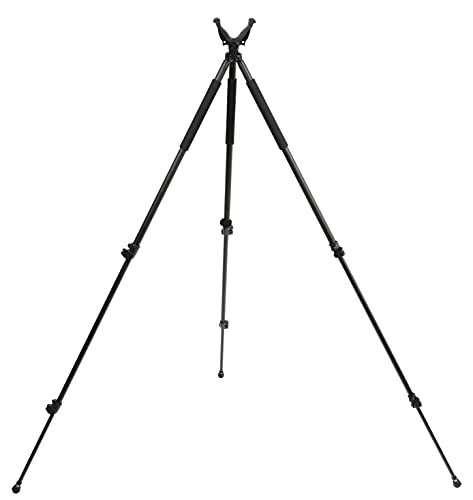
The Hammers tripod is the tall, simple, traditional option. Its three-section aluminum legs telescope to a maximum height of 68 inches, the tallest in this roundup, which suits long-legged shooters and standing shots over tall grass or brush. The V yoke rides on a ball-bearing pivot, so panning across a field edge feels smooth rather than notchy, and the rubber-lined yoke protects the rifle’s finish while it moves.
Each leg ends in a dual tip: a rubber foot for hard ground and blinds, with a carbide tip underneath for rock, ice and frozen dirt. Foam grips keep hands comfortable, quick flip locks handle the height changes, and the yoke detaches for a spotting scope bolt, with a carry bag and strap included for the walk in. At about 2.25 pounds it is light for a full-height tripod. The design is older and less refined than the trigger and clamp systems above it, with no fine tilt control, but for a straightforward standing rest it covers the essentials well.
Allen Company Monopod Shooting Stick (2164)
The Allen monopod, model 2164, is the specialist of the group: a single aluminum staff that adjusts from 14.5 to 34 inches and weighs well under a pound. That low height range is deliberate. It is built for seated shooting, the position turkey hunters and ground-blind hunters actually use, where a tall tripod is more hindrance than help. The cradle rest keeps the shotgun or rifle pointed down the shooting lane while your hands stay free for calling.
Cam locks set the height, the foam padded handle is easy on cold hands, and the top section removes for transport or cleaning. Because it is a monopod, it steadies the vertical wobble rather than eliminating movement entirely, and the top section benefits from an occasional re-tightening. For run-and-gun turkey hunting, dove fields and any sit-on-the-ground style of hunting, its near-zero weight and instant setup make a strong case, and it doubles as a light walking staff between setups.
How to choose
Start with how you actually shoot. Seated hunters need support in the 15 to 40 inch range; standing shots over grass or brush need 55 inches or more. Buy for your tallest regular position, because a stick that maxes out at shoulder height is useless standing. Next, count legs. A monopod is the lightest and fastest to move but only damps vertical movement. A bipod stick adds lateral stability. A tripod is the steadiest and the only style that can hold a rifle unattended, at the cost of weight and setup time.
Then look at the head. A V or U yoke is simple, silent and quick to lift the rifle out of, which suits stalking. A clamp head like the DeathGrip’s holds the rifle hands-free but adds weight and slows a freehand follow-up. Check the leg locks too: trigger systems adjust one-handed, flip locks are fast and glove-friendly, and twist or cam locks are the quietest. Finally, match the feet to your ground. Rubber feet grip blind floors and rock; carbide or spike tips bite into soil, duff and ice. If you also glass, pick a model whose yoke removes to reveal a standard optics thread.
One clarification worth making: the widely reported recalls of hunting “sticks” concern treestand climbing sticks, a completely different product. None of the five shooting supports in this roundup is subject to a CPSC recall.
Who should skip
Skip shooting sticks if most of your shooting is prone or from a bench. A bench rest, a rear bag or a rifle-mounted bipod built for prone work will serve you better, and a tall stick will only get in the way. Handgun hunters should also pass: standard V and U yokes are shaped for rifle fore-ends, not revolver or pistol frames. If you hunt thick timber where shots come fast at close range, a stick adds a step between seeing game and shooting, and offhand practice is the better investment. And if your hunts are short walks to a permanent blind with a built-in rest rail, the rail you already have does this job for free.
FAQ
What is the difference between a shooting stick and a rifle bipod?
A rifle bipod attaches to the gun itself, usually at a sling stud or rail, and travels with the rifle. A shooting stick is a separate, freestanding support the rifle rests on or clamps into. Sticks are generally taller, work for standing shots, and can be shared between rifles or used to steady optics.
How tall should a shooting stick be for standing shots?
For most adults, the yoke should reach roughly chin to eye height when standing, which usually means an extended height of at least 58 to 62 inches. Taller shooters, and anyone shooting over tall grass, should look for models that reach 65 inches or more, like the Hammers tripod in this roundup.
Can a shooting stick hold a crossbow or a spotting scope?
Yes to both, with the right head. Clamp heads such as the DeathGrip grip crossbow fore-ends securely, and wide yokes cradle them well. Several picks here, including the Primos, Vanguard and Hammers, let you remove the yoke to expose a standard thread that accepts a spotting scope, binocular adapter or camera.
Are shooting sticks legal to hunt with?
Shooting sticks and rests are legal for hunting in most states and for most species, since they are passive supports rather than part of the firearm. A few jurisdictions regulate rests for specific seasons or draw-lock and crossbow setups, so check your current state game regulations before relying on one for a hunt.
Final verdict
Match the support to the hunt. The Primos Trigger Stick Gen 3 Tall Tripod is the best all-round choice for hunters who move, thanks to one-handed adjustment across a full sitting-to-standing range. The BOG DeathGrip is the pick for blinds and stands, where its clamp holds the rifle ready for hours. The Vanguard Quest T62U offers the most configurations per pound and per dollar, the Hammers tripod gives tall shooters the most height in a light frame, and the Allen monopod disappears into a turkey vest until the moment it is needed. Any of the five beats an offhand shot at distance.
Product and ASIN Reference
| Product | ASIN |
|---|---|
| Primos Trigger Stick Gen 3 Tall Tripod (65815) | B0728HC759 |
| BOG DeathGrip Aluminum Tripod (1099442) | B07KMPCVMH |
| Vanguard Quest T62U Shooting Stick | B006LZNOKG |
| Hammers Telescopic Shooting Tripod | B001ORBBP6 |
| Allen Company Monopod Shooting Stick (2164) | B000AU4RTU |
FAQ
What is the difference between a shooting stick and a rifle bipod?
How tall should a shooting stick be for standing shots?
Can a shooting stick hold a crossbow or a spotting scope?
Are shooting sticks legal to hunt with?
More from Amazon
Programs that pair well with the guide above. Offers and eligibility are set by Amazon and may change.
Free shipping on eligible items, Prime Video and more. Eligible new members can start with a free trial.
Start a Prime free trialA Prime membership for ages 18-24 with a trial period. Eligibility is set by Amazon.
See Prime for Young AdultsAudiobooks and podcasts to listen to on the go. Eligible new members can start with a free trial.
Try Audible freeAd-free music streaming. Eligible new subscribers can start with a free trial.
Try Music Unlimited freeAs an Amazon Associate we earn from qualifying purchases.