Our Top Picks




Weights and sinkers are the least glamorous items in a tackle box and the ones that quietly decide whether a bait reaches the fish, stays there, and behaves naturally once it arrives. The shape matters as much as the ounces. A split shot pinches on in seconds under a bobber, an egg sinker slides freely on the main line so a catfish can move off with the bait before it feels resistance, a pencil weight hangs below a drop shot hook without wedging in rock, a dense tungsten bullet punches through grass mats, and a flat no-roll sinker lies still in river current where a round weight would tumble downstream. Material matters too, because several states restrict small lead sinkers. This guide compares five proven options, one for each rig freshwater anglers tie most often, and closes with the sizing rules that keep guesswork out of the choice.
As an Amazon Associate, we earn from qualifying purchases.
Quick answer
Start with the Eagle Claw removable split shot assortment for bobber and live bait rigs, and add Bullet Weights egg sinkers for sliding bottom rigs. Bass anglers should add Reaction Tackle drop shot weights for finesse work and Reaction Tackle tungsten flipping weights for heavy cover. River anglers fishing current for catfish should finish the set with Catfish Sumo flat no-roll sinkers.
Eagle Claw Removable Split-Shot Sinker Assortment (124 Pieces)
Split shot is the first weight most anglers ever buy, and this 124-piece assortment from Eagle Claw is the version that belongs in a general tackle box. The shot are round lead sinkers with a slot cut across the top, and the removable design adds two small ears opposite the slot. Pinch the slot closed on the line with pliers and the shot stays put; squeeze the ears together later and the slot opens again, so the same weight comes off without cutting the line and can be reused on another trip.
The assortment spreads the count across the small sizes that bobber rigs, slip floats, and live bait rigs actually use, from tiny shot that barely sink a small float down to sizes that pull a nightcrawler rig to the bottom of a pond.
Rigging is simple. Place the shot six to twelve inches above the hook, add one at a time, and stop when the bobber stands upright with most of its body below the surface. Because the shot are lead, handle them with pliers rather than teeth, wash hands after a session, and check local rules before using the smallest sizes. Anglers who fish restricted waters often should look at the tin version of the same assortment instead.
Bullet Weights Lead Egg Sinkers (1/2 oz, Box of 160)
The egg sinker is the classic sliding weight for bottom fishing, and Bullet Weights has made them in Nebraska for decades. This listing is the half-ounce size in a bulk box of 160, which suits anglers who fish bait from the bank often enough to lose sinkers to snags regularly. The oval body has a smooth hole through the center, so the main line passes straight through the weight.
That free-sliding design is the whole point of the shape. Thread the sinker on the main line, follow it with a bead and a swivel, then tie twelve to twenty-four inches of leader to the hook. A catfish, carp, or bass picking up the bait can move away and pull line through the sinker before it feels the full weight, which produces longer, more confident takes than a fixed weight allows.
Half an ounce is the workhorse size for ponds, lakes, and slow river edges. It holds bottom in light current, casts well on medium spinning and casting gear, and pairs with the split shot pick above to cover most still-water bait fishing. In faster water or wind, the same shape in a one-ounce or two-ounce size is the natural step up, while rocky rivers are better served by the flat no-roll design further down this list. As with all lead tackle, keep the box closed around children and wash hands after rigging.
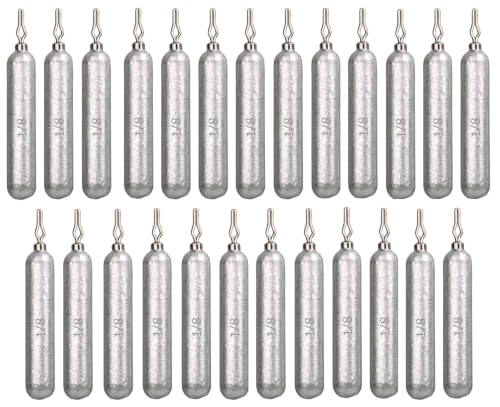
Reaction Tackle Lead Drop Shot Weights (1/8 oz, 25-Pack)
A drop shot rig hangs its weight at the very end of the line, below the hook, so the soft plastic hovers off the bottom and moves with every small twitch of the rod tip. The weight for that job needs to be slim, because it spends the whole retrieve dragging through rock, gravel, and brush. Reaction Tackle builds these as skinny pencil-shaped lead weights, and the narrow profile slides through gaps that grab round sinkers.
The fitting at the top is the other half of the design. A V-shaped pinch eyelet grips the tag end of the line, so the weight clips on without a knot and can be swapped in seconds when the depth changes.
The eighth-ounce size in this 25-pack is the shallow-water and calm-day choice for bass and panfish, and the same line runs through quarter-ounce and heavier sizes for deep or windy work. A useful starting rule is an eighth ounce in shallow, calm water, a quarter ounce as the all-round size, and three-eighths or more when fishing deep structure. Keep the hook twelve to eighteen inches above the weight for most conditions.
Reaction Tackle Tungsten Flipping Weights (1/2 oz, 4-Pack)
Flipping and pitching soft plastics into heavy cover is where tungsten earns its higher cost. Tungsten is far denser than lead, so a tungsten flipping weight is noticeably smaller than a lead weight of the same ounces. That compact bullet profile slips through matted grass, brush, and dock cover instead of plowing into it, and the hard metal transmits bottom contact and light strikes up the line with a sharper feel than soft lead gives.
Reaction Tackle shapes these as streamlined bullets for Texas rigs and flipping presentations, stamps the size on each weight so there is no guessing in the boat, and offers them in several colors including a matte never-chip black finish that keeps its coating in rough cover. The half-ounce four-pack is the standard punching and heavy-grass size: heavy enough to pull a creature bait through a mat, compact enough to follow the bait through the hole it opens. Lighter sizes in the same line cover ordinary Texas rigging in shallow water.
Tungsten is also the straightforward lead-free answer in this guide. It contains no lead, so it sidesteps the state restrictions on small lead sinkers entirely, and it is the material to choose for waters where lead is limited. The trade-off is cost per weight, which is why most anglers reserve tungsten for the rigs where its size and sensitivity change the outcome.
Catfish Sumo Flat No-Roll Lead Sinkers (1 oz, 10-Pack)
Round sinkers roll in current, and a rolling sinker drags the bait out of the strike zone, twists the line, and eventually washes downstream. Catfish Sumo answers that problem with a flat, wide lead sinker that lies on its side on the riverbed and stays where it lands. The one-ounce ten-pack is aimed at river and channel catfish work from the bank or an anchored boat.
The detail that separates this design from a plain flat sinker is the line-protecting insert molded through the center hole. A bare lead hole can develop a rough edge that frays line cast after cast, and the insert gives the line a smooth surface to slide against as the rig moves. Rigged as a slip sinker above a swivel and leader, the same free-sliding benefit described for egg sinkers applies, with the flat body holding position in flow that would roll an egg sinker away.
One ounce is the starting size for slow to moderate current. The honest rule on a river is to add weight until the bait holds: moderate flow often needs two or three ounces, and heavy current can need more, with the same flat shape available in larger sizes. These are lead sinkers, so the handling guidance applies.
How to choose
Match the shape to the rig first, and the ounces second. Split shot belongs under bobbers and on live bait rigs where small, fast adjustments matter. Egg sinkers belong on sliding bottom rigs in still or slow water. Pencil weights belong on drop shot rigs. Bullet and flipping weights belong ahead of Texas-rigged plastics. Flat no-roll sinkers belong anywhere current would move a round weight.
Then use the lightest weight that still does the job. The sinker only has to stand the bobber up, reach the bottom, or hold the bait in place. Start at the light end of the range for your rig, count the bait down, and step up one size at a time for wind, depth, or current.
Finally, decide on material with local rules in mind. Lead is inexpensive, soft, and easy to crimp, which is why it still fills most tackle boxes. It is also restricted in places: New York bans the retail sale of lead sinkers of half an ounce or less, and states including New Hampshire, Vermont, Maine, and Massachusetts limit small lead sinkers and jigs, largely to protect loons and other waterbirds that swallow lost tackle. Tungsten, steel, tin, and brass weights are the usual substitutes, and tungsten adds a smaller profile and sharper feel as a bonus. Whatever the material, never crimp split shot with your teeth, use pliers, and wash your hands after handling lead.
Who should skip
Anglers who fish only one narrow technique do not need five shapes. A dedicated fly angler, a jig-only bass angler, or someone who trolls exclusively will be better served by depth in the one weight style their method uses. Anyone fishing waters with strict lead rules should skip the lead picks entirely and build the same set of shapes in tungsten, steel, or tin.
FAQ
What size sinker should I start with for freshwater fishing?
For most pond and lake fishing, a quarter to a half ounce on a bottom rig and one to three split shot under a bobber is enough. Bass rigs usually run from an eighth ounce to a half ounce, and river catfish rigs start around one ounce and go up until the bait holds.
Is tungsten really better than lead for fishing weights?
Tungsten is denser, so the same weight comes in a smaller body that slips through cover more easily and transmits bottom contact more clearly. It also contains no lead. It costs considerably more per weight, so it earns its place on Texas rigs, flipping rigs, and finesse rigs, while lead remains the sensible choice for bait rigs and high-loss situations.
Are lead sinkers banned?
There is no nationwide ban in the United States, but several states restrict small lead sinkers, and the details differ by state and sometimes by water. New York prohibits the retail sale of lead sinkers of half an ounce or less, and New Hampshire, Vermont, Maine, and Massachusetts have their own limits. Check the current regulations for the water being fished before buying.
Why does my sinker keep rolling or moving in a river?
Round and oval sinkers present a curved surface to the current, so moving water pushes them along the bottom. A flat no-roll sinker lies on its side and resists that push. If a flat sinker still moves, the current is simply stronger than the weight, and the fix is to step up an ounce at a time until the bait stays in place.
Final verdict
A complete freshwater weight kit is smaller than most anglers expect. The Eagle Claw split shot assortment and the Bullet Weights egg sinkers cover bobber fishing and bottom bait rigs, which is most still-water fishing. Reaction Tackle supplies the two bass specialists, pencil drop shot weights for finesse presentations and tungsten flipping weights for heavy cover and lead-free water. Catfish Sumo no-roll sinkers finish the set for rivers and current. Buy the shapes in that order, size them by the lightest-weight rule, and check the lead rules where the fishing happens.
Product and ASIN Reference
| Product | ASIN |
|---|---|
| Eagle Claw Removable Split-Shot Sinker Assortment (124 Pieces) | B000EYY41S |
| Bullet Weights Lead Egg Sinkers (1/2 oz, Box of 160) | B0083GIQF4 |
| Reaction Tackle Lead Drop Shot Weights (1/8 oz, 25-Pack) | B07H6VTTDX |
| Reaction Tackle Tungsten Flipping Weights (1/2 oz, 4-Pack) | B01LW5X7EQ |
| Catfish Sumo Flat No-Roll Lead Sinkers (1 oz, 10-Pack) | B0BWDRKMKL |
FAQ
What size sinker should I start with for freshwater fishing?
Is tungsten really better than lead for fishing weights?
Are lead sinkers banned?
Why does my sinker keep rolling or moving in a river?
More from Amazon
Programs that pair well with the guide above. Offers and eligibility are set by Amazon and may change.
Free shipping on eligible items, Prime Video and more. Eligible new members can start with a free trial.
Start a Prime free trialA Prime membership for ages 18-24 with a trial period. Eligibility is set by Amazon.
See Prime for Young AdultsAudiobooks and podcasts to listen to on the go. Eligible new members can start with a free trial.
Try Audible freeAd-free music streaming. Eligible new subscribers can start with a free trial.
Try Music Unlimited freeAs an Amazon Associate we earn from qualifying purchases.