Key takeaways
- Turn off the tap and open the nozzle briefly before storage to release pressure.
- Drain the hose fully, especially before freezing weather.
- Store it in shade or under cover when possible; ultraviolet exposure weakens many outer jackets.
- Do not drive over a pressurized hose or leave it beneath a sharp-edged tool.
- Use a hose guide at corners and a reel or large-radius hanger for storage.
- Inspect the tap fitting, washer, and first foot of hose at the beginning of each season.
Best Garden Hoses for Everyday Watering and Tough Outdoor Jobs
The best garden hoses are matched to your tap location, watering distance, storage space, and water pressure—not simply chosen by the longest length or lowest price. For most homes, a 5/8-inch hose in a 50-foot length offers the most useful balance of flow, reach, weight, and handling; choose a lighter 1/2-inch hose for containers and balconies, or a 3/4-inch contractor-style hose for high-flow jobs.
Quick picks by watering situation
| Situation | Best hose type | Recommended size | Why it fits |
|---|---|---|---|
| Balcony, patio, or small yard | Lightweight flexible rubber or hybrid hose | 1/2 inch, 25–50 feet | Easy to coil and less tiring for short watering sessions |
| Typical suburban garden | Hybrid polymer or reinforced rubber hose | 5/8 inch, 50 feet | Good reach and useful flow without excessive bulk |
| Large yard or multiple beds | Heavy-duty reinforced rubber or hybrid hose | 5/8 inch, 75–100 feet | Reaches farther, but needs better storage and strain relief |
| Pressure washer, livestock, or high-flow cleaning | Heavy-duty rubber or contractor-grade hose | 3/4 inch, 50–100 feet | Moves more water and tolerates demanding outdoor work |
| Very compact storage | Expandable fabric-covered hose | Advertised length checked carefully | Light when empty, but less suitable for dragging or constant full-pressure use |
How hose diameter changes performance
Diameter refers to the inside diameter, which determines how much water the hose can carry. A 1/2-inch hose is easier to handle, but it restricts flow more than a 5/8-inch model. A 3/4-inch hose can supply substantially more water, although its extra weight and stiffness are noticeable.
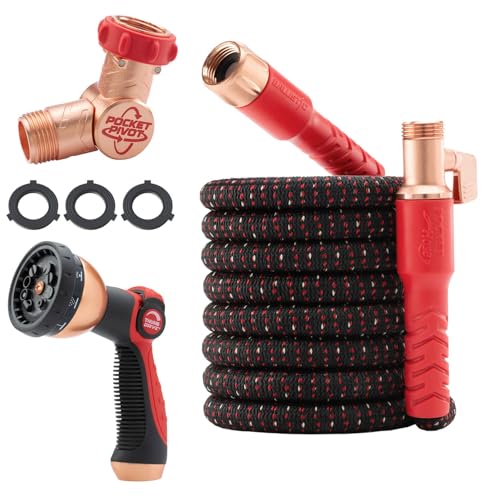
Pocket Hose Ballistic 50 FT Expandable Garden Hose, No-Kink, As Seen on TV
Included for 'Best Garden Hoses for Everyday Watering and Tough Outdoor Jobs' because the listing specifies No-Kink and As Seen on TV, details this guide uses to compare options.
View on Amazon
Flexi Hose with 8 Function Nozzle, 50FT - Lightweight Expandable Garden Hose, No-Kink Flexibility, 3/4 Inch Solid Brass Fittings and Double Latex Core - Black and Green
Included for 'Best Garden Hoses for Everyday Watering and Tough Outdoor Jobs' because the listing specifies 50FT and Lightweight Expandable Garden Hose, details this guide uses to compare options.
View on Amazon
Pocket Hose Copper Bullet 50 FT Expandable Garden Hose, 10-Pattern Nozzle
Included for 'Best Garden Hoses for Everyday Watering and Tough Outdoor Jobs' because the listing specifies 10-Pattern Nozzle, details this guide uses to compare options.
View on Amazon
Flexzilla Garden Hose 5/8 in. x 25 ft., Lightweight All-Weather Water Hose, Durable and Flexible, Leak-Free Connections
Included for 'Best Garden Hoses for Everyday Watering and Tough Outdoor Jobs' because the listing specifies Lightweight All-Weather Water Hose and Durable and Flexible, details this guide uses to compare options.
View on AmazonFor ordinary hand watering, a 5/8-inch hose is usually the sensible middle ground. A 50-foot, 5/8-inch hose holds roughly 1.2 gallons of water when full, while a 50-foot, 3/4-inch hose holds approximately 1.8 gallons. That difference is present every time you lift or drain the hose.
Choose 1/2 inch when the hose runs are short and the priority is portability. Choose 3/4 inch when you regularly fill large containers, wash equipment, supply sprinklers, or work with a tap and fittings capable of maintaining high flow. A larger hose cannot compensate for a weak water supply or a restrictive spigot.
Length: buy enough, but avoid permanent excess
Measure the route from the tap to the farthest point you actually water, then add about 5 feet for maneuvering. Avoid automatically buying 100 feet if a 50-foot hose reaches the beds. Extra length creates more drag, more kinks, more residual water, and a larger coil to store.
A useful calculation is to separate the route into sections. If the tap is 18 feet from the garden and the farthest bed is another 27 feet away, a 50-foot hose provides 5 feet of working margin. If the route includes a corner, steps, or a hose reel, a 75-foot hose may be more practical—but only if the storage system can accommodate it.
For a large property, two 50-foot hoses joined with a solid, full-flow connector can be easier to replace and carry than one 100-foot hose. The trade-off is an additional connection that may leak or restrict flow.
Comparing hose materials
Rubber
Rubber hoses are durable, tolerate temperature changes well, and are less likely to develop permanent flat spots than inexpensive vinyl. They are also heavier and may contain carbon-black residue that can mark light paving when new. A reinforced rubber hose is a strong choice for frequent use, dragging across rough ground, or exposure to hot conditions.
Vinyl
Vinyl is usually the least expensive option and can be perfectly adequate for occasional watering on smooth surfaces. The light construction is more prone to kinking, splitting, and damage from sharp edges. Look for multiple reinforcement layers rather than judging durability by color or advertised length.
Hybrid polymer
Hybrid polymer hoses, including products such as Flexzilla, are designed to remain flexible and resist kinking in a broad range of outdoor conditions. They are often lighter than thick rubber while feeling more substantial than basic vinyl. They can be a good everyday choice, but their fittings and outer jacket still need protection from dragging and sharp corners.
Fabric-covered expandable hoses
Expandable hoses are compact and light when drained, which makes them attractive for small storage areas. They should be used with care: do not drag a pressurized hose around corners, leave it in full sun for long periods, or store it while wet. The fabric cover and end connections are common failure points, and the usable flow may be lower than the stated expanded length suggests.
Kink resistance is a design feature, not a promise
A hose resists kinking through its wall construction, reinforcement, flexibility, and connection design. A thick hose may still kink if it is sharply bent near the tap. Likewise, a lightweight hose may perform well when laid in a broad curve but fail when pulled around a tight corner.
The most important habit is to keep the first 2 or 3 feet from the tap in a gentle loop. A short swivel connector or tap-mounted hose guide can prevent the fitting from being bent sideways. When storing the hose, coil it in loops at least 18 to 24 inches across instead of making tight circles around a small hook.
Fittings often fail before the hose
Look for solid metal or high-quality reinforced polymer couplings, a rubber washer at the female end, and a strain-relief sleeve where the hose enters the fitting. The tap-end connection receives the most twisting and bending, so it deserves more attention than decorative outer material.
Brass fittings are robust but can be heavier and may seize if dissimilar metals corrode together. Aluminum fittings are lighter but can be damaged by overtightening. Polymer fittings are comfortable to handle and resist corrosion, though low-quality versions can crack. Tighten connections by hand, then add only a small additional turn if needed; using pliers can crush washers or damage threads.
Keep spare 3/4-inch garden-hose washers available. A missing or flattened washer commonly causes a leak that is incorrectly blamed on the hose itself. Replace washers when they become hard, split, or permanently compressed.
Decision matrix: which hose makes sense for you?
| Your priority | Choose | Accept this compromise |
|---|---|---|
| Lowest upfront cost | Reinforced vinyl, 5/8 inch | More careful handling and shorter expected service life |
| Frequent weekly watering | Hybrid polymer or rubber, 5/8 inch | Moderately higher cost and storage weight |
| Maximum flow | 3/4-inch heavy-duty rubber | Heavier, less flexible, and more expensive fittings |
| Small storage space | 25-foot lightweight or expandable hose | Less reach and potentially lower durability |
| Dragging over concrete or gravel | Reinforced rubber with protected couplings | More weight to carry and coil |
| Older user or limited lifting strength | 1/2-inch or lightweight 5/8-inch hybrid hose | Slower filling and reduced flow at long distances |
Well-known options and what they are suited to
Dramm hoses are widely known for colorful reinforced constructions aimed at routine residential watering. Flexzilla is associated with flexible hybrid-polymer hoses that are easy to handle in everyday garden work. Gilmour offers hose styles across light-duty and heavy-duty categories, making its specifications more important than the brand name alone. Zero-G hoses emphasize low weight and compact handling for users who do not want a heavy rubber hose.
These products are not interchangeable in every situation. Check the exact diameter, length, coupling material, and warranty terms for the particular model. A light 50-foot version and a heavy-duty 75-foot version from the same brand can behave very differently.
Maintenance that extends hose life
- Turn off the tap and open the nozzle briefly before storage to release pressure.
- Drain the hose fully, especially before freezing weather.
- Store it in shade or under cover when possible; ultraviolet exposure weakens many outer jackets.
- Do not drive over a pressurized hose or leave it beneath a sharp-edged tool.
- Use a hose guide at corners and a reel or large-radius hanger for storage.
- Inspect the tap fitting, washer, and first foot of hose at the beginning of each season.
The common mistake is leaving a hose connected, pressurized, and kinked at the tap. That concentrates stress at the coupling and can cause leaks even when the rest of the hose remains sound. For most households, a properly sized 5/8-inch hybrid or reinforced rubber hose, stored drained and in broad coils, is the best balance of convenience and service life.