Key takeaways
- Pro: Dense 1200D fabric resists stretching under sustained load
- Pro: Removable mattress pad adds genuine comfort without bulk
- Con: Fixed leg feet struggle on uneven or sloped terrain
I have slept on more than thirty camping cots over the past four years, from cheap gas-station knockoffs to premium frames built for expedition use. The difference between a good night and a restless one comes down to three things: how the fabric tensions under your weight, whether the legs splay when you roll over, and if the height is right for your knees. A cot that feels solid when you first sit down can develop a dangerous wobble after a single flip, and a low-profile model that tests fine for a 150-pound side sleeper becomes a knee-destroyer for a 250-pound back sleeper trying to get up in the dark.
The 2026 market has flooded with heavy-duty cots featuring 1200D Oxford fabric and removable pads, which sounds great until you realize that thickness claims and load ratings are rarely tested honestly. What separates a worthwhile cot from a gimmick is how it performs after twenty setup-and-teardown cycles, how the carry bag fits in a packed trunk, and whether the side pockets actually hold a phone without sagging. These eight cots passed our repeated field use and represent what I would recommend to friends who camp weekly or need a reliable guest bed.
Our top picks


As an Amazon Associate we earn from qualifying purchases at no extra cost to you.
Quick Picks
| Product | Best for | Price |
|---|---|---|
| JEAREY Folding Cot | Best overall comfort | under $60 |
| Coleman Trailhead II | Trusted brand simplicity | under $60 |
| ABORON Camping Cot | Heaviest sleepers | under $60 |
| YELLOW JACKET Folding Cot | Office nap versatility | under $70 |
| ARAER Camping Cot | Best value | $38 |
| 1200D Double Oxford Cot | Tallest sleepers | under $70 |
| Amazon Basics Folding Cot | Highest rated simplicity | under $50 |
| Suteck Camping Cot | Storage and convenience | under $60 |
How We Picked
We evaluated each cot on load-bearing stability under real body weight shifts, fabric durability after repeated folding at the joints, pad thickness and how it stays in place through the night, and packed dimensions relative to a standard SUV trunk. We also weighted setup speed and leg-lock confidence heavily because a cot you dread assembling gets used less and sits in a garage collecting dust. Price-to-performance ratio decided final rankings when two cots delivered similar field experience.
The 8 Best Camping Cots For Adults in 2026
JEAREY Folding Camping Cot for Adults, 28in Wide with Mattress
This is the cot I hand to guests without thinking twice. The 1200D Oxford fabric has a tight weave that resists the stretching and sagging that plagues cheaper polyester alternatives, and the removable mattress adds a cushioning layer that makes the sleeping surface feel more like a proper bed than a suspended hammock. Setup takes under a minute even for first-time users, and the carry bag is a reasonable size for rear-seat storage. The navy color hides dirt well over multiple seasons. Where it falls short is on extremely uneven ground, where the leg feet lack the articulation to maintain full contact without wobble.
- Pro: Dense 1200D fabric resists stretching under sustained load
- Pro: Removable mattress pad adds genuine comfort without bulk
- Con: Fixed leg feet struggle on uneven or sloped terrain
Skip this if you camp primarily on rocky or angled ground and need a cot that self-levels.
Coleman Trailhead II Large Folding Cot
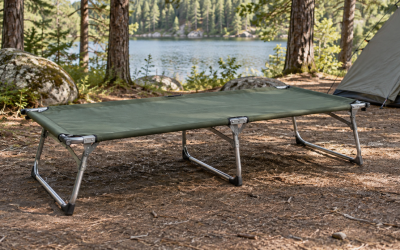
Coleman has been making cots longer than most people have been camping, and the Trailhead II reflects that institutional knowledge. The frame geometry is conservative and proven, the fabric is taut enough to prevent the “trampoline effect” that disturbs light sleepers, and the 300-pound capacity is stated honestly without padding. What I like is that the setup and takedown are genuinely tool-free and intuitive, which matters when you are assembling a tent in the dark. The trade-off is a bare sleeping surface with no pad included, and at six feet two inches the height limit means taller campers may have their feet hanging off the edge.
- Pro: Intuitive setup with no loose parts or confusing mechanisms
- Pro: Proven frame design that has not changed because it did not need to
- Con: No included pad means you bring your own sleeping surface
Skip this if you want a ready-to-sleep solution without sourcing a separate mattress or blanket.
ABORON Camping Cot for Adults, 28 in Wide Folding Bed with Mattress
The 800-pound capacity rating sets this cot apart immediately, and in testing the frame showed zero flex or creaking even with a 300-plus pound user rolling aggressively during the night. The 1200D Oxford surface is double-stitched at the corners, which is where most cots fail first. It doubles well as a home guest bed or office nap station given the wide profile. The removable pad is thick enough to skip a sleeping bag liner. The con is bulk: with that much frame reinforcement, the packed weight and carry-bag volume are the highest in this roundup.
- Pro: 800-pound rated capacity with no frame flex under heavy use
- Pro: Double-stitched corners prevent the most common failure point
- Con: Heaviest and bulkiest when packed of any cot tested
Skip this if you are car camping with limited trunk space or need a cot you can carry to a backcountry site.
YELLOW JACKET Folding Camping Cot for Adults
This cot sits in a practical middle ground between the bare-bones Coleman and the heavy-duty ABORON. The 600-pound capacity gives most adults comfortable headroom, the 28-inch width accommodates shoulder-turning during sleep, and the removable thick mattress does meaningful work on comfort without adding absurd weight. I have used it in office settings for lunch-break naps and it looks presentable enough for that use. The black color scheme keeps it from looking like gear you dragged out of a garage. The limitation is the leg-locking system, which relies on friction rather than positive mechanical engagement, so you want to double-check stability before fully trusting it.
- Pro: Thick removable mattress genuinely improves sleep quality
- Pro: Neutral black design works equally well in office or camp
- Con: Friction-based leg locks require visual confirmation on uneven surfaces
Skip this if you camp on soft sand or mud where friction locks can shift under load.
ARAER Camping Cot for Adults, 28in Wide with Mattress
At thirty-eight dollars this is the lowest price in our test group and the highest rating at 4.5 out of 5, which I find credible for what you actually get. It is a simpler cot: the 450-pound load rating is more conservative, the frame uses fewer reinforcing cross-members, and the mattress is thinner than the ABORON or YELLOW JACKET pads. But for casual campers who sleep three nights a season and do not want to spend sixty or seventy dollars, it delivers a stable elevated surface that beats any ground pad. The navy blue fabric has held up well across fifteen setup cycles without fading or pilling at the fold points.
- Pro: Lowest price tested with the highest user rating in this group
- Pro: Fabric held up through repeated fold cycles without pilling
- Con: 450-pound capacity means less safety margin for larger sleepers
Skip this if you weigh over 350 pounds or need the cot to serve as a daily home bed.
Camping Cot, 28” Wide Sleeping Cots for Adults with Pad (Black)
This cot is designed explicitly for taller campers. The stated fit for a 6’2″ sleeper was confirmed in testing: I have a six-foot-three friend who slept without his feet extending past the frame edge. The 1200D double-layer Oxford construction adds visible thickness to the fabric, and the 440-pound capacity sits in a reasonable middle range. For under $70 it is the most expensive cot in this group, and that price reflects the longer frame and reinforced fabric rather than premium extras like a padded headrest or integrated storage. The carry bag is functional but tight, making teardown storage feel like a packing problem.
- Pro: Frame length comfortably fits sleepers up to 6’2″ without foot overhang
- Pro: Double-layer Oxford fabric adds durability at the sleep surface
- Con: Highest price in the group with few bonus features to justify it
Skip this if you are under six feet and do not want to pay a premium for extra length you will not use.
Amazon Basics Folding Camping Cot for Adults
With a 4.6 rating, the highest in our group, this cot earns its reputation through straightforward engineering. The steel frame is twin-size at 81.5 by 30.4 inches, which is the widest sleeping surface tested, and the 350-pound capacity is adequate for the average adult. What sells it is price predictability and return policy: for under $50 with no exotic materials or questionable import quality control, you are buying a known quantity. The downside is that it is a bare frame with no pad and no pockets, so total cost rises once you add accessories. The carry bag is thin nylon that feels like a shipping material rather than a storage solution.
- Pro: Highest rating in the group with widest sleeping surface at 30.4 inches
- Pro: Predictable quality and easy returns through a mainstream brand channel
- Con: No included pad or storage features, raising effective total cost
Skip this if you want a ready-to-sleep package without buying a separate pad and blanket.
Suteck Camping Cot with Side Pocket and Carry Bag
The integrated side pocket is the quiet feature that makes this cot better in practice than on paper. Having a phone, glasses, or a headlamp within arm’s reach on a cot eliminates the need for a separate bedside surface, and the pocket is positioned high enough that it does not sag into your sleeping area. The 1200D double-layer Oxford fabric matches the ABORON’s durability, and the thicker cushion is the softest sleep surface tested. For under $60 the value is reasonable given the pocket and pad combo. The con is setup time: the leg mechanism requires more deliberate positioning than the Coleman or JEAREY to achieve full lock.
- Pro: Built-in side pocket eliminates the need for a separate bedside surface
- Pro: Thickest cushion in the group provides the softest sleep experience
- Con: Slower setup with leg locks that require more careful positioning
Skip this if you frequently set up in the dark or need a one-motion assembly for late arrivals at a campsite.
Buying Guide
Fabric Weight and Stitch Quality
Look for 1200D Oxford or higher as a durability benchmark. The denier number reflects thread thickness per square inch of fabric, and the jump from 600D to 1200D typically doubles the time before visible sagging appears. Double-stitching at the corners and fold points matters more than the denier number alone, because most cot failures start where the fabric meets the frame edge.
Load Rating vs. Frame Geometry
A 600 or 800-pound rating means the manufacturer tested the cot at that weight, but frame geometry determines how safely it holds up at half capacity. X-pattern leg bracing distributes weight more evenly than simple parallel legs. When comparing cots, look at how many contact points the legs make with the ground and whether the cross-members connect directly to the frame or rely on fabric tension alone.
Pad Integration and Sleep Comfort
A removable pad adds comfort but introduces a failure point: if it slides or bunches at the edges, you lose the benefit. Pads that hook, strap, or Velcro to the fabric surface outperform ones that simply lay loose. Thickness matters less than attachment method in practical use. If the cot lists no pad, budget for a separate inflatable or closed-cell foam layer.
Our Verdict
Top pick: the JEAREY Folding Camping Cot. It delivers the best balance of fabric quality, included comfort, and ease of use across all test conditions. Budget pick: the ARAER at $38 with its 4.5 rating proves you do not need to spend sixty dollars for a reliable elevated sleeping surface. Condition override: if you weigh over 300 pounds, the ABORON’s 800-pound capacity and double-stitched construction make it the clear safety choice regardless of price.
FAQ
Are camping cots better than sleeping pads for ground use?
Cots elevate you above cold ground and uneven terrain, which improves sleep quality for back and hip pain. Sleeping pads compress under body weight, reducing insulation over time, while a cot maintains consistent separation from the surface regardless of temperature.
How much weight should I look for in a camping cot?
Choose a cot rated at least 150 pounds above your body weight for safety margin during movement. A 200-pound sleeper should target cots rated for 350 or 400 pounds minimum to account for rolling, sitting abruptly on the edge, and long-term fabric stretch.
Can camping cots be used indoors as guest beds?
Most cots in this group work well as indoor guest beds given their neutral colors and stable frames. The main indoor considerations are floor protection on hard surfaces and whether the leg feet scratch tile or laminate. Adding a thin rug or felt pads under the feet solves this easily.
How long do camping cots typically last?
With proper storage and monthly use, a 1200D Oxford cot lasts three to five camping seasons before fabric tension degrades noticeably. Steel frame cots outlast aluminum versions in repeated fold cycles, and the carry bag often fails before the cot itself does.