Our Top Picks
The Anthbot M9 is a wire-free robot lawn mower aimed at small, fairly open lawns of roughly a quarter acre or less. Its main appeal is that it maps the yard with satellite-assisted positioning and cameras, so you do not bury a boundary wire, and its listing claims quiet operation of 58 dB or below and 45 percent slope capability. If your yard is small and relatively flat with a clear view of the sky, it is a sensible pick. If you have a lot of tall trees overhead, many narrow passages, or more than a quarter acre, a different model from this guide may suit you better.
This Anthbot M9 robot lawn mower review is research-based. We did not personally use the mower. We compared the maker’s specification details, the product listings for the M9 and M5, and independent reviews published by outlets such as Notebookcheck, Reviewed, Gadget Review, and Basic Tutorials. Where sources disagree, such as the weight and whether the battery can be swapped by the owner, we say so and tell you to confirm with the maker before you buy. Anything not stated in a listing is marked “not listed”. We also cover the Anthbot M5 and the lidar variant of the M5, since many readers compare them, along with other wire-free alternatives in the same size class.

ANTHBOT M9 Robotic Lawn Mower with Garage, 1/4 Acre Wire-Free NRTK & Vision | 45% slope, Adjustable cutting height 1.2-2.8'' via APP, AI obstacle avoidance, ≤58dB, Auto Mapping & Resume, Zero Effort
Chosen because it specifies 1/4 Acre Wire-Free NRTK & Vision and 45% slope.
View on Amazon
ANTHBOT M9 Robotic Lawn Mower, 1/4 Acre Wire-Free NRTK & Vision | 45% slope, Adjustable cutting height 1.2-2.8'' via APP, AI obstacle avoidance, ≤58dB, Auto Mapping & Resume, Zero Effort
Chosen because it specifies 1/4 Acre Wire-Free NRTK & Vision and 45% slope.
View on Amazon
ANTHBOT M5 Robot Lawn Mower 1/8 Acre, Dual Vision+Full-Band RTK Robotic Lawnmower, No Perimeter Wire, App Control Obstacle Avoidance, 45% Slope, Cutting Height, Multi-Zone Mapping
Chosen because it specifies Dual Vision+Full-Band RTK Robotic Lawnmower and No Perimeter Wire.
View on Amazon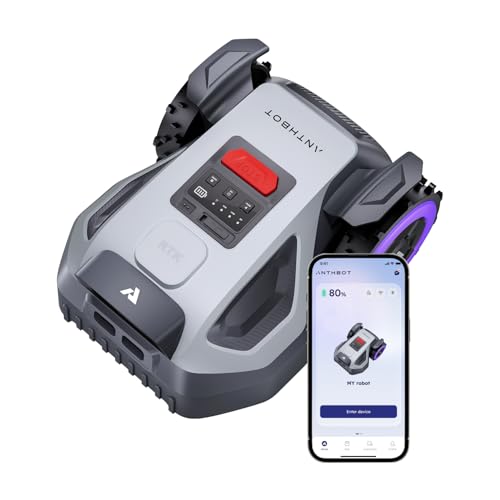
ANTHBOT M9 Robotic Lawn Mower, 1/4 Acre Wire-Free NRTK & Vision | 45% slope, Adjustable cutting height 1.2-2.8'' via APP, AI obstacle avoidance, ≤58dB, Auto Mapping & Resume, Zero Effort
Chosen because it specifies 1/4 Acre Wire-Free NRTK & Vision and 45% slope.
View on AmazonTop Picks at a Glance
- Best Overall for Small Lawns: Anthbot M9 (1/4 acre, wire-free, NRTK and vision)
- Best Budget Anthbot: Anthbot M5 (1/8 acre, dual vision plus full-band RTK)
- Best for Tree-Heavy Yards: Anthbot M5 LIDAR (lidar navigation for yards with poor sky view)
- Best Alternative at a Similar Size: Sunseeker X3 Plus (0.3 acre, RTK and vision AI)
- Best Compact Rival: Segway Navimow i105N (1/8 acre, RTK and vision)
- Best Lidar Step-Up: ECOVACS Goat O1000 LiDAR PRO (wire-free lidar mapping)
Comparison Table
| Model | Best for | Key specs (from listing) | Watch for | Price tier |
|---|---|---|---|---|
| Anthbot M9 | Small open lawns up to about 1/4 acre | NRTK and vision, 45% slope, cutting height 1.2-2.8 in. via app, 58 dB or below | Sky view needed for satellite positioning; sources conflict on weight | Mid-range |
| Anthbot M5 | Lawns up to about 1/8 acre | Dual vision plus full-band RTK, 45% slope, multi-zone mapping | Smaller battery than the M9; smaller lawn rating | Budget |
| Anthbot M5 LIDAR | Yards with partial tree cover | Lidar plus dual vision, 1/8 acre, 45% slope | Same small size rating as the M5 | Mid-range |
| Sunseeker X3 Plus | Up to 0.3 acre, edge cutting | RTK, vision AI, wire-free | Slope rating not listed in the title | Mid-range |
| Segway Navimow i105N | Very small lawns | RTK plus vision, 1/8 acre, wire-free | Small lawn rating | Budget |
| ECOVACS Goat O1000 LiDAR PRO | Buyers who want lidar and AI obstacle avoidance | Wire-free mapping, lidar navigation | Lawn size and slope not listed in the title | Premium |
1. Anthbot M9: Best for Small, Open Lawns
- Rated by the listing for 1/4 acre
- Wire-free navigation using NRTK and vision
- 45 percent slope capability per the listing
- Cutting height adjustable from 1.2 to 2.8 inches through the app
- Noise of 58 dB or below; AI obstacle avoidance; auto mapping and resume
Best for: homeowners with a quarter-acre or smaller lawn, open sky above it, and a wish to stop mowing weekly without installing a boundary wire. Skip if: your lawn is larger than a quarter acre or heavily shaded by tall trees.
Start with how it finds its way. The M9 combines satellite positioning with cameras. The listing names NRTK, which means network-corrected positioning, and independent coverage describes full-band RTK plus a dual-camera system. In practice that means the mower knows where it is within a small distance when it can see enough sky, and it uses vision to spot obstacles and keep to the mapped area. The advantage over a wire system is no trenching and no wire breaks. The limit is that satellite-based systems rely on a reasonably open view. Large oaks, tall hedges, or a house wall that blocks half the sky can degrade positioning, and cameras can struggle in very low light or heavy glare. If your lawn sits in the shadow of tall trees, look at the lidar variant in this guide.
The cutting system is worth understanding. Independent coverage lists a 5-blade disc and a cutting width around 20 cm, which is about 8 inches. That is small compared with a walk-behind mower, which is why robot mowers cut little and often. As a rough calculation, using the figure of up to about 150 square meters per hour that one reviewer attributes to the maker, a 1,000 square meter lawn would take around seven hours of cutting time in total for a full pass. Spread over a day with charging breaks, that is normal for robot mowers. It means they are best set to run several times a week, not as a one-hour chore, and the grass gets a light trim each time.
Battery details come from outside the listing. Reviewers cite a 5 Ah battery for the M9 versus 2.5 Ah for the M5, with runtime around 70 to 90 minutes and a charge time of around 90 minutes. They also disagree on whether the owner can replace the battery. Because sources conflict, confirm battery serviceability and warranty on the maker’s page before you buy, particularly if long-term ownership matters to you.
The slope claim of 45 percent appears in the listing. That is a steep gradient in robot mower terms, but treat it as a ceiling in ideal conditions. Wet grass, loose soil, and sharp transitions at the top or bottom of a slope reduce grip. We cannot confirm slope results and make no claims beyond the listing. Always keep the mower off wet slopes and follow the manual.
Noise is a genuine selling point: the listing says 58 dB or below, quiet enough to run in the evening on most lots. Sound level depends on distance and grass conditions, so expect a gentle hum rather than silence.
Ownership realities matter more than specs with robot mowers. Blades are consumables and are usually replaced every few months with heavy use. Wheels and the underside need cleaning to avoid clippings buildup. A garage or cover protects it from sun and rain, and Anthbot sells a garage for the M and N series; some listings include one. Winter storage guidance from the maker should be followed for the battery.
Pros: no boundary wire; quiet per the listing; app control with adjustable height; garage bundle available; 45 percent slope claim; AI obstacle avoidance.
Cons: needs open sky for the best positioning; quarter-acre rating limits larger lawns; reviewers report occasional missed strips that need a second pass; sources conflict on weight and battery serviceability.
2. Anthbot M5: Best for the Smallest Budget
- Rated by the listing for 1/8 acre
- Dual vision plus full-band RTK, no perimeter wire
- 45 percent slope capability per the listing
- Multi-zone mapping and app control with obstacle avoidance
Best for: small townhouse and urban lawns of up to about an eighth of an acre. Skip if: your lawn is bigger, since the smaller battery means longer total mowing time.
The M5 and M9 share most of their hardware according to published comparisons. The main difference is battery size and the recommended lawn area, with the M5 rated for roughly half of what the M9 is rated for. That makes the M5 the cheaper entry to the same wire-free approach. If your lawn is small enough that a 2.5 Ah battery gets the job done, there is no need to pay for the larger one. Be honest about your lawn size and measure it; robot mowers rarely cut corners on rated area claims, but they cannot stretch beyond them without leaving the job unfinished.
The M5 also appears in several bundles, including versions with a garage and network RTK services, which can change the total cost. Compare bundle contents carefully because the same mower may be sold with different accessories.
Pros: lowest Anthbot entry; wire-free; same navigation family as the M9; multi-zone mapping.
Cons: smaller lawn rating; smaller battery; bundles vary, so compare contents.
3. Anthbot M5 LIDAR: Best for Yards With Tree Cover
- Lidar plus dual vision, wire-free
- Rated by the listing for 1/8 acre
- 45 percent slope claim; cutting height 1.2-2.8 inches via app
Best for: small yards where trees or buildings block part of the sky. Skip if: you have an open lawn, where the standard M5 or the M9 costs less.
Lidar uses a laser sensor to measure distance to nearby objects, so it does not depend on satellite signal in the same way. It can help in yards with tree cover, though it has its own limits, such as lawns that lack features to lock onto. The listing for this variant states the same 1/8 acre rating as the M5. If your priority is reliable navigation in a tricky small yard, this is the Anthbot to compare against the M9.
Pros: lidar navigation helps where satellite view is limited; wire-free; same small size.
Cons: higher tier than the standard M5; small lawn rating.
4. Sunseeker X3 Plus: Best Alternative at a Similar Size
- Rated by the listing for 0.3 acre
- RTK plus vision AI, wire-free
- Edge cutting for homeowners with small lawns
- Slope rating and battery capacity: not listed in the title
Best for: homeowners who want a slightly larger rated area than the M9 with a similar navigation approach. Skip if: slopes are a concern and you need a stated slope figure up front.
The X3 Plus competes directly with the M9. Its 0.3 acre rating sits a little above the M9’s quarter acre. The listing highlights efficient edge cutting, which matters because robot mowers often leave a strip along fences and beds that you trim by hand. Check the maker’s page for the actual cutting method, the slope limit, and the app features before comparing it against the M9.
Pros: slightly larger rated area; RTK and vision; edge-cutting focus.
Cons: slope limit not listed in the title; support details differ by brand.
5. Segway Navimow i105N: Best Compact Rival
- Rated by the listing for 1/8 acre
- Perimeter-wire-free RTK plus vision navigation
- AI-assisted mapping
Best for: very small lawns where you want a recognized consumer brand. Skip if: your lawn is larger than about an eighth of an acre.
The i105N is an eighth-acre competitor to the M5. The decision here is brand ecosystem and support rather than raw capability. Compare the app experience, the warranty terms, and the availability of service in your region.
Pros: wire-free; recognized brand; compact.
Cons: small area rating; limited details in the listing title.
6. ECOVACS Goat O1000 LiDAR PRO: Best Lidar Step-Up
- Wire-free mapping with lidar navigation
- AI obstacle avoidance and smart edge handling named in the listing
- Lawn size and slope: not listed in the title
Best for: buyers who want lidar navigation and are willing to pay a higher tier for it. Skip if: you have a small open lawn, where the M9 does the job for less.
Lidar-first mowers are a different design philosophy from RTK-first mowers. They tend to cost more, and the benefit is most obvious in yards where satellite view is poor. Read the manufacturer’s page for the recommended lawn size and slope capability because neither appears in the listing title.
Pros: lidar navigation; wire-free mapping; AI obstacle avoidance.
Cons: higher tier; key capacity specs not listed in the title.
Also Consider
Anthbot N8
A larger Anthbot rated by the listing for 3/8 acre, with a sweeper and an automatic dump feature for leaf collection. Choose it if you want the Anthbot approach on a bigger lawn.
Anthbot Genie 600
A wire-free Anthbot with RTK and four-camera vision, rated by the listing for 0.22 acre and multi-zone management. A reasonable middle step if the M5 feels too small and the M9 feels like too much.
Anthbot Garage for M/N Series
A protective shelter for the M5, M9, M5 LIDAR, and N8. Worth buying if you have no covered spot for the mower to park.
How We Chose
This is a research-based review. We did not personally use the mower or any of the alternatives. We pulled the M9, M5, and M5 LIDAR details from the product listings, then cross-checked them against the maker’s published specifications and independent coverage from Notebookcheck, Reviewed, Gadget Review, Basic Tutorials, and other outlets. When sources disagreed, we noted it instead of picking one. The alternatives came from the same product store, and we kept only wire-free models of a comparable or slightly larger lawn size, plus one lidar step-up. We use tier words instead of exact prices because discounts and bundles change often.
Buying Guide: Choosing a Wire-Free Robot Mower
Match the lawn size with margin
Measure your lawn in square feet or square meters. One acre is about 43,560 square feet, so a quarter acre is roughly 10,900 square feet, or about 1,000 square meters. Pick a mower rated for at least 20 percent more than your lawn, because rated areas assume ideal conditions: flat ground, few obstacles, and moderate grass growth. A lawn with many islands, narrow passages, or steep slopes needs more margin.
Navigation: RTK, vision, and lidar
RTK uses satellite signals corrected by a base or network to find position precisely. It works best with open sky. Vision cameras identify obstacles and help with lawn boundaries. Lidar measures distances with a laser and does not need satellite view. Many mowers combine two or more. Decide based on your yard: open sky favors RTK plus vision, tree cover favors lidar.
Slopes
Listings often claim slope capability in percent. A 45 percent slope is about 24 degrees. Treat it as a maximum, not a typical working grade, and keep the mower off wet slopes. If your lawn has steep sections, check the manual for guidance and consider leaving those areas to a trimmer.
Cutting width and height
Robot mowers cut a narrow swath, around 8 inches in the M9 class, so they work best when scheduled several times a week. Adjustable height from about 1.2 to 2.8 inches covers most lawn types. Raise the height in summer heat and when grass is stressed.
App, mapping, and zones
Look for multi-zone mapping, no-go zones, scheduling, and rain handling. Read recent user feedback on app reliability, because the app is how you will interact with the mower daily.
Safety and security
Keep children and pets away from a running mower, and follow the maker’s blade and lift-sensor guidance. Look for anti-theft features such as PIN protection and location tracking if your lawn is visible from the street.
What Ownership Looks Like Week to Week
A robot mower changes the rhythm of lawn care rather than removing it. Plan on a short setup session, then a light weekly routine. During setup you place the charging dock or garage on level ground with a clear approach path, ideally near an outdoor outlet and with a view of open sky if the model relies on satellite positioning. You then walk or map the lawn boundary in the app, mark no-go zones around flower beds, ponds, and play equipment, and set a schedule. Expect to supervise the first few runs, because that is when you discover narrow gaps, soft ground, or garden hoses left across the lawn.
Here is a worked example for a 700 square meter lawn, which is roughly 7,500 square feet and under the M9’s rated area. If a reviewer’s mowing speed figure of about 150 square meters per hour holds for your grass, one full coverage pass takes a little under five hours of cutting. With an M9-class battery giving 70 to 90 minutes per charge and about 90 minutes to recharge, one pass spreads across roughly three cycles, or most of a day. Running it four or five days a week, with each run trimming only a small amount, keeps the lawn short without the one-hour weekly chore. Against that, a lawn at the upper end of the rated area leaves little slack for rain days, which is why we recommend choosing a model rated for at least 20 percent more than your lawn.
Clippings are left on the lawn as fine mulch, which is how robot mowers work. This is fine for regular, frequent cutting, but it is a poor match if you let grass grow tall between sessions or want bagged clippings. If you have been mowing a weekly lawn with a walk-behind, expect the first couple of weeks to look different while the mower works through longer grass in small increments.
Maintenance is modest. Every few weeks, wipe down the underside, clear grass from the wheels and the blade disc, and check the blades for nicks. Replace the blades when they look dull; the maker’s manual gives guidance. Update the app and firmware when prompts appear, since navigation changes are often delivered that way. Before winter, follow the maker’s storage guidance for the battery and keep the mower indoors if the manual recommends it. A garage cover helps with sun and rain exposure during the season.
Finally, think about the parts of the lawn the mower will not reach. Edges along fences, walls, and flower beds usually need an occasional trim, and tight corners may need a manual pass. Reviewers of the M9 mention occasional missed strips that were closed on a later run. That is normal for the category and a reason to keep a string trimmer handy.
Common Mistakes
- Ignoring the sky view. Satellite-assisted mowers need open sky for best results.
- Buying to the exact rated area. Leave margin.
- Skipping edge trimming. Most robot mowers leave some strips along fences and beds.
- Neglecting blade changes. Dull blades tear grass and reduce battery life.
Frequently Asked Questions
Is the Anthbot M9 worth buying?
It is worth considering if you have a small, open lawn and want wire-free mowing at a mid-range tier. It is a weaker fit for shaded, large, or complicated yards.
What is the difference between the Anthbot M5 and M9?
Published comparisons show they share most hardware. The M9 has the larger battery and a larger rated lawn area, while the M5 is the cheaper option for smaller lawns.
Does the Anthbot lidar robot lawn mower need satellite signal?
The lidar variant of the M5 uses laser sensing in addition to vision, which can help where sky view is limited. Check the maker’s page for how it combines sensors.
Can the M9 handle slopes?
The listing claims 45 percent. Treat that as a maximum and avoid wet grass on slopes.
How loud is the M9?
The listing says 58 dB or below, which is quiet for outdoor equipment.
Do robot mowers need a boundary wire?
Wire-free models like the M9 map the lawn using satellites, cameras, or lidar instead. You still draw or confirm the boundary in the app.
How often do the blades need replacing?
It depends on use and terrain. Check the blades regularly and replace them when edges are dull or chipped, following the manual.
Which One Should You Buy?
Buy the Anthbot M9 if your lawn is up to a quarter acre with open sky. Buy the M5 if your lawn is closer to an eighth of an acre and you want the lower tier. Pick the M5 LIDAR or the ECOVACS Goat O1000 if trees block your sky view. Look at the Sunseeker X3 Plus if you want a slightly larger rated area and the Segway Navimow i105N for a very small yard. In every case, measure the lawn, confirm the details on the maker’s page, and keep a trimmer ready for edges.
Sources
- Anthbot product pages for M5, M9, and M5 LIDAR
- Notebookcheck Anthbot M9 review
- Reviewed Anthbot M9 review
- Gadget Review and Basic Tutorials Anthbot M9 coverage
- Manufacturer pages for Sunseeker, Segway Navimow, and ECOVACS
Last updated: October 2026