Key takeaways
- Remove leaves before opening the cover so debris does not fall into the pool or jam the tracks.
- Keep the cover pump working and prevent standing water from becoming heavy enough to overstress the fabric.
- Rinse or clean the cover as directed, avoiding harsh solvents and abrasive tools.
- Inspect rope, guides, sliders, end stops, seams, and track fasteners at least each season.
- Never walk, sit, or allow pets onto the cover, even when it is marketed as a safety cover.
- Keep the cover fully open or fully closed rather than leaving it partially deployed.
The best automatic pool covers are motorized, ASTM F1346-compliant safety covers sized to your pool’s exact finished dimensions, with the right choice depending mainly on pool shape, available deck space, operating method, and installation budget.
Quick picks by pool and priority
| Situation | Best-fit cover type | Why it makes sense | Typical installed cost |
|---|---|---|---|
| New rectangular pool with room for a housing | Under-track automatic vinyl cover | Clean appearance, strong perimeter support, and straightforward operation | $12,000–$20,000 |
| Existing pool being renovated | Above-ground or deck-mounted automatic system | Less demolition and easier access for future service | $10,000–$18,000 |
| Freeform, kidney, or unusually shaped pool | Custom automatic cover with an engineered track layout | Can accommodate curves, but usually requires more visible hardware and careful measurement | $15,000–$25,000+ |
| Small pool used frequently | Electric motor system with wall switch or keypad | Fast, repeatable opening and closing without manual handling | $10,000–$18,000 |
| Remote location or unreliable power | Battery-assisted or solar-assisted automatic system | Can reduce dependence on a nearby electrical circuit, subject to manufacturer limits | $13,000–$24,000+ |
These are broad North American market ranges for equipment and installation, not quotes. Deck repairs, electrical work, drainage changes, unusual geometry, and cover-room construction can increase the total.
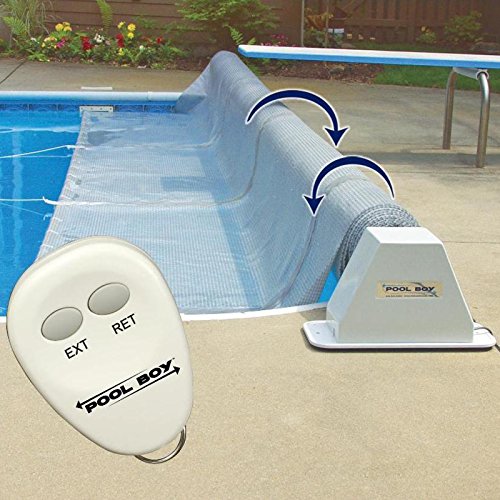
Pool Boy 1 Powered Pool Solar Blanket Reel - Extends and Retracts on The Click of a Button - Works on Inground Pools Up to 20 Feet Wide and 40 Feet Long - Made in The USA - 3 Year Prorated Warranty
Included for 'Best Automatic Pool Covers for Safety, Efficiency, and Easy Use' because the listing specifies Extends and Retracts on The Click of a Button and Works on Inground Pools Up to 20 Feet Wide and 40 Feet Long, details this guide uses to compare options.
View on Amazon
Automatic Motorized Solar Blanket Cover Reel/Roller for Pools up to 20x40'
Included for 'Best Automatic Pool Covers for Safety, Efficiency, and Easy Use' as a relevant option in this category; details come from the product listing.
View on Amazon
Pool Boy III Battery Powered Swimming Pool Solar Blanket Reel System - Works with a Click of a Button - for Inground Pools Up to 20 Feet Wide and 40 Feet Long - Made in The USA - 3 Year Warranty
Included for 'Best Automatic Pool Covers for Safety, Efficiency, and Easy Use' because the listing specifies Works with a Click of a Button and for Inground Pools Up to 20 Feet Wide and 40 Feet Long, details this guide uses to compare options.
View on AmazonHow automatic pool covers compare
Under-track systems
An under-track cover stores in a recessed box or vault at the end of the pool. The cover travels along tracks installed below or very near the deck surface, so the finished result is usually the least obtrusive option. It is the strongest candidate for a new pool or a major renovation because the vault and track supports can be planned before concrete or coping is installed.
The trade-off is construction complexity. Retrofitting an under-track system may require cutting the deck, modifying the pool structure, adding drainage, and creating service access to the motor and cover reel. A poorly drained vault can damage the fabric, hardware, and motor over time.
Top-track and deck-mounted systems
Top-track systems attach to the pool perimeter or deck surface rather than hiding the mechanism below it. They are often more practical for an existing pool because installation can involve less demolition. The housing and tracks are visible, however, and narrow decks, raised walls, spillways, rock features, and irregular coping can restrict the available layout.
For many homeowners, visible hardware is a reasonable compromise: service access is simpler, and the installation may be completed without rebuilding a large section of the patio.
Rope-and-pulley or manual alternatives
Manual safety covers, reel systems, and tensioned mesh covers cost less than fully automatic systems, but they do not provide the same push-button convenience. A manual cover can still be a sensible choice for a seasonal pool, a tight budget, or a pool used only a few times each month. Do not treat a low-cost solar blanket as a safety cover; it is designed primarily for heat retention and does not provide equivalent load-bearing protection.
Material and operating-system choices
Most automatic safety covers use reinforced vinyl, commonly around 16 to 20 ounces per square yard, with a heavier or more abrasion-resistant construction available from some manufacturers. Solid vinyl blocks sunlight and keeps leaves and rainwater from entering the pool, but accumulated water must be removed with a cover pump or an approved drainage arrangement. Mesh covers reduce standing-water concerns but may allow fine debris and some sunlight through.
| Feature | Common specification | What it means in ownership |
|---|---|---|
| Cover fabric | Reinforced vinyl, about 16–20 oz/sq yd | Durable and opaque, but vulnerable to sharp edges, chemical imbalance, and abrasion |
| Typical cover size | Custom-made; many residential systems handle roughly 12–20 ft widths and 20–50 ft lengths | Actual limits vary by manufacturer, geometry, wind exposure, and track design |
| Drive system | Low-voltage or dedicated electric motor, commonly 24 V or 120 V architecture | Requires correct electrical installation and protected controls |
| Opening time | Often about 45–120 seconds for a typical residential pool | Longer pools, low temperatures, friction, or a nearly discharged battery can increase runtime |
| Cover mass | Often approximately 100–300 lb for residential sizes | Explains why motorized winding and properly supported tracks matter |
| Safety standard | Look for ASTM F1346 compliance or certification | Confirms the complete installed cover system was designed for recognized safety performance |
A wall switch is simple and dependable. Keypads can add access control, while remote controls are convenient but should not replace a clearly visible safety check before operating the cover. Some systems include interlocks that prevent operation when the pump, water level, or cover position is unsuitable. Ask whether the control is weather-resistant and whether replacement remotes remain available.
Pool-shape compatibility
A simple rectangle is the easiest shape for an automatic cover. Tracks run parallel to the long sides, the cover has fewer corners to negotiate, and the storage reel can sit at one end. Squares and narrow rectangles are also generally uncomplicated if the deck leaves enough room for the track and housing.
Freeform, L-shaped, kidney-shaped, oval, and Roman-end pools require a custom track design. Curves may be covered with shaped fabric, but the cover still needs a practical path from the waterline to the storage mechanism. A deep inside corner, raised spa, tanning ledge, attached steps, waterfalls, or a disappearing edge can make a standard system unsuitable or require separate engineering.
Ask the installer to show the proposed track route on a scaled drawing. The important question is not simply whether the cover “fits” the pool; it is whether the cover can travel without rubbing walls, snagging on fittings, crossing raised features, or leaving unsupported gaps at the perimeter.
How to measure for a proper fit
Final dimensions should come from an authorized installer, but these homeowner measurements make estimates more useful:
- Measure the finished water opening. Record width at several points, length at several points, and both diagonals. A rectangle that differs by more than about 1 inch from one end to the other needs closer inspection.
- Map every obstruction. Note stairs, ladders, handrails, skimmers, lights, waterfalls, raised walls, attached spas, and changes in coping height. Include their distance from each pool corner.
- Measure the deck. Record clear width on all four sides. A track, housing, or vault needs structural support and service clearance; do not assume a narrow strip of concrete is sufficient.
- Check level and elevation. Use a straightedge or laser level to identify slopes, uneven coping, and transitions between deck surfaces. The cover must seal and travel across a consistent perimeter.
- Plan the storage location. Measure the available end-of-pool space for a reel, box, vault, or bench. Include room to remove the motor and reel later.
- Confirm water-level requirements. Automatic covers typically need the water maintained near the manufacturer’s specified operating level. A low pool can leave unsupported fabric; an overfilled pool can interfere with the mechanism.
For a simple rectangular pool, a rough fabric-area estimate is length multiplied by width. For example, a 16-by-32-foot pool has a 512-square-foot water opening. If the cover extends 6 inches beyond the opening on each side for the track system, the planning envelope becomes approximately 17 by 33 feet, or 561 square feet. That is only a planning calculation: the manufacturer’s pattern accounts for track clearances, corners, hardware, and tension.
Installation requirements that affect the decision
Automatic covers are not usually a do-it-yourself replacement for a standard pool cover. Installation may involve anchoring tracks into concrete, routing electrical power, constructing a dry vault, fitting the fabric, setting limit switches, and testing the completed safety system. Concrete must be sound enough to hold repeated track loads; cracked or hollow coping may need repair first.
For a new pool, specify the cover before the deck is poured. For an existing pool, obtain a site drawing and a written scope that identifies demolition, electrical work, drainage, deck restoration, and warranty responsibility. A low installation quote can become expensive if it excludes the vault, control wiring, coping repair, or cover pump.
Durability and maintenance realities
The cover fabric and leading edge usually experience the most wear. Dirt caught in the tracks increases friction, sharp landscaping debris can puncture vinyl, and dragging furniture or toys across the closed cover can damage it. Keep the water chemistry within the cover manufacturer’s stated range; excessive sanitizer concentration and very low pH can shorten fabric life.
- Remove leaves before opening the cover so debris does not fall into the pool or jam the tracks.
- Keep the cover pump working and prevent standing water from becoming heavy enough to overstress the fabric.
- Rinse or clean the cover as directed, avoiding harsh solvents and abrasive tools.
- Inspect rope, guides, sliders, end stops, seams, and track fasteners at least each season.
- Never walk, sit, or allow pets onto the cover, even when it is marketed as a safety cover.
- Keep the cover fully open or fully closed rather than leaving it partially deployed.
Expect periodic service for fabric adjustment, track cleaning, motor components, switches, and seals. Ask about the fabric warranty separately from the motor and installation warranties, since these often have different terms and exclusions.
Bottom line
Choose an under-track system when appearance and a new-build installation matter most. Choose a top-track or deck-mounted system when you need a practical retrofit. For a freeform pool, prioritize an installer who can provide a measured track drawing rather than selecting solely by motor brand. In every case, verify the complete system’s ASTM F1346 status, confirm the pool and deck measurements, and budget for professional installation and ongoing track and fabric maintenance.