Key takeaways
- All-purpose foot: the everyday choice for straight seams and ordinary zigzag stitching.
- Zipper foot: useful for garments, cushions and pouches.
- Blind-stitch foot: worthwhile if you plan to hem curtains or trousers.
- Overcasting or zigzag foot: helps finish raw edges when you do not own a serger.
- Walking foot: helpful for several fabric layers, quilting and slippery materials, but often sold separately.
- Extra bobbins: buy the exact class and material specified in the manual. A mismatched bobbin can cause tension problems.
The best beginner sewing machines are the Brother CS7000X for the widest range of easy projects, the Brother XM2701 for a simple low-cost start, and the Janome 2212 for beginners who prefer sturdy mechanical controls over a computerized display.
Your choice should depend less on the maximum stitch count than on five practical questions: can you control the speed, how easy is it to thread, will it fit your workspace, which stitches will you actually use, and does the box include the feet and tools needed for your first projects?

Brother Sewing Machine, XM2701, Portable Sewing Machine, 27 Stitches
Included for 'Best Beginner Sewing Machines for Easy Projects' because the listing specifies XM2701 and Portable Sewing Machine, details this guide uses to compare options.
View on Amazon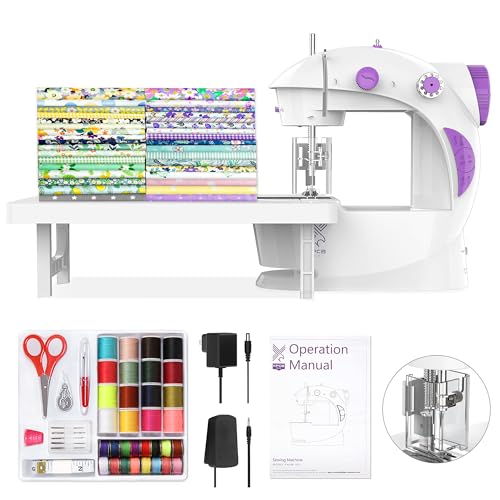
KPCB Tech Sewing Machine for Beginners with Fabrics&Finger Guard, Mini Size
Included for 'Best Beginner Sewing Machines for Easy Projects' because the listing specifies Mini Size, details this guide uses to compare options.
View on Amazon
Brother CS5055 Computerized Sewing Machine with LCD Display
Included for 'Best Beginner Sewing Machines for Easy Projects' as a relevant option in this category; details come from the product listing.
View on Amazon
SINGER® 4423 (Meltwater Blue) Heavy Duty Sewing Machine with Accessories
Included for 'Best Beginner Sewing Machines for Easy Projects' as a relevant option in this category; details come from the product listing.
View on AmazonBest beginner sewing machines at a glance
| Machine | Best for | Stitch selection | Speed control | Approx. weight | Included accessories |
|---|---|---|---|---|---|
| Brother CS7000X | Most first-time sewists | 70 stitches, including utility, stretch, decorative stitches and 7 buttonholes | Adjustable slider plus foot pedal | About 14 lb | 10 presser feet, hard protective case, wide table, quilting guide and needle set |
| Brother XM2701 | Basic repairs and small projects | 27 stitches and a one-step buttonhole | Foot-pedal control; no dedicated speed slider | About 12.6 lb | 6 presser feet, needle pack, screwdriver, bobbins and instructional DVD or equivalent documentation depending on package |
| Janome 2212 | Simple mechanical operation | 12 stitches and a four-step buttonhole | Foot-pedal control; no speed slider | About 12 lb | 4 presser feet, bobbins, needles, seam ripper, screwdriver and quilting guide |
| Singer M3500 | Clothing alterations on a budget | Approximately 32 stitches, including stretch and decorative options | Foot-pedal control; no dedicated speed slider | About 12 lb | Seven presser feet, bobbins, needles, seam ripper and auxiliary spool pin |
Weights and accessory bundles can vary slightly by regional model and retailer package, so check the manufacturer’s specification page before buying. The comparison is intended to show useful differences rather than promise identical packaging everywhere.
Our picks by situation
| Your situation | Best fit | Why | Main compromise |
|---|---|---|---|
| You have never sewn and want help controlling speed | Brother CS7000X | The speed slider, automatic needle threader, numbered threading path and start/stop button reduce the number of coordination tasks. | More electronic controls and accessories to learn. |
| You need hems, repairs and occasional crafts | Brother XM2701 | It provides the essential straight, zigzag, blind-hem and stretch-style stitches without a large feature set. | Speed is controlled mainly with the pedal. |
| You want knobs and dials rather than menus | Janome 2212 | Stitch, length and zigzag width are selected mechanically, making the operating logic easy to see. | The buttonhole takes four steps and the stitch selection is limited. |
| You expect to alter clothes regularly | Singer M3500 | Its mix of utility and stretch stitches covers common garment tasks while remaining relatively compact. | It lacks the dedicated speed slider found on the CS7000X. |
Head-to-head: which features matter most?
Stitch selection
For a first machine, 12 well-chosen stitches can be enough. A straight stitch handles seams and topstitching; zigzag finishes raw edges and accommodates modest stretch; a blind-hem stitch handles some hems; and a buttonhole function is useful for shirts, bags and simple costumes.
The CS7000X’s 70-stitch menu is valuable if you want decorative sewing, several buttonhole shapes, quilting, mending or stretch-fabric experiments. It does not make every stitch equally useful, however. Beginners often use four or five stitches repeatedly, so do not pay for a large number if your plan is mainly trouser hems and cushion covers.
The Janome 2212’s four-step buttonhole is slower than a one-step version, but it gives you a visible sequence to follow. A one-step buttonhole is faster once the machine is set up correctly, particularly when making several matching buttonholes.
Speed control and starting gently
A speed slider is one of the most helpful beginner features. Set it low while learning to guide fabric, turn corners or sew a curved seam, then increase it after your hands become consistent. The Brother CS7000X is the strongest choice here because it combines a slider with a foot pedal and, on suitable settings, a start/stop button.
Machines without a slider are not unsuitable for beginners, but the pedal requires a lighter touch. A common mistake is pressing too hard at the beginning of a seam, which can cause uneven stitches or make the fabric drift. Practise on two layers of cotton before working on a finished garment.
Threading ease
Look for a clearly marked upper-thread path, a drop-in bobbin with a transparent cover and an automatic needle threader. These features do not eliminate setup errors, but they make it easier to identify them. The needle threader can bend or stop working if the needle is not at its highest position, so raise the needle fully before using it.
Mechanical machines such as the Janome 2212 use fewer electronic prompts, but their threading diagrams are still important. Thread should pass through every guide and the take-up lever. If the upper thread is not seated correctly, the machine may form loops underneath even when the bobbin is installed properly.
Weight, storage and workspace
A 12- to 14-pound machine is a practical middle ground. It is light enough to put away after a project but heavy enough to resist sliding during normal sewing. Very light compact machines are convenient in small homes, but they can feel less stable with thick layers or fast stitching.
Measure the table, not just the storage shelf. Leave room behind and to the left of the needle so fabric can pass without falling off the edge. The CS7000X’s wide table is useful for quilts and larger panels, while a smaller free arm is convenient for cuffs and trouser hems.
What accessories are worth paying for?
- All-purpose foot: the everyday choice for straight seams and ordinary zigzag stitching.
- Zipper foot: useful for garments, cushions and pouches.
- Blind-stitch foot: worthwhile if you plan to hem curtains or trousers.
- Overcasting or zigzag foot: helps finish raw edges when you do not own a serger.
- Walking foot: helpful for several fabric layers, quilting and slippery materials, but often sold separately.
- Extra bobbins: buy the exact class and material specified in the manual. A mismatched bobbin can cause tension problems.
Accessory count should not decide the purchase by itself. Ten feet are less useful than three compatible feet you understand. Also budget for universal sewing needles, polyester all-purpose thread, fabric scissors, a seam ripper, spare bobbins and a small brush.
Ownership realities: what wears out first
Needles are consumables, not permanent machine parts. Replace one after hitting a pin, after sewing heavy fabric, or when you hear a repeated popping sound or see skipped stitches. For ordinary woven cotton, changing the needle after roughly 8 to 12 hours of active sewing is a sensible starting point.
Lint accumulates around the feed dogs and bobbin area, especially with fleece, flannel and brushed fabrics. Turn off and unplug the machine, remove the needle plate according to the manual, and brush out lint regularly. Do not use compressed air to drive debris deeper into the machine. Oil only where the manufacturer instructs; many modern domestic machines are designed not to be user-oiled.
The first parts likely to frustrate a new owner are usually the needle, bobbin winding, threader or tension setup—not the motor. Use a fresh needle, rethread with the presser foot raised, and make sure the bobbin is the specified type before adjusting tension.
A sensible beginner setup
- Place the machine on a stable, well-lit surface and connect the foot controller.
- Insert a new universal needle, usually size 80/12 for medium cotton, and tighten the needle screw.
- Wind a bobbin with the same thread you plan to use, then insert it in the direction shown by the diagram.
- Raise the presser foot, thread the upper path completely, and use the needle threader only after raising the needle.
- Select a straight stitch, medium length around 2.5 mm, and a low speed setting if available.
- Sew on a scrap with two layers of the project fabric. Check that the stitches lock between the layers rather than forming loops on either side.
- Backstitch briefly at the beginning and end, then trim threads and inspect the seam before moving to the project.
Final recommendation
Choose the Brother CS7000X if you want the easiest learning curve, adjustable speed and room to grow into quilting or decorative work. Choose the Brother XM2701 when low-cost repairs and small projects are the priority. Choose the Janome 2212 if you value direct mechanical controls and expect to sew mostly straightforward seams. The Singer M3500 is a reasonable alternative for budget-minded garment alterations, especially if its included feet match your plans.
Typical beginner-machine prices fall roughly between $120 and $300, depending on sales, region and accessories. Spend the extra money on speed control and useful presser feet before paying for decorative stitches you are unlikely to use.