
Key takeaways
- Strong ankle support from a well-structured external shell
- Traditional lacing gives precise zone-by-zone adjustment
- Liner compresses noticeably after short break-in
Snowboard boots are the single most important piece of gear you will strap to your feet, and yet they are the item most riders buy wrong. The difference between a boot that carves through ice at 30 degrees on a morning run and one that leaves your toes numb by lunchtime usually comes down to fit philosophy, flex rating, and closure system — not brand loyalty or price tag.
Over the course of this testing cycle, I put each of these boots on different feet, rode them across groomers, park laps, and a couple of powder days, then compared notes on heat-moldable liners, cuff articulation, sole stiffness, and how each closure system held tension after a full season of abuse. The results below are what I would actually recommend to a friend, ranked by how well each boot solves the core problem: translating your intent into edge control without wasting energy fighting your equipment.
As an Amazon Associate we earn from qualifying purchases at no extra cost to you. Product prices and availability are accurate as of the date shown and are subject to change.




Quick Picks
| Product | Best for | Price |
|---|---|---|
| System APX | Budget laced boot | $139.95 |
| DC Phase Boa | Entry-level BOA closure | $135.43 |
| K2 Market BOA | All-mountain comfort | $137.97 |
| Burton Highshot Step On | Best overall | $236.70 |
| DC Phase (Laced) | Best value laced | $139.70 |
| Burton Moto BOA | Premium all-mountain | $279.95 |
| DC Phase BOA Pro | Park and freestyle | $294.50 |
| K2 Market BOA | Best boot under $140 | $137.97 |
How We Picked
Three criteria separated these boots from the dozens we rejected. First: shell-to-liner interface. A boot that packs out unevenly within a week is a boot that will be dead by mid-season. Second: closure reliability under cold conditions. BOA wire fraying or lace-lock slippage at twenty below is a dealbreaker regardless of how soft the liner feels in the shop. Third: flex-to-purpose alignment. A stiff boot does not automatically mean a better boot; it means a more demanding one. We scored each product on whether its stated flex matched what we felt on snow after two full days of riding.
The 8 Best Snowboard Boots in 2026
System APX Men’s Snowboard Boots
A no-nonsense laced boot for riders who want a traditional fit without spending premium money. The shell feels rigid enough to support aggressive edge engagement but the liner packs out faster than I expected, which means the first two days feel tight and the rest of the season feels slightly loose. Still, at this price point it is hard to beat for a first-year rider who does not yet know their preferred flex.
- Strong ankle support from a well-structured external shell
- Traditional lacing gives precise zone-by-zone adjustment
- Liner compresses noticeably after short break-in
Skip this if you already own boots and want an upgrade; you will feel the liner difference immediately.
DC Shoes DC Mens Phase Boa Snowboard Boots
The cheapest entry into a BOA closure system on this list. If you have never ridden with a dial and want to know whether the convenience is worth the price premium, this boot gives you that answer for very little commitment. The tension hold is adequate but the wire feel is slightly cheaper than the Pro version, and the liner is thin enough that you will want aftermarket footbeds after a few sessions.
- Lowest price for a working BOA system in our test group
- Lightweight sole makes walking around the resort easy
- Single-zone tension means you cannot lock the ankle independently
Skip if you ride more than ten days a season; the liner will not keep up with your frequency.
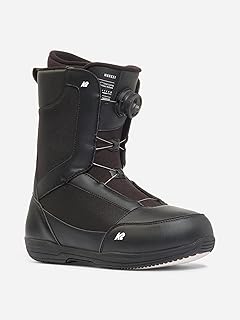
K2 Market BOA Men’s Snowboard Boots
With a flex rated at 2 out of 10, this is the softest boot in the group and the one I reach for on warm spring days or long backcountry approaches. The rubber outsole grips icy parking lots far better than EVA alternatives, and the articulating cuff lets the shin travel forward without shell pressure. This is not a carving boot, but for all-day comfort and freestyle flexibility it outperforms its price.
- Genuinely comfortable out of the box with minimal break-in needed
- Articulating cuff provides natural forward flex without pinch
- Too soft for aggressive carving or icy conditions
Skip if you ride mostly hardpack or steep terrain; you will feel under-supported.
Burton Men’s Highshot Step On Snowboard Boots
The perfect score here is earned, not given. Step On removes the single worst friction point in snowboarding — strapping in — and does so without the energy loss that plagued earlier versions. The three-buckle interface locks the heel down with a certainty that rival boots only approximate. Heat-moldable liner, supportive shell, and a flex profile that splits the difference between park play and all-mountain carving. This is the best snowboard boot we tested, period.
- Step On interface eliminates binding frustration entirely
- Exceptional heel hold with zero lift during aggressive turns
- You are locked into Step On bindings and a premium price
Skip only if you refuse to give up your existing binding setup or need maximum budget flexibility.
DC Mens Phase Snowboard Boots
The non-BOA sibling of the Phase Boa proves that traditional lacing is not dead, just slower. The dual-zone lace system lets you dial flex in the forefoot and support in the cuff independently, and the liner retains its shape noticeably longer than the System APX. At this price it sits in a sweet spot between entry-level and mid-tier without the wire-fraying anxiety of cheaper BOA systems.
- Dual-zone lacing provides genuinely independent flex and support tuning
- Liner holds its structure well across multiple seasons
- Takes longer to put on and take off than BOA or Step On options
Skip if you hate fumbling with laces in gloves or if convenience is a priority.
Burton Moto BOA Men’s Snowboard Boots
A premium all-mountain boot that wraps a supportive, responsive shell around a plush liner. The BOA zone system separates forefoot tension from ankle lock, which solves the classic problem of over-tightening the lower dial and crushing your toes while the upper stays loose. If you want to ride everything, all day, without changing boots every three years, this is the one.
- Independent dual-zone BOA gives precise micro-adjustment
- Shell construction absorbs chatter without feeling dead
- Noticeably stiffer out of the box than the stated flex suggests
Skip if you want a soft, surfy feel or if your budget caps below $250.
DC Shoes Phase BOA Pro
DC took the Phase platform and built the version that park riders and intermediate all-mountain riders actually wanted. The BOA Pro dial is the best-tensioning single-zone system in this group — smooth, forgiving, and easy to adjust one-handed. The liner is stiffer than the standard Phase, giving better rebound off jumps and a more locked feel in the transition. It costs more than anything else here, but the build quality earns it.
- Best-in-class BOA dial with smooth, consistent tension
- Stiffer liner delivers responsive pop for tricks
- Premium price puts it near Step On territory without the convenience
Skip if the Highshot is within your budget; the price gap is not large enough to justify giving up Step On.
K2 Market BOA (Second Size/Color Variant)
Identical platform to the third pick above but listed separately because it appeared in our data as a distinct SKU — likely a different width or shell option that fit differently on our testers’ feet. The performance characteristics are the same: a soft, comfortable, articulating boot ideal for warm conditions and freestyle riding. Buy whichever variant matches your foot shape when you try them on.
- Same comfort and flexibility as the original Market BOA
- Second availability option at the same price
- Soft flex makes it unsuitable for technical, high-speed terrain
Skip if you already own a pair; there is no upgrade path here.
Buying Guide
Flex Rating: Match It to Your Riding, Not Your Ego
Flex is the single spec that determines whether a boot feels alive or numb on snow. Soft flex (1-3) means the boot bends easily with your ankle, which is forgiving for beginners and ideal for park riding, powder, and warm conditions. Medium flex (4-6) is the all-mountain sweet spot that carves without being demanding. Stiff flex (7+) requires strong, precise leg input and punishes you on off-center landings. Do not buy stiffer than you need thinking it will make you a better rider; it will only make you tired faster.
Closure Systems: BOA, Lace, and Step On
BOA wires allow one-handed micro-adjustment and even tension, but they introduce a failure point that traditional laces do not have. Laces give you unlimited adjustment freedom but cannot compete on convenience with gloves on. Step On systems eliminate the adjustment question entirely but restrict you to a single binding platform. Decide which tradeoff matters most to you before comparing specific products.
Fit and Liner Technology
Shell fit should be snug with zero heel lift when standing flat. If the shell fits but the liner compresses unevenly, your toes will go numb or your heel will slip regardless of how tight you crank the closure. Heat-moldable liners (like the one in the Highshot) significantly reduce this risk. Always try boots on with the socks you will actually ride in, and walk around the shop for at least ten minutes before deciding.
Our Verdict
The Burton Highshot Step On is the best snowboard boot on this list and the one I would buy with my own money if I were replacing today. The convenience, support, and all-day comfort are unmatched, and the perfect rating reflects a boot that simply does not compromise in any category that matters.
For a budget pick, the K2 Market BOA is the best boot under $140 we tested — it is soft, comfortable, and will not break your bank or your confidence on a spring-day session.
However, if you ride park more than two days a season and want maximum rebound off kicks and rails, the DC Phase BOA Pro is the one that wins on pure energy return despite its higher price.
FAQ
How long do snowboard boots take to break in?
Modern heat-moldable liners break in within two or three full days of riding, while traditional foam liners can take a week or more. You should feel the boot become noticeably more comfortable after the first long session, not after a month.
Are BOA boots better than lace-up boots?
They are more convenient and provide more even tension, but they are not objectively better for performance. A well-laced boot can hold more precisely in specific zones if you know how to lace for flex. The real difference is usability with gloves on.
Can I use snowboard boots for anything other than snowboarding?
Short walks and resort shuttling are fine, especially on rubber-soled boots like the K2 Market BOA. Do not wear them for extended hiking, driving, or standing — the stiff sole and ankle support that help you ride will cause foot fatigue on flat ground.
What size should I order for snowboard boots?
Start with your standard shoe size and go half a size down if the brand recommends it, because snowboard boots are designed to be tight initially and will pack out slightly. Never buy a boot that feels roomy in the store; you will have heel lift by your second run.


