Key takeaways
What's inside
Outdoor emergency communication is what turns a backcountry crisis into a phone call for help when cell service disappears. This roundup compares five field-tested devices across coverage, range, cost, and ease of use, from a global satellite messenger to a simple whistle, so you can build a layered plan to reach help from anywhere you hike.
As an Amazon Associate we earn from qualifying purchases.
By Jake Thompson
How to Plan Outdoor Emergency Communication
The best communication plan uses layers, since no single device covers every situation. Good outdoor emergency communication weighs satellite coverage, subscription costs, and how you will actually signal for help. Start by understanding three factors before you choose your devices.
Coverage and Range
Devices differ enormously in reach. Satellite messengers and beacons work almost anywhere on Earth, two-way radios reach only line-of-sight over a few miles, and a whistle carries just within earshot. Match the tool to how far from help you travel, since remote trips demand true global coverage.
Terrain affects even satellite devices. Steep canyons and dense forest can block the sky view these tools need, slowing or delaying messages. Understanding these limits keeps your outdoor emergency communication realistic, so you position yourself with a clear view of the sky when sending a critical message.
Two-Way Messaging vs SOS-Only
Decide how much you need to communicate. Two-way satellite messengers let you text family, get weather, and describe your emergency to rescuers, while a personal locator beacon simply sends an SOS with your location. Two-way devices offer flexibility, while beacons offer rugged simplicity with no subscription.
Cost follows capability. Satellite messengers require a monthly or annual subscription, while beacons are a one-time purchase you register for free. Weigh how often you will use non-emergency messaging against the ongoing cost, a core decision in any outdoor emergency communication plan.
Backup and Redundancy
Even the best device can fail, so layering matters. A satellite messenger handles most needs, a whistle adds a battery-free signal for nearby rescuers, and a fully charged phone covers areas with coverage. Together they ensure a single failure never leaves you completely unable to signal.
The most important layer costs nothing: telling someone your plan. Sharing your route and expected return time means a rescue launches even if every device fails. Pairing that habit with reliable gear is the foundation of dependable outdoor emergency communication in the backcountry.
Top Picks: Emergency Communication Devices
With those factors in mind, this outdoor emergency communication roundup lines up five field-tested tools, each covering a different part of a layered plan. The table sums up the essentials, and the reviews below explain who each one suits and the trade-offs to weigh before you buy.
| Device | Type | Coverage | Best For |
|---|---|---|---|
| Garmin inReach Mini 2 | Satellite messenger | Global (Iridium) | Two-way messaging |
| ACR ResQLink View | Personal locator beacon | Global (406 MHz) | Subscription-free SOS |
| ZOLEO | Satellite messenger | Global | Value and check-ins |
| Two-Way Radio | GMRS radio | Line of sight | Group comms |
| Fox 40 Whistle | Whistle | Earshot | Ultralight backup |
Garmin inReach Mini 2 – Best Two-Way Messenger
The Garmin inReach Mini 2 is the proven backcountry standard for two-way contact. Weighing around four ounces, it sends and receives messages and an SOS over the global Iridium network, offers tracking and weather, and works as a standalone device, making it a versatile lifeline far beyond cell range.
It requires a subscription and is not ideal for detailed navigation on its own. But for reliable global two-way messaging and SOS in a tiny package, it is the benchmark that most serious hikers reach for first.
ACR ResQLink View – Best Subscription-Free SOS
The ACR ResQLink View is a personal locator beacon for pure emergency use. It transmits a powerful 406 MHz distress signal to the global search-and-rescue satellite network with no subscription ever, and it is buoyant and rugged, making it a dead-simple SOS device you register once and forget.
It offers no two-way messaging or check-ins, only an emergency alert. But for hikers who want a bombproof, cost-free SOS beacon without monthly fees, its simplicity and no-subscription model are exactly the point.
ZOLEO – Best Value
The ZOLEO Satellite Communicator delivers two-way messaging at the lowest entry cost. It pairs with your phone app, provides a dedicated phone number so contacts can text you easily, and sends check-ins and SOS over a global network, making it a friendly, affordable choice for casual backcountry users.
It relies more on your phone app for full messaging and connects a bit slower than premium units. But for hikers who want dependable two-way contact and a real phone number without top-tier pricing, it is an excellent value.
Two-Way Radio – Best Group Comms
A GMRS two-way radio keeps a group connected where there is no cell service. Rugged hiking-focused radios offer clear line-of-sight communication over a few miles, letting party members coordinate, regroup, and check in on one another during a trip without relying on satellites or subscriptions.
Range is limited by terrain and line of sight, so radios cannot summon outside rescue like a satellite device. But for real-time coordination within your own group, they add a practical layer no messenger replaces.
Fox 40 Whistle – Best Ultralight Backup
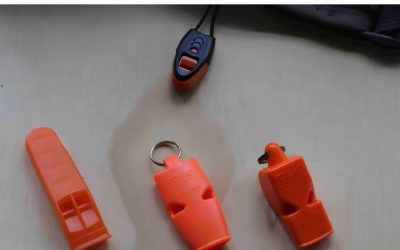
The Fox 40 whistle is the simplest, most reliable signal of all. Its pealess design produces a piercing blast that carries far beyond your voice and needs no batteries, letting you signal nearby rescuers or group members even when you are exhausted, injured, or your electronics have failed.
A whistle only reaches those within earshot, so it cannot replace a satellite device on remote trips. But as a near-weightless, foolproof backup that never runs out of power, it belongs in every outdoor emergency communication kit.
Frequently Asked Questions
A few questions come up again and again about outdoor emergency communication. Here are quick, practical answers to help you choose.
Satellite messenger or personal locator beacon?
A satellite messenger offers two-way texting, tracking, and weather for a subscription, while a personal locator beacon sends only an SOS but needs no subscription and is extremely rugged. Choose a messenger if you want to communicate regularly, or a beacon if you want a simple, cost-free emergency signal you rarely use.
Do satellite devices work everywhere?
They work almost anywhere with a clear view of the sky, but steep canyons, dense forest, and heavy cloud can delay or block messages. Position yourself in the open when sending a critical message, and understand that no device offers a perfect guarantee, which is why layering and telling someone your plan matter.
Can my phone call for help in the backcountry?
Only where there is cell coverage, which is absent across most real backcountry, though some newer phones add limited satellite SOS. A phone is a useful layer but not a reliable backcountry lifeline on its own, so carry a dedicated satellite device for trips beyond cell service.
What is the most important step for emergency communication?
Telling someone your route and expected return time. It costs nothing, weighs nothing, and launches a rescue even if every device fails. Pair that habit with a reliable satellite device, keep it accessible and charged, and register any beacon, and you have a genuinely dependable communication plan.
See More:
- Best camp chair
- Lightweight camp chair
- Camping table review
- Backpacking cookware set
- Camp stove review
Final Thoughts
Strong outdoor emergency communication is layered, not dependent on one gadget. The Garmin inReach Mini 2 and ZOLEO handle two-way messaging, the ACR ResQLink View gives subscription-free SOS, a two-way radio coordinates your group, and a Fox 40 whistle backs it all up. Carry a reliable device, add a battery-free signal, and always tell someone your plan.