
Key takeaways
What's inside
Best rated evaporative cooler shortlists usually rank on airflow alone, which is why so many buyers end up with a unit that is too big for the room or useless in humid air. These five models are compared by CFM, tank capacity, rated coverage and the conditions each one actually needs to cool. Nothing here is a substitute for air conditioning.
As an Amazon Associate we earn from qualifying purchases at no extra cost to you. Product prices and availability are accurate as of the date shown and are subject to change.


As an Amazon Associate we earn from qualifying purchases at no extra cost to you. Product prices and availability are accurate as of the date shown and are subject to change.
By Jake Thompson, gear writer for Roger Bacon Outdoors.
🛒 Best Price Today on Amazon
Prime members get fast, free shipping on everything above, plus member-only deals. New members get a 30-day free trial — cancel anytime.
What Makes the Best Rated Evaporative Cooler on Paper
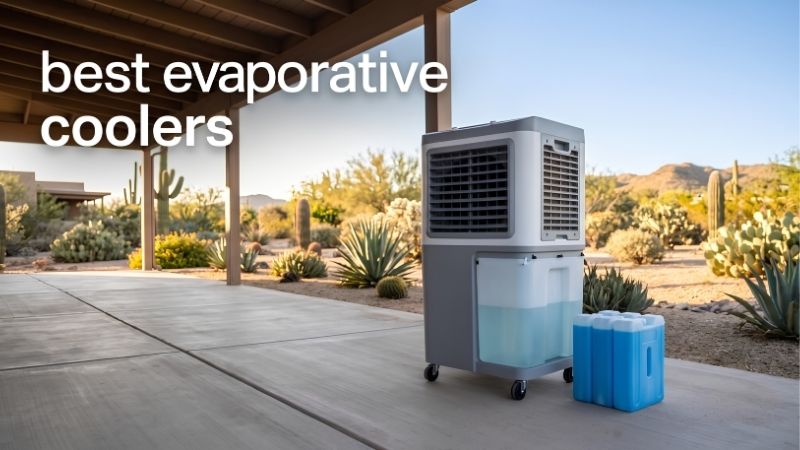
Ratings in this category combine three published numbers, namely airflow, tank volume and recommended coverage, plus one unpublished condition that overrides all of them. Understanding how those interact is the difference between the best rated evaporative cooler for your room and an expensive box fan with a water tank.
Airflow and the Coverage Figure
Manufacturers pair CFM with a square-footage rating, and the ratio varies more than you would expect. The Honeywell CL30XC produces 806 CFM for around 320 square feet indoors, while the Hessaire MC18M produces 1,300 CFM for 500 square feet. Both work out near 2.5 CFM per square foot.
Larger units hold that ratio loosely. The MC37M is rated at 3,100 CFM for 950 square feet, and the Honeywell CO60PM at 1,540 CFM for roughly 850. Where the ratio falls, the unit is built for enclosed rooms; where it climbs, it is designed for open or outdoor spaces.
Pad Media Does the Actual Cooling
The fan only moves air; the media is where evaporation happens. Hessaire uses high-density XeL50 rigid media that the company states delivers around 80% more evaporation surface than standard-density pads. Honeywell’s larger units run honeycomb media across three sides to increase the effective intake area.
More media surface means a larger temperature drop at the same airflow, and it is the specification most buyers skip past entirely. It also drives maintenance, since rigid and honeycomb media need periodic rinsing and eventual replacement, and hard water shortens their working life considerably.
The Humidity Ceiling Nobody Advertises
Every manufacturer in this category states a humidity limit. Honeywell recommends 60% relative humidity or less for maximum efficiency, and specialist retailers list 40 to 50% as the range where cooling is genuinely effective. Above those levels the achievable temperature drop shrinks toward nothing at all.
This is physics rather than brand quality, so no best rated evaporative cooler overcomes it and no amount of airflow compensates. Check your typical afternoon humidity before comparing models. Across the arid southwest and much of the midwest these units work well; along humid coastlines they largely do not.
Best Rated Evaporative Cooler Picks by Room Size
Five units, ordered from indoor spot cooling through to large open areas, with all figures taken from manufacturer publications. The best rated evaporative cooler for a bedroom is a completely different machine from the one for an open workshop, so start with square footage rather than review scores.
| Model | Airflow | Tank | Rated coverage | Best suited to |
|---|---|---|---|---|
| Honeywell CL30XC | 806 CFM | 7.9 gal | approx. 320 sq ft indoors | Bedrooms, home offices |
| Hessaire MC18M | 1,300 CFM | 4.8 gal | 500 sq ft | Single garage bay |
| Hessaire MC37M | 3,100 CFM | 10.3 gal | 950 sq ft | Workshops, large patios |
| Honeywell CO60PM | 1,540 CFM | 15.9 gal | approx. 850 sq ft | Unattended running |
| Uthfy 41-inch | 4,800 CFM | 10.6 gal | Large open areas | Yards, commercial floors |
Honeywell CL30XC – Indoor Rooms and Home Offices
806 CFM, a 7.9-gallon detachable tank and 288 watts of draw make this the indoor specialist here, rated for about 320 square feet with cross-ventilation. It includes a remote, an energy-saving timer, a low water alarm, a washable carbon dust filter and a top-loading ice compartment.
The limitations come with indoor use itself. The room needs an open window or door, and the added humidity is noticeable in a sealed space within an hour. The ice compartment delivers a brief improvement rather than a sustained one, and a detachable tank still means carrying water to the sink.
Hessaire MC18M – Small Garages and Covered Patios
1,300 CFM through XeL50 rigid media, 4.8 gallons of water and 500 square feet of rated coverage, in a 16-pound cabinet measuring 20 x 10 x 28 inches. It accepts a garden hose for continuous supply, and the product listing quotes noise at 53.4 dB on two manual fan speeds.
Two speeds and no timer is spartan if you want scheduled operation, and the small reservoir empties in three to four hours without a hose connected. For a workshop bay or a covered patio used most evenings, it remains the efficient and genuinely portable choice.
Hessaire MC37M – Large Open Spaces
At 3,100 CFM with a 10.3-gallon tank and 950 square feet of rated coverage, this is the general-purpose large unit. A three-panel intake, oscillating louvers, three fan speeds and a hose connection cover most workshop, garage and patio scenarios without stepping into commercial pricing territory.
Casters are packed inside the cabinet and must be fitted before first use. Storage is the other real cost, since this is a bulky object to keep through winter, and the controls remain simple rotary dials rather than anything programmable or remote-operated.
Honeywell CO60PM – Longest Unattended Operation
1,540 CFM, a 15.9-gallon tank and honeycomb media on three sides, with a copper continuous water outlet and overflow protection. The service manual rates it at roughly 850 square feet with air throw around 36 feet, driven by a ball-bearing motor turning metal fan blades, mounted on castors.
Honeywell’s product pages advertise significantly higher airflow and coverage than the service manual specifies, so plan around the lower number. It is also heavy to reposition and adds substantial humidity in a closed garage, which owners in dry states notice within the first hour or two.
Uthfy 41-Inch – Highest Listed Airflow
A listed 4,800 CFM with a 10.6-gallon tank, metal frame, three speeds, 110-degree oscillation and three included ice packs. This is the option for yards, large shops and open commercial spaces where the smaller units simply cannot move enough air for the cooling to be felt at distance.
Long-term parts support is less established than with Honeywell or Hessaire, and replacement media availability matters across a five-year ownership window. The ice packs also fade quickly, so treat the airflow figure rather than the included ice as the actual reason to buy this one.
Prices, Availability and When to Buy This Season
Two things shape what the best rated evaporative cooler costs right now: import duties working through the supply chain, and the fact that late July is peak demand for anything that moves cool air. Both point the same way if you need cooling before the summer ends.
Tariffs Are Feeding Into Prices
Industry survey data indicates 84% of outdoor businesses expect to be affected by new tariffs, with costs rising roughly 7.7%. Aluminium and steel duties hit housings, frames and fan assemblies directly, while specialised plastics and foams are reported up 10 to 15% over the same period.
Manufacturers have said openly that published prices are estimates while supply chains settle. That removes the usual argument for waiting, because there is no reliable expectation that the same model will be cheaper in six weeks than the figure sitting on the listing today.
Peak Season Means Backorders
Both Hessaire units above have appeared as backordered at specialist retailers during the hottest weeks of the year, and that pattern repeats every summer. What stays in stock is usually one size larger or smaller than the model your square footage actually calls for.
If you can wait, September and October clearance is historically the cheapest window for cooling appliances, and stock returns as demand collapses. If you cannot, buying the correctly sized unit today beats compromising on capacity and regretting it for the rest of the season.
Running Cost Is Part of the Value
The Honeywell CL30XC draws 288 watts. A window air conditioner covering a similar floor area typically draws several times that. In a dry climate where evaporative cooling works properly, the electricity difference across a full summer is the strongest single part of the value argument.
Set against inflation near 4.2% and an estimated $1,600 tariff burden per US household in 2026, that running-cost gap matters more than it did two years ago. It also justifies buying the right size once rather than the cheapest available option twice.
Frequently Asked Questions
These four questions cover the practical ground buyers raise most often, from room sizing through to maintenance. All assume a climate dry enough for evaporative cooling to function, since humidity determines performance far more than any difference between the brands listed above.
What is the best rated evaporative cooler for a bedroom?
An indoor-rated unit such as the Honeywell CL30XC, run with a window cracked open. Bedrooms are small enough that 806 CFM suffices, and the timer and remote matter more overnight than raw airflow does. Expect added humidity, which is precisely why cross-ventilation is not optional here.
How often do the pads need replacing?
It depends almost entirely on water hardness. Rinsing the media periodically and draining the tank weekly extends life considerably, but in hard-water areas expect replacement every season or two. Running the fan without water for about 30 minutes before storage prevents mould from establishing in the pads.
Can these replace air conditioning?
In a dry climate they can make an unconditioned garage, workshop or patio usable, but they do not reach refrigerated temperatures and manufacturers state this directly. They lower air temperature through evaporation while raising humidity, which is a fundamentally different outcome from a compressor-based air conditioner.
Do the ice packs actually help?
They produce a modest and short-lived improvement. Cooling comes from evaporation rather than from the water’s starting temperature, so ice mainly lowers output air slightly for as long as it lasts. Dry incoming air affects performance far more than anything you add to the reservoir.
See More:
- Evaporative Cooler Best Uses: Where These Units Work Well
- Evaporative Air Cooler Best Features: 5 Top Units Compared
- Swamp Cooler Best Picks: 5 Top Evaporative Units Compared
- Best Rated Swamp Cooler: 5 Units Judged on Build Quality
Final Thoughts
The best rated evaporative cooler is the one sized to your square footage and honest about your climate. Check afternoon humidity first, then match CFM to the area: the CL30XC indoors, the MC18M for a single bay, the MC37M or CO60PM for large spaces, and 4,800 CFM units for yards. Buy while stock holds.

Write Your Review
No reviews yet. Be the first to share your experience!