Our Top Picks
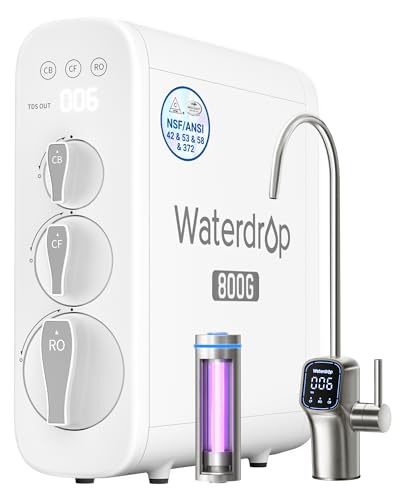 Waterdrop G3P800 Tankless Reverse Osmosis Water Filter System800 GPD18.12 x 5.67 x 17.72 inches33.7 poundsCheck on Amazon
 Waterdrop G3P600 Tankless Reverse Osmosis Water Filter System600 GPD18.06 x 5.68 x 17.76 inches32 poundsCheck on Amazon
 iSpring RO500AK Alkaline Reverse Osmosis SystemNSF 500 GPD Alkaline RO17.5 x 5.2 x 16.25 inches21 poundsCheck on Amazon

A family drinks, cooks, and fills bottles all day, and a traditional reverse osmosis tank quietly gives back the under-sink cupboard while delivering water at the speed of a storage tank emptying itself. The real decision with a tankless system is whether its daily output, flow at the faucet, and drain ratio match your household’s headcount and habits, because there is no reservoir to hide a slow membrane when three people want water at once.
These four under-sink systems suit families replacing bottled water, parents mixing formula and filling school bottles every morning, and cooks who want filtered water for soups and coffee without waiting. They were selected from their Amazon product names and listed specifications, spanning 500 to 800 gallons per day, and each one reports its drain ratio and certifications plainly on the listing.
Quick Picks
As an Amazon Associate we earn from qualifying purchases
| Product | Best for | Key spec from title |
|---|---|---|
| Waterdrop G3P800 | Large families with heavy daily use | 800 GPD tankless RO system |
| Waterdrop G3P600 | Mid-size families wanting a smart faucet | 600 GPD tankless RO system |
| Frizzlife PD600-TAM3 | Households wanting alkaline remineralization | 600 GPD tankless RO with TAM3 |
| iSpring RO500AK-BN | Smaller kitchens and lighter demand | 500 GPD tankless RO system |
How to Choose
Size the Output to Your Headcount
Gallons per day is the headline figure, but what you feel at the tap is flow while the system is running. A household of five or six, filling large pots and bottles back to back, will notice a slower unit at breakfast; a couple will not. As a working approach, match the rating to your busiest hour rather than your average day, and remember that tankless designs produce water on demand, so the membrane’s pace is the pace you get. Ratings from 500 to 800 GPD cover most families, with the top end buying headroom rather than luxury.
Weigh the Drain Ratio Honestly
Every reverse osmosis system sends some water to the drain carrying away the contaminants the membrane rejected. The pure-to-drain ratio tells you how much: a 3:1 system makes three cups of filtered water for each cup sent away, while a 2:1 system sends away proportionally more. Over a year of family drinking and cooking, that difference reaches your water bill and matters in drought-conscious households. Check the ratio on the listing rather than assuming, and note that real-world figures depend on your home’s water pressure and temperature, so treat the printed ratio as a comparison tool between models.
Decide How You Want to Watch Water Quality
Some systems put a TDS readout on a smart faucet, some show it on the unit’s body, and some offer neither. A visible TDS display turns filter changes from guesswork into observation: you see the number creep as the membrane ages and know the cartridges are due. For families with infants, elderly relatives, or anyone advised to watch mineral content, that feedback loop is worth having. Also confirm which certifications the listing names for TDS reduction specifically, since a system certified under NSF/ANSI 58 for that purpose carries a clearer claim than filtration wording alone.
Plan the Under-Sink Space and Cartridge Changes
Tankless units free the cupboard space a pressure tank used to occupy, but they still need room for the body, the lines, and your hands during cartridge swaps. Measure the cabinet, including the space your disposal and pipes already claim, and check the unit’s height against the underside of the sink basin. Then look at how the filters are arranged: composite cartridges that combine stages reduce the number of parts you handle, while a separate remineralization cartridge adds a step but lets you replace it independently. Easy access matters because a filter change that fights you gets postponed.
The 4 Best Options
Waterdrop G3P800
The strongest output in this group belongs to the G3P800, rated at 800 GPD with a 10-stage filtration path and a 3:1 pure-to-drain ratio that wastes less than most. Its smart faucet carries an LED TDS monitor, so the number is visible every time someone fills a glass. The listing names NSF/ANSI 42, 53, 58, and 372 certifications, with NSF 58 covering TDS reduction, and states support for source water up to 1,000 PPM TDS. For a big household drawing water all day, this is the specification sheet that asks the fewest compromises.
Specs
- Output: 800 GPD
- Filtration: 10-stage filtration
- Pure to drain ratio: 3:1
- Faucet: smart faucet with LED TDS monitoring
- Certifications per listing: NSF/ANSI 42 & 53 & 58 & 372 (NSF 58 for TDS reduction)
- Source water: supports TDS up to 1,000 PPM
- Installation: under-sink
Best for: Large families and heavy cooking households that want the highest output and the leanest drain ratio here.
Watch out for: The 800 GPD class is more system than a small household needs; match it to real demand.
ASIN: B0987FCQQW
Waterdrop G3P600
Stepping down to 600 GPD, the G3P600 keeps the features families use most: an 8-stage filtration path, a 2:1 pure-to-drain ratio, and a smart LED faucet with a TDS display at the tap. The listing names the same NSF/ANSI 42, 53, 58, and 372 certifications as its larger sibling, again with 58 tied to TDS reduction. It suits the middle of the market honestly — enough pace for a family of four’s drinking, cooking, and bottle filling, in the same under-sink format, without paying the decision in cabinet space or complexity for capacity you will rarely touch.
Specs
- Output: 600 GPD
- Filtration: 8-stage filtration
- Pure to drain ratio: 2:1
- Faucet: smart LED faucet with TDS display
- Certifications per listing: NSF/ANSI 42 & 53 & 58 & 372
- Installation: under-sink
Best for: Families of three to five who want a TDS readout at the faucet and a balanced drain ratio.
Watch out for: At peak breakfast demand its flow is shared like any tankless unit, so stagger big pot fills.
ASIN: B07P1XFYJP
Frizzlife PD600-TAM3
Frizzlife builds this 600 GPD system around three cartridges: a composite pre-filter, the 600G RO membrane, and a TAM3 alkaline remineralization cartridge that brings the finished water above pH 7.5. The smart TDS display sits on the unit body rather than the faucet, which some households prefer because the tap stays plain. Its 2:1 pure-to-drain ratio matches the class, and the listed maximum flow is 0.41 GPM. If your family dislikes the flat taste of straight RO water, the remineralization stage is the deciding feature here, and it is replaceable on its own schedule.
Specs
- Output: 600 GPD
- Pure to drain ratio: 2:1
- Maximum flow: 0.41 GPM
- Display: smart TDS display on the unit body
- Cartridges: composite pre-filter, 600G RO membrane, TAM3 alkaline remineralization cartridge (pH above 7.5)
- Installation: under-sink
Best for: Households that want minerals and a mildly alkaline finish back in their drinking water.
Watch out for: The remineralization cartridge is a third consumable to track alongside the pre-filter and membrane.
ASIN: B083DFW1QS
iSpring RO500AK-BN
The RO500AK-BN is the measured choice for smaller families: 500 GPD, a 2:1 pure-to-drain ratio, and alkaline remineralization that returns a natural pH to the water. Its title carries NSF 58 certification, and the listing states support for source water up to 1,000 PPM TDS with a maximum flow of 0.4 GPM. The unit measures 17.5 x 5.2 x 16.25 inches and weighs 21 lb, a slim profile that helps in crowded cabinets, and the brushed nickel faucet suits kitchens where the extra tap is on display. It trades headline output for a compact, simpler installation footprint.
Specs
- Output: 500 GPD
- Pure to drain ratio: 2:1
- Certification per title: NSF 58 certified
- Remineralization: alkaline remineralization (natural pH)
- Maximum flow: 0.4 GPM
- Source water: supports TDS up to 1,000 PPM
- Dimensions: 17.5 x 5.2 x 16.25 in
- Weight: 21 lb
- Faucet finish: brushed nickel
Best for: Couples and small families in compact kitchens who still want remineralized RO water.
Watch out for: The 500 GPD rating is the lowest here, so big gatherings will feel the on-demand pace.
ASIN: B09CHBC9CP
Which One Fits Your Situation
You Have Five or More People at Home
Choose output first. The G3P800’s 800 GPD rating and 3:1 drain ratio were built for households where the tap rarely rests, and its faucet TDS display keeps quality visible without opening the cabinet. Smaller systems will technically work, but you will feel their pace at exactly the moments everyone is thirsty, cooking, and filling bottles for the next day.
Taste Is Why You Keep Buying Bottled Water
If flat-tasting water is what sends your family back to bottles, look at the remineralizing models. The Frizzlife PD600-TAM3 raises pH above 7.5 through its dedicated TAM3 cartridge, while the iSpring RO500AK-BN restores a natural pH in a smaller package. Both address flavor directly; pick between them by output and by whether you want the TDS display on the unit body or the slimmer cabinet footprint.
Your Cabinet Is Crowded
Measure before you fall for a specification sheet. The iSpring’s 5.2-inch depth and 21 lb weight make it the easiest fit where a disposal and pipework already compete for room. Tankless designs already return the space a storage tank took; a slim unit returns even more. Leave yourself hand room for cartridge changes, because a system you cannot service comfortably is a system whose filters get changed late.
You Want to See the Numbers
A TDS readout changes maintenance from calendar guessing to evidence. The two Waterdrop models put the display on the faucet, where it is seen daily, while the Frizzlife shows TDS on the unit body for those who prefer an unadorned tap. Any of the three beats flying blind; the choice is about where your household will actually look, not about which number is more precise.
Common Mistakes
- Comparing gallons per day without checking the flow rate you will actually feel at the faucet.
- Ignoring the drain ratio, then being surprised by the water bill in a high-use household.
- Forgetting that tankless systems need an electrical outlet under the sink for the pump and display.
- Choosing a unit that fills the cabinet so completely that cartridge changes become a plumbing project.
- Expecting RO water to taste like spring water without choosing a remineralization model.
Frequently Asked Questions
How many gallons per day does a family need?
Work backward from your busiest hour, not your daily total. A couple usually finds 500 GPD ample, a family of four is comfortable at 600 GPD, and larger households or heavy cooking justifies 800 GPD. Because tankless systems make water as you draw it, the rating describes pace under demand, which is why headcount and simultaneous use matter more than the day’s total volume.
What does a 2:1 or 3:1 drain ratio actually mean?
It compares filtered water produced to water sent to the drain. A 3:1 system yields three parts of pure water for one part of drain water; a 2:1 system yields two parts for one. Higher is more efficient. Your real ratio shifts with household water pressure and temperature, but the listed figure is the fairest way to compare models side by side before buying.
Why do some systems add minerals back after filtering?
Reverse osmosis removes nearly everything, including the calcium and magnesium that give water its familiar taste, which many people describe as flat. Remineralization cartridges return a controlled amount, lifting pH toward neutral or mildly alkaline levels. The Frizzlife TAM3 cartridge targets a pH above 7.5, while the iSpring describes a natural pH result. It is a taste and preference feature, not a filtration requirement.
Does a smart faucet matter, or is it a gimmick?
It matters if you will act on what it shows. A faucet TDS display, like those on the Waterdrop models, tells you the membrane is still performing and warns you when the reading climbs. A body-mounted display, as on the Frizzlife, gives the same information with a plainer tap. Households that ignore indicators gain nothing from either, but for most families the visible number keeps filter changes honest.
FAQ
How many gallons per day does a family need?
What does a 2:1 or 3:1 drain ratio actually mean?
Why do some systems add minerals back after filtering?
Does a smart faucet matter, or is it a gimmick?
More from Amazon
Programs that pair well with the guide above. Offers and eligibility are set by Amazon and may change.
Free shipping on eligible items, Prime Video and more. Eligible new members can start with a free trial.
Start a Prime free trialA Prime membership for ages 18-24 with a trial period. Eligibility is set by Amazon.
See Prime for Young AdultsAudiobooks and podcasts to listen to on the go. Eligible new members can start with a free trial.
Try Audible freeAd-free music streaming. Eligible new subscribers can start with a free trial.
Try Music Unlimited freeAs an Amazon Associate we earn from qualifying purchases.