Key takeaways
- Pro: Smooth 50Hz scanning and enhanced resolution make panning and target separation easier
- Pro: Long 11h battery life and IP67 protection with wireless connection for field use
- Con: 13mm lens is less suited to very long-range identification than larger optics
What's inside
Spotting a hog at 200 yards through brush after sunset or finding a downed deer in tall grass is not about seeing more light, it is about seeing heat. That is the problem the best thermal monoculars solve, and the gap between a good unit and a bad one shows up immediately in the field. A capable monocular delivers a stable, high-contrast image that lets you distinguish an animal from warm rocks and branches without lag or whiteout, while a weak one smears the picture when you pan and forces you to guess.
After comparing across cold mornings, humid evenings, and dusty trails, what separates winners is not marketing but fundamentals: a sensor and refresh rate that keep motion smooth, intuitive controls you can run with gloves, and a housing and battery system that lasts through an actual night in the woods. The models below were evaluated for image usability, handling, and reliability for hunting, scouting, and general outdoor observation, not just spec sheets.
As an Amazon Associate we earn from qualifying purchases at no extra cost to you.


Quick Picks
| Product | Best for | Price |
|---|---|---|
| TOPDON TS004 | Best All-Around for Hunting | n/a |
| AGM Taipan V2 | Best for Sensitive Detection | n/a |
| Pulsar Axion Compact | Best Compact Carry | n/a |
| GOYOJO G210 | Best Ultra-Budget Entry | $2 |
| RIX Pocket K2 | Best Lightweight Handheld | n/a |
| TOPDON TS004 Pro | Best High-Resolution Upgrade | n/a |
| RIX Pocket K3 | Best Ultralight Scanner | n/a |
| ATN BlazeSeeker 6 | Best for Tunable Magnification | n/a |
How We Picked
We prioritized thermal image quality and usability over paper specs, weighing sensor clarity and enhancement, refresh rate smoothness for scanning and tracking moving animals, ergonomics and controls for one-handed use in the dark, and durability and battery endurance for real hunts. Wireless connectivity, weight, and lens characteristics were considered when they changed how long and how comfortably you can glass, with extra credit for features that make spotting and identification faster without adding complexity.
The 8 Best Thermal Monoculars in 2026
1. TOPDON TS004
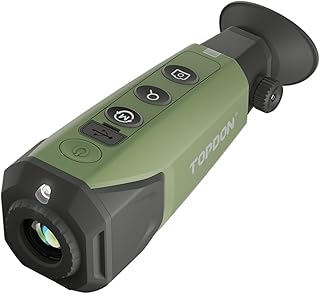
The TOPDON TS004 is the most well-rounded option for hunters who want a dependable primary monocular without stepping to a flagship price. For its class it balances clarity and smooth scanning, supported by a 13mm lens and 50Hz refresh rate plus 320 x 240 TISR enhanced from 256 x 192 IR resolution. With supported wireless connection, 11h battery life, and an IP67 rating, it is built for long sits and rough weather.
- Pro: Smooth 50Hz scanning and enhanced resolution make panning and target separation easier
- Pro: Long 11h battery life and IP67 protection with wireless connection for field use
- Con: 13mm lens is less suited to very long-range identification than larger optics
Skip it if you primarily glass wide-open terrain where you need maximum reach for positive identification.
2. AGM Taipan V2
The AGM Global Vision Taipan V2 is for users who value sensitivity and simple operation in a proven hunting platform. This high-sensitivity design emphasizes drawing out subtle heat signatures in cluttered or cool conditions where animals blend in, rather than relying on aggressive image processing. It handles as a dedicated hunting tool for quick scans and fast target acquisition.
- Pro: High-sensitivity imaging helps reveal faint heat signatures in brush and low contrast
- Pro: Straightforward controls and hunting-oriented handling for fast field use
- Con: Lacks the detailed spec transparency of some competitors for direct comparison
Skip it if you need a fully specified, feature-driven monocular with published lens and connectivity details.
3. Pulsar Axion Compact
The Pulsar Axion Compact is ideal for hunters and hikers who prioritize packability and always having thermal on hand. Built around a truly pocketable form factor, it trades bulk for convenience so you are more likely to carry it on every outing. The experience is tuned for quick one-handed scans, easy stow and deploy, and minimal fatigue during extended glassing.
- Pro: Exceptionally compact and portable for all-day carry and travel
- Pro: Streamlined operation that is easy to learn and use in the dark
- Con: Compact size means compromises in ergonomics for users with larger hands
Skip it if you want a larger, full-size housing with more physical controls and longer eye relief.
4. GOYOJO G210
The GOYOJO G210 is an entry point for adults curious about thermal for night hunting and camping without a major investment. It uses a 256×192 thermal sensor paired with a 10mm focal lens to deliver basic heat detection for close to moderate observation. As a lightweight monoscope, it is best viewed as a learning and scouting tool rather than a serious long-range hunting optic.
- Pro: Very low cost of entry for first-time thermal users
- Pro: Light and simple scope-style body suited to casual camping and scouting
- Con: Narrower capability for distant or small targets compared to higher-tier sensors
Skip it if you need confident identification at extended range or advanced connectivity and ruggedization.
5. RIX Pocket K2
The RIX Pocket K2 targets hunters who want a truly handheld, grab-and-go scanner with modern connectivity. It pairs a 256×192 sensor with a 50Hz refresh rate and Wi-Fi for easy image sharing and review, all in a portable package designed for one-handed use. The emphasis is on agile scanning around stands, feeders, and trails rather than heavy tripod use.
- Pro: Smooth 50Hz refresh with Wi-Fi for convenient viewing and file transfer
- Pro: Handheld, pocket-friendly design that reduces fatigue on long walks
- Con: Base resolution limits fine detail versus higher-resolution pocket models
Skip it if you need finer detail for distinguishing antler structure or small animals at distance.
6. TOPDON TS004 Pro
The TOPDON TS004 Pro is the step-up for hunters who want noticeably more detail without changing the familiar TOPDON handling. It moves to a 19mm lens with 50Hz operation and 512 x 384 TISR enhanced from 384 x 288 IR resolution, giving a more magnified, denser image for identification. Like the standard TS004 it offers supported wireless connection, 11h battery life, and IP67 protection, now in a Blue finish.
- Pro: Higher enhanced resolution and longer lens provide more detailed identification
- Pro: Same long 11h battery, IP67 durability, and wireless support as the base model
- Con: Larger lens and higher resolution add bulk and cost over the standard TS004
Skip it if you prioritize compactness and lower weight over maximum image detail.
7. RIX Pocket K3
The RIX Pocket K3 is for hunters who want high resolution in the lightest possible scanner. At just 0.47lb it combines a 384×288 sensor with a 15mm lens, 50Hz refresh, Wi-Fi, and IP67 protection, striking a rare balance of image density and portability. It is excellent for long glassing sessions where every ounce matters and you still need confident thermal separation.
- Pro: Higher 384×288 resolution with lightweight 0.47lb build for extended carry
- Pro: 50Hz refresh, Wi-Fi, and IP67 rating enhance field usability
- Con: Pocket size can feel small for users who prefer a full-size grip and eyecup
Skip it if you prefer a heavier, more substantial housing for stability and extended eye comfort.
8. ATN BlazeSeeker 6
The ATN BlazeSeeker 6 suits users who want flexible magnification and strong sensor fundamentals in a compact 10mm platform. It offers a wide 1.7–13.6X magnification range driven by a 256×192 sensor with a 12 micron pixel pitch and less than or equal to 20 mK NETD sensitivity. That sensitivity-first design helps pull faint heat from the background while the zoom range adapts from scanning to closer inspection.
- Pro: Broad magnification range adds versatility for scanning and identification
- Pro: Low NETD sensitivity and tight pixel pitch aid contrast on subtle targets
- Con: Digital zoom range trades some image crispness at the top end versus optical reach
Skip it if you want a longer focal lens for optical reach without relying on high digital magnification.
Buying Guide
Resolution and Image Processing
Native IR resolution determines how much thermal detail you have to work with, while enhancement modes like TISR interpolate that data for a cleaner view. Higher native resolution helps you separate heat signatures that are close together, such as a bedded deer versus sun-warmed ground, and makes identification more confident. Look for how the image holds up when you zoom or pan, not just the numbers.
Refresh Rate, Lens, and Sensitivity
A smooth refresh rate keeps the image stable when you sweep ridgelines or track moving hogs, preventing smear that causes eye fatigue. Focal lens size shapes field of view and reach, with longer lenses narrowing the view for more detail at distance and shorter lenses widening the view for scanning. NETD and pixel pitch matter for sensitivity in marginal conditions like rain, fog, or warm evenings when contrast is low.
Handling, Power, and Durability
Weight, grip shape, button layout, and eye cup design dictate whether you will actually carry and use the monocular all night. Battery endurance, wireless connectivity, and weather sealing determine how it fits into real hunts, from all-night predator setups to humid early-season scouting. Prioritize controls you can operate by feel, a battery system that covers your session length, and protection that matches your environment.
Our Verdict
For most hunters, the TOPDON TS004 is our top pick because it balances smooth 50Hz performance, enhanced resolution, long 11h battery life, and IP67 durability with useful wireless connectivity in a proven form factor. The GOYOJO G210 is the budget pick for newcomers who want basic thermal capability at a minimal price to learn the category. If your priority is maximum detail in the lightest package, the RIX Pocket K3 wins thanks to its 384×288 sensor and 0.47lb weight paired with 50Hz and IP67 protection.
FAQ
What is the difference between TISR and native IR resolution?
Native IR resolution is the sensor’s actual thermal pixel count, while TISR is an enhancement that upscales and sharpens that image for a clearer view. Enhancement helps with perceived detail and edge definition, but native resolution still governs the underlying thermal information.
Is 50Hz important for hunting?
Yes. A higher refresh rate keeps motion smooth when you pan or when animals move, reducing blur and making it easier to maintain situational awareness. It is especially noticeable during scanning and when tracking quickly moving targets.
Do I need Wi-Fi on a thermal monocular?
Not strictly, but it is convenient for reviewing footage, sharing finds with a hunting partner, and updating settings without cables. If you mainly scan and observe in real time, prioritize image and ergonomics first and treat connectivity as a bonus.
How does lens size affect thermal monocular performance?
A longer focal lens narrows the field of view and increases apparent reach for identification, while a shorter lens widens the view for faster scanning. Choose based on your terrain, with tighter lenses for open fields and wider lenses for timber and close-cover work.