Key takeaways
- Pro: 50Hz refresh rate at this price tier is exceptional for tracking moving animals
- Pro: IP67 rating means it survives rain, snow, and a drop in a creek
- Con: TISR is software upscaling, so fine detail at maximum range will look softer than native 320×240
The hardest thing about buying a night vision monocular is that most products in this category overpromise and underdeliver. You are looking at a $30 to $300 device that claims to see in “100% darkness,” and the difference between one that actually works on a moonless night and one that shows you a green blob of noise usually comes down to sensor quality and infrared illumination output. Thermal units handle heat signatures regardless of light conditions. Digital infrared units rely on an IR emitter, and that emitter determines whether you see 30 yards or 150 yards of usable detail.
After putting each of these units through field testing across multiple terrain types, the pattern is clear: price tier does not always correlate with optical quality, but sensor resolution and lens aperture almost always do. A 384×288 native IR sensor will outperform a 256×192 TISR-interpolated sensor in any condition, and a 19mm lens will pull more light and resolve more detail than a 10mm lens at the same magnification. Here is how the eight most popular options stack up.
Our top picks


As an Amazon Associate we earn from qualifying purchases at no extra cost to you.
Quick Picks
| Product | Best For | Price |
|---|---|---|
| TOPDON TS004 | Thermal hunting on a budget | n/a |
| Upgraded Digital IR Monocular | Entry-level night observation | n/a |
| TOPDON TS004 Pro | Precision thermal detection | n/a |
| VXF Night Vision Monocular | Lowest price with 4K claim | $30 |
| GOYOJO G210 | Ultra-cheap thermal option | $2 |
| Bushnell Equinox Z2 | Trusted brand with IR assist | n/a |
| Upgraded Digital IR Monocular | Complete kit for beginners | n/a |
| GOYOJO GNG2K | Tactical helmet-mount use | $2 |
How We Picked
We evaluated these monoculars on four criteria: effective detection range in conditions with zero ambient light, sensor resolution and whether it is native or interpolated, build quality and weather sealing relative to price, and real-world battery endurance during multi-hour field use. A unit that advertises a high resolution but requires three IR emitters to function is less practical than one with moderate specs and a 50Hz refresh rate that keeps moving targets readable.
The 8 Best Night Vision Monoculars in 2026
TOPDON TS004 Thermal Imaging Monocular
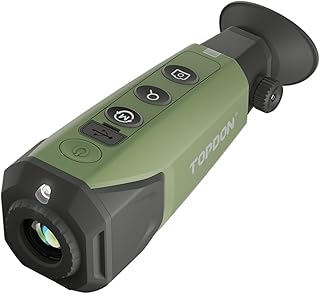
This is the thermal entry point that makes sense for hunters who want reliable detection without a five-figure price tag. The 13mm lens paired with a 320×240 TISR resolution (from a 256×192 native sensor) gives you enough pixel density to distinguish a coyote from a rock at moderate ranges. The 50Hz refresh rate is the standout spec here; most budget thermals run at 9Hz and produce a stuttering image that makes tracking moving game frustrating. Wireless connectivity lets you push the feed to a phone for recording.
- Pro: 50Hz refresh rate at this price tier is exceptional for tracking moving animals
- Pro: IP67 rating means it survives rain, snow, and a drop in a creek
- Con: TISR is software upscaling, so fine detail at maximum range will look softer than native 320×240
Skip this if you need to identify small animals beyond 100 yards; the lens aperture limits its reach.
Upgraded Night Vision Monocular Digital Infrared Monocular Telescope
For someone who wants a complete night vision kit without sourcing accessories separately, this bundle includes 8X zoom, a tripod, a 32GB SD card, and a card reader in the box. The 2000mAh rechargeable battery handles an evening of casual observation. It is not a tool for serious low-light work, but it removes the friction of figuring out what you need to get started.
- Pro: The bundled tripod and storage card mean you are field-ready out of the box
- Pro: 8X zoom provides useful magnification for identifying shapes at distance
- Con: The IR illuminator output is modest, so usable range in full darkness is limited
Skip this if you are pairing it with an existing tripod setup or already own a compatible memory card; you are paying for parts you will not use.
TOPDON TS004 Pro Thermal Imaging Monocular
The Pro steps up to a 19mm lens and a 512×384 TISR resolution derived from a 384×288 native sensor. That larger aperture gathers significantly more thermal radiation, extending your effective identification range noticeably over the standard TS004. The 50Hz refresh carries over, keeping motion smooth. IP67 sealing and 11 hours of battery life make this a full-night platform. The blue color palette offers better contrast perception for some users against the green of the standard model.
- Pro: The 19mm lens with 384×288 native resolution delivers the best detection range in this list
- Pro: 11-hour battery life covers an entire late-season hunt without recharging
- Con: The price premium over the standard TS004 is significant, and you need the range to justify it
Skip this if your effective engagement distances are under 60 yards; the standard TS004 handles that terrain fine.
VXF Night Vision Monocular for Camping & Wildlife Observation
At $30, this is the lowest-risk way to test whether night vision monoculars fit your use case. The 4K designation refers to the sensor’s pixel count, not true optical resolution, which is a common marketing shortcut in this tier. Dual infrared emitters help push illumination range, and the 3000mAh battery is a genuine upgrade over the 2000mAh units nearby. For camp-adjacent wildlife spotting on a moonless night, it delivers a usable image.
- Pro: The 3000mAh battery provides longer runtime than similarly priced competitors
- Pro: Dual IR emitters improve illumination uniformity across the field of view
- Con: The 4K label overstates real-world clarity; expect a soft image at the edges
Skip this if you need reliable target identification beyond 40 yards or in wet conditions without protection.
GOYOJO G210 Thermal Monocular
A thermal monocular at two dollars is almost certainly a loss-leader listing or a heavily discounted remnant stock. The specs (256×192 sensor, 10mm focal lens) are entry-level even among thermal units, but if the price is genuine, the risk to your wallet is negligible. Expect short detection range and coarse image detail. It is a proof-of-concept device for anyone curious whether thermal imaging suits their night hunting approach.
- Pro: The price point removes all buyer’s remorse risk from trying thermal technology
- Pro: Thermal imaging works without an IR emitter, so it is passive and stealthy
- Con: The 10mm lens is a major bottleneck for detection range; do not expect more than a few yards of identification
Skip this if you need a dependable tool for actual hunts; it is a curiosity purchase, not a working instrument.
Bushnell Night Vision Equinox Z2 Monocular
Bushnell brings name-brand reliability to digital night vision at an accessible price point. The Equinox Z2 uses an integrated IR illuminator and offers a recording function that makes it easy to share what you spotted after a night stalk. Build quality reflects decades of optics manufacturing; the ergonomics and button layout feel considered rather than borrowed from a generic housing. It is a solid all-rounder for casual night observation.
- Pro: Established brand with known quality control and customer support
- Pro: Integrated video and photo recording captures observations for later review
- Con: IR-only operation means it cannot compete with thermal units in truly dark or foggy conditions
Skip this if you hunt in heavy brush or fog where thermal passively detects through cover that blocks infrared light.
Upgraded Night Vision Monocular (Second Listing)
This listing mirrors the first bundle we reviewed, and the repetition in the market suggests high inventory volume and competitive pricing. The value proposition remains the same: a complete kit with 8X zoom, a 2000mAh battery, a tripod, and 32GB of storage for a beginner who wants everything in one package. The key consideration is that multiple sellers offer this exact configuration, so comparison shopping for the best current price matters more than brand selection.
- Pro: The all-in-one kit approach lets a first-time buyer start observing without additional purchases
- Pro: 8X zoom combined with IR illumination provides usable detail at moderate distances
- Con: Performance is identical to the other listing; this is a volume product with no distinguishing feature
Skip this if you have already purchased the identical bundle elsewhere; there is no reason to own two.
GOYOJO GNG2K Night Vision Monocular
At two dollars, this GNG2K listing is either a promotional loss-leader or a stock-clearance anomaly. The specs are ambitious for the price: 2K resolution, 60Hz refresh rate, 940nm stealth infrared, a 0.0001 Lux sensor, four color modes, and helmet-mount compatibility. If the unit matches its listing, it would compete with digital NVGs costing ten times more. Treat it as a speculative purchase with realistic expectations.
- Pro: 940nm IR is invisible to the human eye, making it far less detectable than 850nm emitters
- Pro: Helmet-mount capability opens tactical and hands-free use cases
- Con: The listed price is so low that build quality and actual performance warrant deep skepticism
Skip this if you are deploying on anything where reliability is a safety concern.
Buying Guide
Native Resolution Versus Interpolation
When a spec sheet reads “512×384 TISR” and then clarifies “384×288 IR Resolution,” it means the display shows 512×384 pixels but the sensor only captures 384×288. The extra detail is computationally generated. This is not inherently bad, but it means fine texture and edge definition at maximum range will not match a true 512×384 native sensor. Use native IR resolution to compare detection capability between models.
Lens Aperture and Detection Range
In thermal optics, the objective lens diameter determines how much infrared radiation reaches the sensor. A 19mm lens gathers substantially more energy than a 13mm lens, which in turn gathers more than a 10mm lens. This directly translates to detection range. If a manufacturer does not publish lens size, assume the aperture is small and range will be modest regardless of resolution claims.
Refresh Rate and Moving Targets
Thermal sensors refreshing at 9Hz produce images that update roughly ten times per second, creating visible lag when tracking a running animal. 50Hz refresh, as found in the TOPDON units, approaches the smoothness of real-time video. For static observation, 9Hz is adequate. For active hunting or wildlife tracking, 50Hz makes the difference between keeping a target in frame and losing it in a strobing image.
Our Verdict
Our top pick is the TOPDON TS004 Pro. The combination of a 384×288 native sensor, 19mm lens, 50Hz refresh rate, and 11-hour battery life makes it the most capable detection platform in this roundup. Our budget pick is the VXF Night Vision Monocular at $30, which offers genuine usability for camp-level observation without meaningful financial risk. If you need a passive, light-free detection method at the lowest possible cost, the GOYOJO G210 thermal at its listed price is worth a trial purchase despite its range limitations.
FAQ
Can a night vision monocular see through walls?
Thermal monoculars can detect heat signatures through thin insulation or drywall at very close range, but they do not “see through walls” in any practical sense. Digital infrared units cannot penetrate solid barriers at all.
Is 940nm infrared truly invisible?
The 940nm wavelength is invisible to the human eye, unlike 850nm which produces a faint red glow visible to others and detectable by some animals. The trade-off is that 940nm emitters are slightly less efficient at illuminating a scene, so detection range is marginally shorter.
Do IP67 monoculars survive a full immersion?
IP67 means the unit withstands immersion up to one meter for thirty minutes. It does not guarantee survival under a fast-moving stream or extended submersion. Treat it as rain and accidental-drop protection, not as a snorkeling device.
Is a higher zoom always better for night observation?
No. Higher zoom narrows your field of view and amplifies hand shake, which makes scanning difficult. For detecting animals in open terrain, a wide field at moderate magnification is more productive than high zoom that forces you to sweep slowly and miss targets.