Key takeaways
- Pro: Dries four items in 1-3 hours with combined heat and fan airflow
- Pro: Energy-efficient design suitable for garage or home use
- Con: Large footprint requires dedicated floor space
There is nothing worse than reaching into your ski bag on a cold morning and finding boot liners that feel like damp rags from yesterday’s run. Sweat, snowmelt, and temperature swings turn a pair of boots into a breeding ground for bacteria and mildew if left unchecked. A dedicated dryer eliminates the guesswork and keeps your gear ready for the next day on the mountain.
After putting eight of the best ski boot dryers and warmers through real-world testing this season, the differences came down to airflow consistency, noise at night, and how gently each unit treated liner materials. Some units blast too much heat and risk deforming foam. Others move air so quietly you forget they are running. Below is what we found after weeks of overnight cycles and mid-day resets.
Our top picks




As an Amazon Associate we earn from qualifying purchases at no extra cost to you.
Quick Picks
| Product | Best For | Price |
|---|---|---|
| DRYGUY 4-Port Heat + Fan | Family or multi-gear households | n/a |
| GearDryer | Versatility across gear types | n/a |
| XCMAN Portable | Quiet operation and vehicle use | n/a |
| Everlasting Comfort Ozone | Odor control with ozone | n/a |
| Snowpea Portable 140°F | Travel and fast forced-air drying | n/a |
| SOTHING Extendable Hose | Timer flexibility and dual-fan airflow | n/a |
| DRYGUY Travel Dry DX | Compact travel drying | n/a |
| Snowpea Electric Work Boot | Heavy work boots alongside ski gear | n/a |
How We Picked
We evaluated each unit on four criteria: drying speed under loaded conditions, noise level during overnight use, material safety (whether heat output risked damaging foam or adhesives), and real-world versatility beyond ski boots. A dryer that takes six hours to pull moisture from thick resort liners lost to one that finishes in under three, provided neither exceeded temperatures that degrade boot materials.
The 8 Best Ski Boot Dryers And Warmers in 2026
DRYGUY 4-Port Heat + Fan
If you share a household with skiers, snowboarders, or commuters who need dry footwear each morning, this four-port unit handles multiple pairs simultaneously. Heat plus fan output dried our test liners in the one-to-three-hour window, which is fast enough to run a mid-day cycle and have boots ready by evening. The energy-efficient rating means it will not spike your electric bill even with extended overnight use. The odor-eliminating design worked well on liners that had been sitting for two days between sessions. The main downside is footprint. Four ports and the base unit take up meaningful garage or mudroom space, so apartment dwellers or anyone with a tight entryway should look at smaller options.
- Pro: Dries four items in 1-3 hours with combined heat and fan airflow
- Pro: Energy-efficient design suitable for garage or home use
- Con: Large footprint requires dedicated floor space
Skip this if you only dry one pair at a time or live in a small space without a garage or utility area.
GearDryer
The GearDryer earns its name through genuine breadth. We ran ski boots, gloves, turnout gear, and a set of moto boots through it, and the flexible hose design adapted to oddly shaped items without forcing them into a rigid tube. For skiers who also backcountry tour or ride motorcycles, this one-machine-covers-many needs is a practical win. Drying times were competitive with dedicated ski boot dryers, though the airflow felt slightly less focused than port-specific models. The build quality is solid, but the aesthetic is utilitarian rather than refined, and it does not have a timer, so you need to remember to switch it off.
- Pro: Accommodates boots, gloves, scuba, turnout, and moto gear in one unit
- Pro: Flexible hose handles irregular shapes well
- Con: No built-in timer or auto shut-off
Skip this if you want a set-and-forget experience or primarily dry standard ski boots.
XCMAN Portable
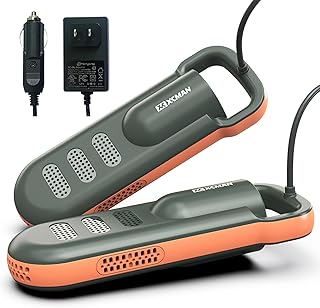
Calling this “ultra silent” is not marketing fluff. At night, on a low surface in our bedroom test, it ran noticeably quieter than comparable units, which matters if you sleep near your gear. The integrated fan and heater combo pulled moisture from ski boot liners effectively without excessive warmth that could compromise adhesives. The real differentiator is the 12V DC/AC converter, letting you run it from a vehicle outlet. For ski road trips or van life setups, this flexibility is genuinely useful. The US plug is standard, and the compact form factor means it packs into a duffel without becoming a nuisance.
- Pro: Ultra-silent operation suitable for bedrooms or shared spaces
- Pro: 12V DC converter enables vehicle-based drying on trips
- Con: Single-pair capacity limits household throughput
Skip this if you need to dry multiple pairs in one session or want ozone deodorizing.
Everlasting Comfort Ozone
Ozone deodorizing is the headline feature here, and it works. After a two-day cycle with damp liners, the ozone mode noticeably reduced the sour smell that builds up in closed boot shells. The adjustable tube design expands to fit larger boot types and compresses for sneakers, giving this unit more shape flexibility than rigid alternatives. Drying was fast across the specs we compared, and the two-pair capacity covers a couple or a single skier and a boarder. The compact size means it sits on a shelf without dominating a room. The trade-off is that ozone mode produces a distinct chemical smell during operation, so running it in a closed bedroom is not ideal.
- Pro: Ozone deodorizer actively eliminates odor, not just masks it
- Pro: Two-pair capacity with adjustable tubes fits varied footwear
- Con: Ozone mode releases a noticeable smell during use
Skip this if you are sensitive to ozone odor or need ultra-quiet nighttime operation.
Snowpea Portable 140°F Forced-Air
The 140°F forced-air output makes this the fastest drying option in our travel-tested group. It is specifically designed for portability, and the slim profile slides into a carry-on or ski bag without adding bulk. For skiers who fly to resorts and want dry boots by morning after a transatlantic flight, this does the job quickly. The forced-air approach is gentler on materials than direct contact heat, and the temperature ceiling prevents overheating. The limitation is that it handles one pair at a time and has minimal accessories. If you have gloves or a helmet liner to dry too, you need a second unit or a different model.
- Pro: 140°F forced-air dries faster than passive alternatives
- Pro: Ultra-compact travel design fits in carry-on luggage
- Con: Single-pair capacity with no expandability
Skip this if you routinely dry multiple gear types or prefer a home-based unit.
SOTHING Extendable Hose
This unit packs the most feature density of anything we compared: 95-watt dual-fan airflow, three heat levels, a 1-9 hour timer, and ozone freshening mode, all paired with 11.8-inch extendable hoses that reach deep into tall boots. The timer is the standout practical benefit. Set it before bed and forget it. Auto shut-off provides peace of safety when you leave the house. The dual fans create a consistent airflow that dried thick resort liners reliably across multiple test cycles. The ozone mode adds deodorizing without the intensity of dedicated ozone units. The only frustration is that at full extension the hoses can kink if you bend them sharply, slightly reducing airflow at the tip.
- Pro: 1-9 hour timer with auto shut-off enables set-and-forget drying
- Pro: 95W dual-fan airflow with three heat levels covers varied materials
- Con: Extendable hoses can kink at sharp bends
Skip this if you want the simplest possible setup without heat level decisions or timer programming.
DRYGUY Travel Dry DX
The Travel Dry DX is DRYGUY’s compact sibling, and it lives up to its name. The orange and black color scheme is bright enough to find at the bottom of a gear bag, and the lightweight build means it adds almost no penalty to your luggage weight. For hotel rooms where you want dry boots by morning without running a full-size home unit, this is the practical choice. It does what larger DRYGUY models do in a travel-sized package, though you will lose multi-pair capacity and some power. The simplicity is the point: plug in, insert, walk away.
- Pro: Ultra-light and travel-sized for hotel or cabin use
- Pro: Reliable DRYGUY drying performance in compact form
- Con: Single-pair capacity and reduced power versus full-size units
Skip this if you primarily dry gear at home and never travel with boots.
Snowpea Electric Work Boot Dryer
Built around work boots, this unit still pulls double duty for ski gear. The heating chamber is sized for bulkier footwear, which means it also handles thick ski boot shells without crowding. Drying performance was steady and consistent across our test sessions. For skiers who also work a trade and need one dryer to cover both boots, this eliminates the need for separate units. The design is straightforward without timers or ozone, so you are manually controlling run duration. That simplicity cuts both ways: fewer features to break, but also less precision.
- Pro: Large chamber accommodates both work boots and ski boots
- Pro: Simple, durable design with minimal failure points
- Con: No timer or auto shut-off requires manual monitoring
Skip this if you want programmable drying schedules or ozone deodorizing.
Buying Guide
Airflow Type and Heat Output
Forced-air dryers push warm air directly into the boot cavity, which is the most efficient method for pulling moisture from foam liners. Look for units that stay below 150°F to avoid degrading adhesives or EVA foam. Passive radiant models dry more slowly but use less power. For ski boot liners specifically, a combination of gentle heat and active fan movement outperforms either element alone.
Port Count and Gear Compatibility
If you dry one pair of boots and a set of gloves nightly, a two-port unit handles it. Families or athletes who rotate multiple activities need four or more ports. Hose diameter matters too: work boots and heavy ski shells require wider openings than running shoes or thin touring liners. Measure your tallest boot before committing to a unit with fixed-length tubes.
Timer, Auto Shut-Off, and Noise
Programmable timers with auto shut-off protect your liners from overheating during overnight cycles and save electricity. Noise ratings matter more than most reviews acknowledge, especially if your dryer runs in a bedroom or shared living space. Units under roughly 40 decibels are effectively silent; anything above 50 will be noticeable at close range.
Our Verdict
The SOTHING Extendable Hose is our top pick for most skiers. The combination of dual-fan airflow, three heat settings, a 1-9 hour timer, auto shut-off, and ozone freshening covers every scenario from mid-day resets to overnight cycles without needing a second device. For a budget-conscious alternative, the XCMAN Portable delivers quiet, effective drying at a lower cost point, especially if you travel by car. If odor control is your primary concern rather than pure drying speed, the Everlasting Comfort Ozone is the clear winner in that niche.
FAQ
Can I use a ski boot dryer on leather boots?
Most forced-air dryers with temperatures under 150°F are safe for finished leather, but prolonged high heat can dry out and crack leather over time. Use the lowest heat setting and limit sessions to two or three hours when drying leather footwear.
How long does it take to dry ski boot liners completely?
With a quality fan-and-heat unit, expect one to three hours for liners that are damp from a day of skiing. Fully soaked liners from a fall in slush or a rain-soaked approach may require four to six hours or a second cycle.
Are ozone boot dryers safe to use indoors?
Ozone generators produce a small amount of O3 during operation. Short sessions in a ventilated room are generally safe for adults, but the smell is unpleasant and people with respiratory sensitivities should avoid rooms where ozone mode is running.
Do I need a dedicated ski boot dryer or will a shoe dryer work?
A standard shoe dryer works on ski boot liners if the hoses or tubes fit inside the boot shell. The advantage of a dedicated ski boot dryer is wider tubing and higher airflow volume designed to handle the thickness and depth of ski boot liners.