Key takeaways
- Individual water drips or valves for each wheel.
- Flexible tubing that can be removed for cleaning.
- A catch basin with enough capacity for a full session.
- Guards that can be adjusted without blocking the working surface.
- Noncorroding or corrosion-resistant parts near the water path.
The best cabbing machines for most hobbyists are the CabKing 6V or Hi-Tech Diamond 6″ All-U-Need, while frequent lapidaries should step up to an 8-inch, multi-wheel machine such as the CabKing 8V or Diamond Pacific Genie.
Best cabbing machines by type of user
| Best for | Recommended machine | Why it fits | Main compromise |
|---|---|---|---|
| Beginner with limited space | CabKing 6V | Compact six-inch wheel layout, integrated water handling, and a relatively gentle learning curve | Smaller wheels remove less material per pass than eight-inch wheels |
| Beginner who wants a flexible setup | Hi-Tech Diamond 6" All-U-Need | Wet grinding and polishing in one compact machine, with room to change wheel arrangements | Less enclosed splash control than some dedicated multi-wheel cabinets |
| Frequent hobby use | CabKing 8V | Eight-inch wheels, a stronger motor, and a complete multi-wheel workflow | Requires more bench depth, water, and storage space |
| Production-oriented lapidary work | Diamond Pacific Genie | Established six-wheel configuration, robust construction, and broad accessory support | Higher purchase cost and more deliberate cleanup |
| Occasional cab shaping on a budget | Single-wheel wet grinder or trim-saw/grinder combination | Lower initial cost and smaller footprint | Slower grit changes and less consistent polishing workflow |
These recommendations assume you are shaping and polishing cabochons rather than cutting large slabs. A cabbing machine is not a substitute for a slab saw, trim saw, or faceting machine.
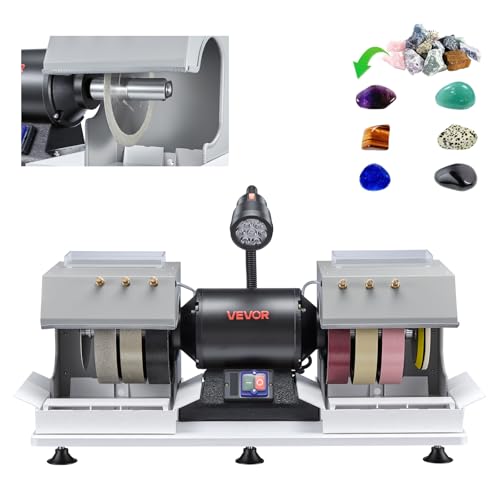
VEVOR Cabbing Machine, 8" 3/4 HP 1800 RPM Efficient, Lapidary Rock Grinder Polisher with Diamond and Resin Wheels, LED Lamp, Water System, Lapidary Equipment for Gemstone Grinding, Stone Polishing
Included for 'Best Cabbing Machines for Shaping and Polishing Stone' because the listing specifies 8" 3/4 HP 1800 RPM Efficient and Lapidary Rock Grinder Polisher with Diamond and Resin Wheels, details this guide uses to compare options.
View on Amazon
CabKing 6" Cabbing Machine Lapidary Equipment - Complete Grinder Polisher
Included for 'Best Cabbing Machines for Shaping and Polishing Stone' because the listing specifies Complete Grinder Polisher, details this guide uses to compare options.
View on Amazon
VEVOR Cabbing Machine, 6" 1/4HP 1800rpm Efficient, Lapidary Rock Grinder Polisher With Lamp & Water Pump, Gem Faceting Machine, Rock Grinding Machine for Gem Jade Stone, Create Cabochons for Necklaces
Included for 'Best Cabbing Machines for Shaping and Polishing Stone' because the listing specifies 6" 1/4HP 1800rpm Efficient and Lapidary Rock Grinder Polisher With Lamp & Water Pump, details this guide uses to compare options.
View on Amazon
Hi-Tech Diamond 6" Slant Cabber Lapidary Machine, Rock Polishing Kit
Included for 'Best Cabbing Machines for Shaping and Polishing Stone' because the listing specifies Rock Polishing Kit, details this guide uses to compare options.
View on AmazonWhat separates a good cabbing machine from a frustrating one?
Wheel diameter
Six-inch wheels are usually the better starting point for beginners. They need less bench depth, reach operating speed quickly, and make it easier to see the contact area while learning to hold a stone. They are also commonly less expensive to replace.
Eight-inch wheels have a larger working radius. The stone contacts a gentler curve, which is useful for broad domes and larger cabochons. Their greater circumference also gives more abrasive surface before a particular section of diamond becomes worn. The tradeoff is a larger machine, more water movement, and a higher replacement cost.
For small stones and occasional projects, six inches is adequate. For large cabs, repeated production, or a smoother transition across a curved dome, eight inches is preferable.
Motor power and duty cycle
Most complete hobby cabbing systems fall roughly in the 1/4 to 1/3 horsepower range. That is enough for normal cabochon work, but horsepower alone does not determine performance. Water cooling, bearing quality, wheel balance, and the motor’s duty cycle matter just as much.
A 1/4-horsepower machine suits light-to-moderate home use when you let the abrasive do the work. A 1/3-horsepower motor is a better choice for larger stones, harder materials, and longer sessions. Do not force a stone into the wheel to compensate for a weak or glazed abrasive; that creates heat, slows the motor, and can damage the stone or machine.
For production work, look for a continuously rated motor, sealed bearings, replaceable splash components, and a manufacturer that lists replacement parts. A machine that can run for several hours is more valuable than one with a larger advertised horsepower number but poor cooling.
Water and splash control
Wet grinding controls dust and keeps diamond abrasives cooler, but water management is one of the biggest ownership issues. Enclosed cabinets and adjustable splash guards keep the surrounding wall and floor cleaner. Open machines are easier to inspect and modify, but they need a larger catch tray and more careful operator technique.
Look for:
- Individual water drips or valves for each wheel.
- Flexible tubing that can be removed for cleaning.
- A catch basin with enough capacity for a full session.
- Guards that can be adjusted without blocking the working surface.
- Noncorroding or corrosion-resistant parts near the water path.
Use clean water and avoid letting abrasive sludge dry inside the tray or tubing. Dried slurry can restrict flow, stain components, and send a dirty stream onto a finished polishing wheel.
Head-to-head: six-inch versus eight-inch machines
| Specification or requirement | Typical six-inch system | Typical eight-inch system |
|---|---|---|
| Wheel diameter | 6 inches | 8 inches |
| Typical motor range | About 1/4 hp | About 1/3 hp |
| Common wheel count | Four to six | Six or more |
| Approximate machine width | 28 to 36 inches | 32 to 42 inches |
| Useful bench depth | 18 to 24 inches | 22 to 30 inches |
| Practical use | Small and medium cabs, learning, moderate sessions | Large cabs, smoother domes, frequent or production work |
| Typical replacement-wheel cost | Roughly $25 to $100 per wheel | Roughly $35 to $140 per wheel |
Dimensions and prices vary by wheel package, motor voltage, and accessories. Treat the figures as planning numbers, then check the manufacturer’s current dimensional drawing before building a bench.
Choosing between the leading configurations
CabKing 6V
The CabKing 6V is a sensible first complete system when you want multiple stages, integrated water delivery, and a relatively compact footprint. Its six-inch wheels are forgiving for beginners and suitable for common cabochon sizes. It is particularly attractive when you want to move from coarse shaping through polishing without repeatedly rebuilding the machine.
Choose it for a dedicated hobby bench, small stones, and several sessions per month. Choose an eight-inch system instead if you regularly work large slabs or need to shape many stones in one sitting.
Hi-Tech Diamond 6" All-U-Need
The six-inch All-U-Need is a flexible wet-grinding platform rather than only a fixed production line. It suits users who want to experiment with wheel arrangements, discs, or different abrasive stages. Its compact format works well where bench space is limited.
Its flexibility also means the buyer must pay attention to the exact package. Confirm which wheels, discs, adapters, splash parts, and polishing accessories are included; the base machine may not provide every stage needed for a complete cabbing workflow.
CabKing 8V
The CabKing 8V makes more sense for frequent work because its eight-inch wheels provide a broader curve and more working surface. It is a strong middle ground between a small home setup and a larger production bench.
Plan for a sturdy, level bench. An eight-wheel machine loaded with water and accessories is not something to place on a flimsy folding table. Also leave clearance behind and beside the machine for tubing, cleaning, and wheel changes.
Diamond Pacific Genie
The Genie is aimed at lapidaries who value a well-established multi-wheel design and a wide ecosystem of replacement and accessory parts. It is a serious investment, but its serviceability can matter more than a lower purchase price if the machine will be used often.
It is best suited to a permanent workspace. Before buying, price the complete abrasive sequence rather than the machine alone: coarse diamond, intermediate wheels, pre-polish, polish, wheel expanders or adapters where required, and replacement belts or splash components.
A simple decision matrix
| Your situation | Best direction | Reason |
|---|---|---|
| Under $1,000 total and fewer than 10 stones per month | Six-inch system or single-wheel setup | Leaves money for diamond wheels and avoids paying for unused capacity |
| Beginner with a 30-inch-wide bench | Six-inch complete machine | More likely to fit while retaining multiple grit stages |
| Large stones or 20-plus stones per month | Eight-inch, six-wheel machine | Reduces handling interruptions and provides a broader working curve |
| Shared garage or indoor workspace | Enclosed or well-guarded wet system | Better control of spray and slurry |
| Production work with varied materials | Serviceable machine with replaceable parts | Downtime and unavailable consumables cost more than a higher initial price |
How many grit stages do you need?
A practical sequence is coarse shaping, medium refinement, fine refinement, pre-polish, and polish. For example, a workflow might use approximately 80 or 100 mesh for rapid shaping, 220 mesh, 600 mesh, 1,200 mesh, and then a polishing stage. Softer or easily scratched materials may need a different sequence.
More wheels reduce grit changes, but they do not automatically produce a better cab. The most important transition is removing every scratch from the previous stage before moving finer. A polished surface cannot hide a deep 220-mesh scratch; it only makes that scratch harder to remove later.
A useful cost calculation is to compare the machine with its abrasive set. If a six-wheel machine costs $1,200 and the initial diamond wheels, polishing media, dop supplies, and plumbing extras add $350, the usable starting cost is $1,550—not $1,200. If you make 50 cabochons in the first year, the equipment cost alone is about $31 per stone before electricity, rough material, and replacement abrasives.
Setup and maintenance that protect the investment
- Level the machine. A stable base prevents vibration and uneven wheel wear.
- Label every wheel. Keep coarse and fine abrasives physically separated to prevent contamination.
- Set a modest water flow. The wheel should stay wet without flooding the tray.
- Use a separate rinse container. Rinse the stone and your hands before touching a finer wheel.
- Clean after every session. Flush tubing, wipe trays, and remove settled slurry before it hardens.
- Inspect consumables. Replace worn belts, cracked splash guards, glazed wheels, and restricted tubing promptly.
The most common beginner mistake is pressing too hard. Excessive pressure can round edges, create heat, load a polishing wheel with swarf, and shorten diamond life. Let the abrasive cut, keep the stone moving, and check the shape often.
Bottom line
For a first purchase, choose a complete six-inch wet system if space, budget, and experience are limited. The CabKing 6V and Hi-Tech Diamond 6" All-U-Need are appropriate starting points. Move to the CabKing 8V or Diamond Pacific Genie when larger wheels, longer sessions, easier grit progression, and production capacity justify the extra bench space and consumable cost.