Key takeaways
- The best Eizo monitors for photography are the ColorEdge CG2700X for demanding 4K editing, the CG2700S for a more affordable 27-inch reference display, and the CS2740 for photographers who want high resolution without paying for built-in hardware calibration. Quick comparison:…
The best Eizo monitors for photography are the ColorEdge CG2700X for demanding 4K editing, the CG2700S for a more affordable 27-inch reference display, and the CS2740 for photographers who want high resolution without paying for built-in hardware calibration.
Quick comparison: which Eizo is right for your photography?
| Monitor | Panel and resolution | Gamut coverage | Calibration and uniformity | Best suited to |
|---|---|---|---|---|
| Eizo ColorEdge CG2700X | 27-inch IPS, 3840 × 2160 | Up to 99% Adobe RGB, 98% DCI-P3 | Built-in sensor; factory-calibrated; digital uniformity correction | Professional photography, 4K work, print and video |
| Eizo ColorEdge CG2700S | 27-inch IPS, 2560 × 1440 | Up to 99% Adobe RGB, 98% DCI-P3 | Built-in sensor; factory-calibrated; digital uniformity correction | Serious stills work and proofing in a smaller budget |
| Eizo ColorEdge CG319X | 31.1-inch IPS, 4096 × 2160 | Up to 99% Adobe RGB, 98% DCI-P3 | Built-in sensor; factory-calibrated; digital uniformity correction | Large-format studio work and DCI 4K workflows |
| Eizo ColorEdge CS2740 | 27-inch IPS, 3840 × 2160 | Up to 99% Adobe RGB, 98% DCI-P3 | Requires external calibration sensor; digital uniformity correction | Advanced enthusiasts and photographers upgrading to 4K |
| Eizo ColorEdge CS2731 | 27-inch IPS, 2560 × 1440 | Up to 99% Adobe RGB | Requires external calibration sensor; digital uniformity correction | Budget-conscious photographers working mainly in print-oriented RGB |
Coverage figures are manufacturer specifications and describe the color space a display can reproduce, not the accuracy of every image under every viewing condition. Your computer, application, ICC profiles, ambient light, and calibration target still matter.

EIZO ColorEdge CG2700S-BK 27" Class WQHD LCD Monitor - 16:9 - Black
Included for 'Best Eizo Monitors for Photography' because the listing specifies 16:9 and Black, details this guide uses to compare options.
View on Amazon
EIZO ColorEdge CG2700X 27" Class 4K UHD LCD Monitor - 16:9 - Black
Included for 'Best Eizo Monitors for Photography' because the listing specifies 16:9 and Black, details this guide uses to compare options.
View on Amazon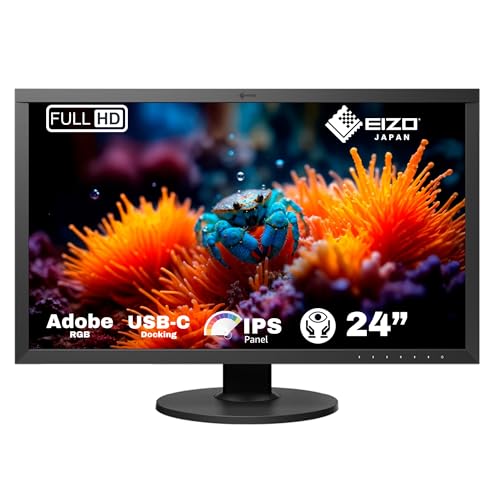
EIZO CG2420-BK ColorEdge Professional Color Graphics Monitor 24.1" Black
Included for 'Best Eizo Monitors for Photography' as a relevant option in this category; details come from the product listing.
View on Amazon
Eizo ColorEdge CG319X 31.1" Wide Screen Hardware Calibration IPS LED 4K Monitor, 4096x2160
Included for 'Best Eizo Monitors for Photography' because the listing specifies 4096x2160, details this guide uses to compare options.
View on AmazonBest overall: Eizo ColorEdge CG2700X
The CG2700X is the strongest all-round choice when image quality takes priority over purchase price. Its 27-inch 4K panel gives photographs noticeably finer detail than a QHD display, while the wide-gamut backlight covers nearly all of Adobe RGB and DCI-P3. That combination suits photographers who move between camera raw files, soft-proofed prints, and occasional video work.
The built-in calibration sensor is the important distinction from the CS series. It can periodically recalibrate the display without requiring you to attach a separate colorimeter, and the monitor stores calibration targets internally. Factory calibration also reduces the amount of setup needed when the monitor is first installed.
Connectivity is unusually useful for a single-monitor desk. The CG2700X includes DisplayPort, HDMI, USB-C with video and power delivery, and a USB hub. USB-C power delivery can simplify a laptop setup, although the exact charging benefit depends on the computer. Expect a general market price in the professional range, commonly around $2,000 to $2,500 depending on region and promotions.
Best value among reference displays: Eizo ColorEdge CG2700S
Choose the CG2700S if you want the CG-series calibration system and wide-gamut performance but do not need 4K resolution. At 2560 × 1440, it provides a useful amount of workspace for Lightroom, Capture One, Photoshop, or similar software while placing less demand on your graphics hardware.
Its 27-inch size is also practical for a normal desk. A QHD display can make interface text comfortably readable at 100% scaling, whereas a 4K panel often encourages operating-system scaling. For photographers who print at moderate sizes and rarely inspect images at extreme magnification, the lower resolution is not automatically a disadvantage.
The CG2700S includes the built-in calibration sensor, wide-gamut coverage, uniformity correction, USB-C connectivity, and a USB hub. It is usually priced below the CG2700X, often in the approximate $1,500 to $2,000 range.
Best 4K choice without built-in calibration: Eizo ColorEdge CS2740
The CS2740 is the sensible middle ground for an experienced photographer who already owns a reliable calibration instrument. Its 27-inch 4K resolution and wide-gamut panel are well suited to detailed retouching, large raw files, and print preparation, but you save money by calibrating with an external colorimeter or spectrophotometer.
That saving only makes sense if you include the cost and maintenance of the instrument. A typical colorimeter may add roughly $150 to $300 to the system price. If you do not already own one, the gap between a CS2740 and a CG2700X becomes smaller once calibration hardware is included.
The CS2740 offers DisplayPort, HDMI, USB-C video input, and USB connectivity. It is a strong choice for a desktop workstation or laptop-based editing desk, provided you are comfortable scheduling calibration yourself.
Best for a large studio workspace: Eizo ColorEdge CG319X
The CG319X is for photographers who can genuinely use a large 31.1-inch canvas. Its 4096 × 2160 DCI 4K resolution is particularly attractive for studios handling high-resolution retouching, cinema-related material, or large compositions with many panels and palettes open at once.
The extra area is productive, but it demands a deeper desk and a suitable viewing distance. It is also more expensive and physically imposing than the 27-inch models. If you mainly edit single images for web galleries, the CG319X may buy workspace you do not need rather than visibly better photographs.
Like the other CG models, it combines factory calibration, a built-in calibration sensor, wide-gamut reproduction, and uniformity management. It is best viewed as a reference display for a professional studio rather than a casual upgrade.
Best lower-cost option: Eizo ColorEdge CS2731
The CS2731 remains a compelling choice for photographers who want dependable wide-gamut editing at a lower cost and do not require 4K. Its 27-inch QHD panel provides enough space for most still-image applications, and Adobe RGB coverage is appropriate for photographers working with inkjet printing and profiled workflows.
It lacks the CG series’ integrated calibration sensor, so budget for a separate measurement device and allow time for regular profiling. It is also less suitable if your work is centered on DCI-P3 video delivery or if you frequently crop deeply into very high-resolution files.
Decision matrix by budget, space, and working habits
| Your situation | Recommended model | Why |
|---|---|---|
| Professional print work several days per week | CG2700X | 4K detail, built-in calibration, wide gamut, and strong connectivity |
| Professional color work but limited desk depth | CG2700S | 27-inch footprint with CG-series calibration and lower GPU demand |
| Already own a colorimeter and want 4K | CS2740 | High resolution and wide gamut without paying for an integrated sensor |
| Large studio, multiple applications, or DCI 4K work | CG319X | Largest workspace and 4096 × 2160 reference-display format |
| Occasional print work and a tighter budget | CS2731 | Wide-gamut QHD editing with a lower initial cost |
What matters most for print-proofing?
For print-proofing, gamut coverage is only one part of the decision. The monitor should be calibrated to a luminance level that suits the room, commonly around 80 to 120 cd/m² for a dim print-editing environment. A very bright screen can make prints appear disappointingly dark even when the profile is correct.
You also need the printer-and-paper ICC profile installed in your editing application. Soft-proofing then simulates the smaller gamut and characteristic contrast of the chosen paper. Adobe RGB coverage helps preserve colors before conversion, but it cannot display colors that the paper and ink cannot reproduce.
The CG2700X, CG2700S, and CG319X are the easiest Eizo choices for frequent proofing because their integrated sensors simplify repeatable calibration. The CS2740 and CS2731 can be just as useful, but only when an external sensor and a consistent calibration routine are part of ownership.
Setup and maintenance that affect accuracy
- Let the monitor warm up before critical editing. Allow about 30 minutes so brightness and color stabilize.
- Control the room light. Avoid sunlight or a bright lamp reflecting from the panel, and use a neutral, consistent wall color where possible.
- Choose a target white point and luminance appropriate to your delivery. Daylight-oriented screen settings are not automatically best for prints.
- Calibrate on a schedule. Monthly calibration is a sensible starting point for frequent professional use; occasional users can check less often but should recalibrate after major changes.
- Keep the screen clean with a soft, dry microfiber cloth. For stubborn marks, use a small amount of screen-safe cleaner on the cloth, never spray directly onto the panel.
The parts most likely to affect long-term performance are the backlight’s gradual aging, dust and fingerprints on the surface, and a calibration sensor that has been stored poorly or used beyond its service life. Do not confuse the monitor’s factory calibration with permanent accuracy: all displays drift over time, and a calibration report is not a substitute for periodic measurement.
Final recommendation
Buy the CG2700X if you need one monitor for demanding 4K photography, print-proofing, and color-managed video. Choose the CG2700S when QHD is sufficient and you want to reduce cost and graphics-hardware demands. The CS2740 is the best fit for photographers who already own calibration hardware, while the CS2731 offers the most economical route into serious wide-gamut editing. The CG319X earns its premium only when its large DCI 4K workspace will improve your daily workflow.