Key takeaways
- Seat suspension and adjustability: Important on rough lawns, where repeated jolts cause fatigue and make it harder to maintain a consistent line.
- Steering effort: A comfortable steering wheel and low-effort controls matter on tractors used for several hours at a time.
- Deck engagement: Electric blade engagement is more convenient than a stiff mechanical lever.
- Foot platform: A flat, uncluttered platform makes it easier to mount, dismount, and clean grass from the machine.
- Noise and vibration: Battery models generally reduce engine noise, while gasoline machines provide quick refueling for long sessions.
- Cut-height adjustment: A single-lever adjustment is faster, but verify that the deck remains level from side to side.
The best riding lawn mowers for large yards depend less on the biggest engine and more on matching deck width, turning ability, transmission, comfort, and maintenance to your mowing area and terrain.
Quick picks by lawn size and terrain
| Lawn situation | Best mower type | Useful deck range | Why it fits |
|---|---|---|---|
| 1/2 to 1 acre, mostly open | Rear-engine rider or compact lawn tractor | 30–42 inches | Lower purchase cost, easier storage, and adequate maneuverability |
| 1 to 2 acres with trees and beds | 42–46-inch lawn tractor | 42–46 inches | Balances cutting speed with a manageable turning radius |
| 2 to 4 acres, open or gently rolling | 46–54-inch lawn tractor or zero-turn mower | 46–54 inches | Reduces mowing time without becoming excessively wide for gates and storage |
| 4 or more open acres | 54–60-inch zero-turn mower | 54–60 inches | Fast ground coverage and near-zero turning for large uninterrupted areas |
| Slopes, rough ground, or frequent towing | Heavy lawn or garden tractor | 46–54 inches | Better stability, traction, and towing capability than many lightweight riders |
These are starting points rather than hard limits. A heavily landscaped 2-acre property can take longer to mow than a simple 4-acre field, because every tree, pond, fence, and garden bed adds turning and trimming time.
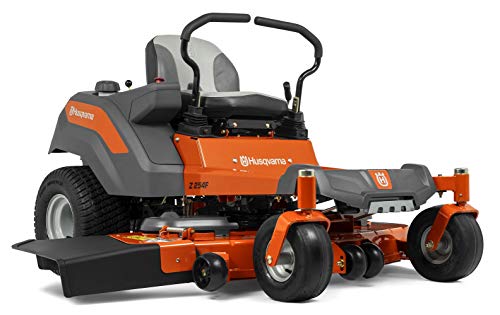
Husqvarna Z254F 54 in. 23 HP Kawasaki Zero Hydrostatic Turn Riding Mower
Included for 'Best Riding Lawn Mowers for Large Yards' as a relevant option in this category; details come from the product listing.
View on Amazon
EGO Power+ Electric Riding Lawn Mower, 42" Deck Lawn Tractor - TR4204
Included for 'Best Riding Lawn Mowers for Large Yards' because the listing specifies 42" Deck Lawn Tractor and TR4204, details this guide uses to compare options.
View on Amazon
EGO Power+ Z6 Zero Turn Electric Riding Lawn Mower, 42" Deck - ZT4214L
Included for 'Best Riding Lawn Mowers for Large Yards' because the listing specifies 42" Deck and ZT4214L, details this guide uses to compare options.
View on Amazon
EGO Power+ Electric Riding Lawn Mower, 52" Deck with Zero Turn Radius, Includes (6) 56V 12.0Ah Batteries and Charger - ZT5207L
Included for 'Best Riding Lawn Mowers for Large Yards' because the listing specifies 52" Deck with Zero Turn Radius and Includes (6) 56V 12.0Ah Batteries and Charger, details this guide uses to compare options.
View on AmazonBest riding lawn mowers for common buying situations
Best all-around lawn tractor: John Deere S100 or S120
The John Deere S100 series is a sensible choice for homeowners who want conventional steering, a comfortable operating position, and a familiar hydrostatic transmission. The S100 is aimed at simpler residential use, while the S120 adds features such as a stronger engine package and more convenient controls, depending on configuration.
Choose a 42-inch deck for roughly 1 to 2 acres with obstacles. A 48-inch deck makes more sense on larger, more open properties, provided it fits through gates and around storage doors. These tractors are easier to learn than a zero-turn mower and can use optional carts, spreaders, and snow attachments. Their main limitation is turning time: the front wheels require a wider arc around trees and corners.
Best value-oriented lawn tractor: Cub Cadet XT1 Enduro Series
The Cub Cadet XT1 Enduro Series is well suited to homeowners who want a conventional tractor with hydrostatic foot-pedal control and a relatively comfortable seat. Models commonly use decks in the 42- to 54-inch range, so select the width based on the property rather than automatically choosing the largest option.
An XT1 with a 42-inch deck is easier to maneuver through gates and between landscaping. A 46- or 50-inch version can shorten mowing on open ground. The stamped decks used on many residential tractors are adequate for normal lawns, but they benefit from regular cleaning because packed grass holds moisture against the deck and restricts airflow.
Best for fast mowing around obstacles: Toro TimeCutter
The Toro TimeCutter is a residential zero-turn mower for people who value speed and tight maneuvering. Its independent rear-wheel drive lets the mower pivot around trees and landscape islands, eliminating much of the three-point turning required by a lawn tractor.
A 42-inch deck suits smaller, more crowded properties, while a 50- or 54-inch deck is more efficient on open lawns. Zero-turn mowers are particularly productive when the mowing route contains many isolated obstacles. They are less suitable for steep slopes, wet ground, or areas where the operator needs tractor-like towing versatility. Learn the controls at low speed before mowing near fences, retaining walls, or flower beds.
Best battery option: EGO POWER+ Z6
The EGO POWER+ Z6 is a battery-powered zero-turn mower aimed at homeowners who want lower routine engine maintenance and quieter operation than a gasoline machine. Battery capacity varies by configuration, and the practical mowing area depends heavily on grass height, moisture, deck width, speed, and slope. Some versions are designed around multiple removable 56-volt batteries rather than a single fixed pack.
Battery zero-turns work especially well when the property can be divided into regular mowing sessions and the batteries can be charged indoors in a suitable, manufacturer-approved location. They require no oil changes or fuel stabilizer, but batteries, chargers, deck belts, blades, and tires still have ownership costs. For a large property, buy enough battery capacity for the required area rather than relying on an optimistic runtime figure.
How deck width changes cutting time
Deck width is useful only when the mower can maintain a steady speed and make efficient passes. The theoretical coverage calculation is:
Acres per hour = deck width in feet × mowing speed in miles per hour × mowing efficiency ÷ 8.25
Mowing efficiency accounts for overlap, turning, obstacles, and brief stops. A realistic residential efficiency factor is often 65% to 80%.
For example, a 48-inch deck is 4 feet wide. At 4.5 mph and 70% efficiency:
4 × 4.5 × 0.70 ÷ 8.25 = about 1.53 acres per hour
That is a theoretical mowing rate, not a promise that every 2-acre lawn will take 78 minutes. If the property has trees and beds that reduce efficiency to 55%, the same mower covers about 1.2 acres per hour. A 60-inch deck may not save much time if it forces wide turns or cannot pass through the access gate.
Transmission, steering, and terrain decisions
Hydrostatic lawn tractors
Hydrostatic transmissions use a pedal or hand control to vary speed without manually shifting gears. They are the easiest choice for properties where speed changes are frequent. Look for a sturdy pedal layout, smooth reverse control, and a transmission appropriate for the mower’s weight and towing duties.
Zero-turn drive systems
Zero-turn mowers steer with separate controls for the rear drive wheels. They are quick on open ground and can trim closely around obstacles, but the learning curve is steeper. Their front casters and rear-drive layout also demand more care on slopes. Follow the manufacturer’s slope guidance; a zero-turn is not automatically the safest option simply because it is faster.
Manual or gear-drive transmissions
Gear-drive riders can cost less and may appeal to buyers who prefer mechanical simplicity, but they require more deliberate shifting and clutch use. They are less convenient when mowing terrain that repeatedly changes speed or direction.
Comfort features that affect real mowing time
- Seat suspension and adjustability: Important on rough lawns, where repeated jolts cause fatigue and make it harder to maintain a consistent line.
- Steering effort: A comfortable steering wheel and low-effort controls matter on tractors used for several hours at a time.
- Deck engagement: Electric blade engagement is more convenient than a stiff mechanical lever.
- Foot platform: A flat, uncluttered platform makes it easier to mount, dismount, and clean grass from the machine.
- Noise and vibration: Battery models generally reduce engine noise, while gasoline machines provide quick refueling for long sessions.
- Cut-height adjustment: A single-lever adjustment is faster, but verify that the deck remains level from side to side.
Ownership costs and maintenance realities
Typical residential riding mower prices span roughly $1,500 to $3,500 for many lawn tractors and about $3,000 to $7,000 or more for higher-specification zero-turn and battery models. Attachments, extra batteries, delivery, and seasonal servicing can substantially increase the total.
The components that commonly wear first are blades, deck belts, idler pulleys, tires, battery terminals, and steering or caster hardware. A mower that cuts wet grass frequently may need blade sharpening and deck cleaning more often than the service interval suggests.
- Check engine oil before each gasoline mowing session and change it according to the manual.
- Clean grass from the deck after the deck has cooled; buildup reduces airflow and encourages corrosion.
- Sharpen or replace blades when grass tips look ragged rather than cleanly cut.
- Inspect the deck belt for cracking, glazing, or slack before the heavy mowing season.
- Keep tire pressures even so the deck does not cut lower on one side.
- Grease specified fittings and front axles at the manufacturer’s interval.
- Store gasoline properly, or drain and stabilize it before extended storage.
- For battery models, follow the instructions for charging temperature, storage level, and battery removal.
A practical decision matrix
| Your priority | Recommended choice | Compromise to expect |
|---|---|---|
| Lowest initial cost and simple operation | 42-inch hydrostatic lawn tractor | Slower around obstacles than a zero-turn |
| Fastest mowing on open 3-acre property | 54- or 60-inch zero-turn | Less versatile on slopes and for towing |
| Many trees, beds, and narrow passages | 42- to 46-inch zero-turn or compact tractor | Smaller deck means more passes |
| Minimal engine maintenance | Battery zero-turn or rider | Higher upfront cost and charging limitations |
| Uneven ground and regular cart use | Heavier lawn or garden tractor | Usually slower and less agile than a zero-turn |
What to measure before buying
Measure the narrowest gate, shed door, bridge, and path the mower must use. Add clearance for the deck and do not rely solely on the advertised overall width; chute position and discharge deflectors can add several inches. Also measure the storage length, turning space, and the slope of the steepest mowing area.
For most homeowners, a 42- to 48-inch hydrostatic tractor is the safest all-purpose starting point. Move to a 50- to 60-inch zero-turn when the property is sufficiently open to exploit its speed, and choose a heavier tractor when traction, towing, or uneven terrain matters more than maximum mowing pace.