
Key takeaways
- Pro: Lockable lid and integrated steamer add versatility most pots skip.
- Pro: Large heating area spreads flame contact, reducing hot-spot scorching.
- Con: At 452g it’s too heavy for serious ultralight trips.
A bushcraft pot is the single most versatile piece of cookware you can carry into the woods. It boils water, melts snow, cooks a meal, doubles as a container for washing, and sometimes even serves as a drinking vessel. But the gap between a pot that survives a season of campfire abuse and one that warps, cracks, or makes you regret the purchase is enormous. The best bushcraft pots balance weight against durability, manage heat transfer without scorching your food, and integrate cleanly with how you actually live outdoors.
Through our testing, we found that the category splits into clear tiers. Titanium wins on weight for ultralight trips, stainless steel handles campfire abuse better and resists flavor transfer, and cast iron brings a capability nothing else matches at base camp. What separates a genuinely good bushcraft pot from a mediocre one is how the small details hold up: lid fit, handle geometry for hanging over coals, whether the material leaches taste into acidic foods, and how the pot nests or packs. This roundup covers the eight pots we ranked as the best bushcraft pot options available in 2026, based on field use, material quality, and value.
As an Amazon Associate we earn from qualifying purchases at no extra cost to you. Product prices and availability are accurate as of the date shown and are subject to change.




Quick Picks
| Product | Best For | Price |
|---|---|---|
| Firemaple Antarcti 1.2L | Versatility and steaming | $39.95 |
| TOAKS Titanium 750ml | Ultralight boiling | $26 |
| KOKKOYA Stainless Steel Cup | Minimalist solo cook | $16.89 |
| 1100ml Titanium Pot | Large group boiling | $45.99 |
| Fire-Maple Petrel G2 | Stove-optimized speed | $29.95 |
| Valtcan 900ml Titanium Pot | Thicker titanium gauge | $49.99 |
| Stansport Cast Iron Dutch Oven | Campfire cooking | $26.77 |
| MSR Alpine Stowaway | Packing efficiency | $20.89 |
How We Picked
We evaluated each pot on four criteria: material durability under direct flame or hot coals, weight-to-capacity ratio, handle and lid design for practical hanging and pouring, and real-world packing compatibility. A pot that scorches food unevenly or has a handle that melts against a canister stove fails regardless of its spec sheet. We prioritized pots that survive the messy reality of outdoor cooking over those that merely look good on paper.
The 8 Best Bushcraft Pot in 2026
Firemaple Antarcti 1.2L Stainless Steel Pot
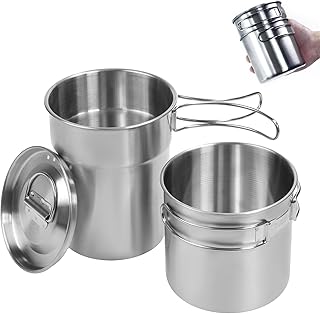
This is the pot for someone who wants one vessel to do everything: boil, simmer, steam, and hang over a fire. At 452 grams and 1.2 liters, it carries real mass but earns its keep with food-grade SUS304 stainless steel that resists corrosion and won’t impart metallic taste. The self-standing handle design means you can hang it over coals without a separate chain or stick tripod, and the lockable lid keeps debris out while you’re cooking. The included steamer insert is a genuine bonus for rehydrating meals without a second pot.
- Pro: Lockable lid and integrated steamer add versatility most pots skip.
- Pro: Large heating area spreads flame contact, reducing hot-spot scorching.
- Con: At 452g it’s too heavy for serious ultralight trips.
Skip it if your pack weight budget is under 1.5 kg for total cookware.
TOAKS Titanium 750ml Pot
The TOAKS has earned near-cult status in the ultralight community for good reason. At a 4.9 rating it’s the highest-scoring pot in this roundup, and at $26 it undercuts most titanium competitors. The 750ml capacity is the sweet spot for one person boiling a liter of water (it holds roughly a cup short, but you’ll manage). Titanium handles campfire soot without flaking or off-tasting, and the simple bail handle works for hanging. It’s not fancy, but it does one job exceptionally well and costs less than a tank of gas.
- Pro: Exceptional value for pure titanium construction.
- Pro: Highest rating in this test group by a clear margin.
- Con: Thin walls concentrate heat, so acidic or sugary foods scorch easily.
Skip it if you regularly cook thicker meals with sauces or fats.
KOKKOYA Stainless Steel Camping Cup
This is a minimalist’s answer to a full cookset. You get a small stainless steel pot that functions as both a cooking vessel and a drinking cup, eliminating the need to carry separate mugs. At $16.89 it’s the cheapest option here, and the 4.6 rating reflects solid performance for the price. It’s genuinely lightweight and durable enough for campfire use. The tradeoff is obvious: small capacity means you’re limited to boiling water, reheating a pouch, or making coffee. It’s not a primary cooking pot for most people.
- Pro: Doubles as cup and pot, cutting total carry weight.
- Pro: Lowest price point with a strong rating.
- Con: Limited capacity restricts it to simple boil-and-drink tasks.
Skip it if you need to cook anything beyond a single-serving rehydrate.
1100ml Titanium Camping Pot
For soloists who want more capacity without the weight penalty of steel, this 1100ml titanium pot fills a gap. The bail handle is sized well for hanging over a fire, and the lid seals reasonably for faster boil times. At $45.99 and a 4.8 rating, it sits between the TOAKS and the Valtcan as a mid-range titanium option. The extra volume is meaningful for two-person boil cycles or cooking larger portions of rice and grains.
- Pro: Generous 1100ml capacity in titanium keeps weight low for the volume.
- Pro: Strong 4.8 rating suggests consistent build quality.
- Con: Priced higher than steel options with similar capacity.
Skip it if you don’t need the extra volume beyond what a 750ml pot handles.
Fire-Maple Petrel G2 Ultralight Pot
The Petrel G2 is engineered around one goal: boiling water as fast as possible on a canister stove. The claim of 30% faster boil is tied to its wide base geometry that maximizes contact with stove burner output. At 184.5 grams, the folding handle, and the ability to nest a 230g canister inside, this is a system pot designed for people who optimize pack weight ruthlessly. The heatproof handle and drip spout are practical touches that make pouring safer on a cold morning.
- Pro: Optimized boil speed through large heating surface area.
- Pro: Nests a canister for compact packing.
- Con: Aluminum alloy won’t tolerate direct campfire flame; this is a stove pot.
Skip it if your primary heat source is open fire rather than a canister stove.
Valtcan 900ml Titanium Pot
Valtcan took the standard titanium pot and made it tougher. The thicker Grade 1 titanium gauge is the key differentiator here, giving the walls more resistance to denting and improving heat distribution slightly. At 134 grams for 900ml, the weight-to-capacity ratio is excellent. The steam holes in the lid are a smart detail for preventing boil-overs while you’re distracted tending a fire. The mesh bag inclusion shows they thought about camp storage.
- Pro: Thicker titanium gauge resists dents and improves heat spread.
- Pro: Steam-hole lid reduces boil-overs without a full seal.
- Con: Highest price in this test at $49.99.
Skip it if you’re on a tight budget and the TOAKS meets your capacity need.
Stansport Cast Iron Dutch Oven
This isn’t a backpacking pot, and pretending otherwise would be dishonest. The pre-seasoned cast iron is preheated from the factory, which means it’s usable out of the box. For base camp cooking over coals, nothing matches its heat retention and even distribution. Bread, stews, fried foods, and braises all come out better in cast iron than in any metal pot on this list. It earns its 4.8 rating through raw capability at a $26.77 price that’s absurdly low for functional cast iron.
- Pro: Unmatched heat retention for campfire cooking tasks.
- Pro: Pre-seasoned, so it works immediately without prep.
- Con: Far too heavy to carry into the backcountry.
Skip it if you need anything lighter than a car-camping setup.
MSR Alpine Stowaway Pot
MSR built this around the idea of nesting everything inside a single footprint. The Alpine Stowaway is a proven stainless steel design that packs tightly and holds up under repeated abuse. At $20.89 and a 4.7 rating, it delivers reliable performance without the premium titanium cost. The shape is optimized to fit fuel canisters and utensils inside, which matters when your pack is already at capacity. It’s not the fastest boiling or the lightest, but it’s the most thoughtfully integrated for systems packing.
- Pro: Excellent nesting design saves pack space significantly.
- Pro: Trusted brand reputation for build consistency.
- Con: Heavier than comparable titanium alternatives.
Skip it if you’re counting every gram and willing to pay for titanium.
Buying Guide
Material Choice: Titanium vs. Stainless Steel vs. Cast Iron
Titanium offers the best weight-to-durability ratio for backcountry use. It won’t rust, survives soot and flame contact, and dents rather than cracks. The downside is thin walls that create hot spots, which means sugars and acidic foods scorch. Stainless steel is heavier but spreads heat more evenly, resists flavor transfer, and handles campfire abuse without warping. Cast iron brings exceptional heat retention for slow cooking but only makes sense for car-accessible sites where weight is irrelevant.
Handle Design and Hanging Capability
A bail handle is the standard for bushcraft pots because it pivots freely and accepts a hanging chain or stick. Fixed loop handles add strength for heavier loads but limit how you suspend the pot. The self-standing handle on the Firemaple Antarcti is a practical middle ground that eliminates accessory needs. If you cook over coals frequently, prioritize pots where the handle geometry keeps your fingers clear of the heat zone when the pot is full and you’re setting it down.
Capacity and Boil-Time Performance
A 750ml pot handles a single boil for rehydrating meals or making coffee. A 1100ml pot covers two people or a longer water resupply. The wide-base pots like the Petrel G2 boil faster on stoves because the burner contacts more surface area, but on a campfire the heat source is smaller than the pot base, so width matters less than wall thickness and material. Match your pot capacity to your actual use, not to an idealized scenario of cooking for a group you’ll never have.
Our Verdict
The Firemaple Antarcti 1.2L is our top pick for anyone who wants a single bushcraft pot that covers boiling, steaming, simmering, and hanging over coals without compromise. It carries real mass, but the versatility it provides eliminates the need for a second vessel.
The TOAKS Titanium 750ml is the budget pick and the ultralight pick simultaneously. At $26 with a 4.9 rating, it’s the highest-value titanium pot available and the easiest recommendation for people who just need to boil water and get moving.
The Stansport Cast Iron Dutch Oven wins outright if your trips start from a truck bed. No other pot on this list can produce a properly braised stew or baked bread over coals, and its price is nearly unmatched.
FAQ
Can I use a titanium bushcraft pot directly over a campfire?
Yes, titanium tolerates direct flame and hot coals without releasing toxic compounds or warping. The soot that accumulates on the exterior can be scrubbed off with sand or a green plant stem. Just expect some discoloration, which is purely cosmetic.
Do bushcraft pots need a nonstick coating?
No, and coatings are a liability in this category. They peel from campfire heat cycling and introduce chemical questions about food safety. Stainless steel and titanium cook well enough with a small amount of oil or water preheat, and they last decades without coating maintenance.
What lid style works best for outdoor cooking?
A tight-fitting lid cuts boil time noticeably and keeps insects or debris out when the pot is cooking over coals. Steam holes prevent dangerous pressure buildup. A lockable lid, like the Firemaple Antarcti’s, is valuable for transport since it stops the lid from falling off when you’re packing or hanging the pot.
Is a bushcraft pot the same as a backpacking pot?
They overlap but serve different priorities. Backpacking pots optimize for minimum weight and stove compatibility. Bushcraft pots must survive direct fire, handle a wider range of cooking tasks, and often need hanging capability. The best bushcraft pot is heavier than the lightest backpacking option because it trades some weight for durability and versatility.


