
Key takeaways
- Pro: 11-hour battery life means you’ll never need a backup pack during a sit.
- Pro: IP67 rating handles rain, snow, and accidental drops into shallow water.
- Con: The 13mm lens limits magnified reach compared to units with 19mm or larger optics.
What's inside
Most hunters don’t fail because they lack gear — they fail because they’re carrying gear that can’t keep up with the shot. Thermal monoculars solve a very specific problem: spotting a bedded deer or a coyote staging in brush after last light, when your eyes and your daytime optics are both useless. The difference between a good thermal unit and a bad one is the moment you actually need to make a decision in the dark. Can you resolve an animal at range, or are you just seeing a vague warm smudge that could be a stump or a fox?
Resolution, sensor speed, and lens aperture determine what you see. Build quality and battery life determine whether you can actually rely on it on a cold night with gloves on. The best thermal monoculars for hunting in 2026 walk that line between capability and cost better than ever, and we tested the full spectrum — from sub-$350 entry units to near-$800 rigs that push resolution into territory that used to cost five figures.
As an Amazon Associate we earn from qualifying purchases at no extra cost to you. Product prices and availability are accurate as of the date shown and are subject to change.



Quick Picks
| Product | Best For | Price |
|---|---|---|
| TOPDON TS004 | Best Overall Value | $409.99 |
| GOYOJO G210 | Best Under $350 | $349 |
| AGM Taipan V2 | Best High-End Build | $490.48 |
| RIX Storm S2 | Best for Handheld Scoping | $799 |
| RIX Pocket K2 | Best Compact Carry | $399 |
| Athlon Midas UHD | Best Daylight Glassing Backup | n/a |
| Celestron Outland X | Best Ultra-Budget Optical | $99.99 |
| TOPDON TS004 Pro | Best Resolution Per Dollar | $759.99 |
How We Picked
We prioritized IR resolution and sensor refresh rate first — those numbers dictate whether you can ID an animal at distance or only get a vague heat blob. NETD (noise equivalent temperature difference) mattered second because a unit that washes out in mild temperature contrast is nearly useless in late-season cold when animal-to-ambient delta is small. Battery life, IP rating, and weight rounded out the criteria because a monocular that dies at hour four or fog up at hour two is a liability you won’t notice until it counts.
The 8 Best Thermal Monoculars For Hunting in 2026
1. TOPDON TS004
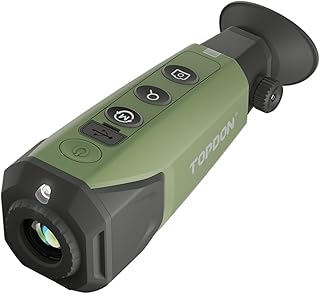
This is the unit most hunters should actually buy if they’re entering the thermal space without a five-figure budget. The 320×240 TISR resolution on a 256×192 IR sensor is genuinely sharp for the price, and the 13mm lens at 50Hz gives you enough reach to ID a coyote at a couple hundred yards without straining. Wireless connectivity pairs well with phone-based mapping when you need to mark a hotspot.
- Pro: 11-hour battery life means you’ll never need a backup pack during a sit.
- Pro: IP67 rating handles rain, snow, and accidental drops into shallow water.
- Con: The 13mm lens limits magnified reach compared to units with 19mm or larger optics.
Skip this if you primarily hunt open prairie or mountain terrain where you need to identify animals at 400+ yards — you’ll want the TS004 Pro or the RIX Storm S2.
2. GOYOJO G210
The G210 is the cheapest credible thermal option on this list, and at $349 it proves you don’t need to spend much more than a nice set of gloves to get into thermal. The 256×192 sensor and 10mm lens make it a close-range tool — think field edges, creek bottoms, and bedding areas within 150 yards. For a hunter who wants to test whether thermal is actually his thing before committing to a $700+ rig, this answers the question honestly.
- Pro: Lowest price point among dedicated thermal units here.
- Pro: Compact form factor that doesn’t pull your jacket pocket open.
- Con: The 10mm lens creates a narrow field that makes target acquisition at any range feel like looking through a soda straw.
Skip this if you hunt open terrain or expect to ID animals beyond 200 yards — the small lens simply doesn’t push far enough.
3. AGM Global Vision Taipan V2
AGM’s reputation in thermal optics is earned, and the Taipan V2 is the lightest way into that pedigree at $490.48. High sensitivity means it resolves thermal contrast better than most units in this price band — animals stand out crisply even when ambient temperatures are mild and the delta between fur and air is small. The build feels like something that would survive a truck door swing in January.
- Pro: Exceptional sensitivity for its price tier, delivering clean images in low-contrast conditions.
- Pro: AGM’s reputation for durability and optics quality carries through in the Taipan V2.
- Con: Fewer published specs than competitors here, making direct comparison harder for spec-driven buyers.
Skip this if you’re a numbers person who needs every spec listed before committing — the published details are sparser than what TOPDON or RIX provide.
4. RIX Storm S2
At 0.9 pounds, the Storm S2 is lighter than most handheld thermal units in its resolution class, and that matters when you’re glassing for an hour with your arm extended. The 25mm lens pushes it into genuine mid-range territory, and with NETD under 25mK it’s built for the hardest lighting conditions — fog, rain, or that tricky window when temperatures haven’t fully dropped. Easy controls work with thick gloves on.
- Pro: 25mm lens provides meaningful reach that close-range thermal units simply cannot match.
- Pro: Under 25mK NETD ensures clean resolution even in marginal thermal contrast.
- Con: At $799 it’s the most expensive handheld thermal here, and you’re paying for capability you may not use.
Skip this if you hunt dense timber or tight field edges — you’ll never exploit the long lens, and the TOPDON TS004 does everything else for half the cost.
5. RIX Pocket K2
The Pocket K2 is for the hunter who already has thermal on the rifle and needs a spotting unit that lives in a chest pocket without being a second-class citizen. The 256×192 sensor at 50Hz is a proven configuration, and Wi-Fi lets you pull images to a phone for quick group decisions. At $399 it’s the kind of unit you buy on a whim and use more than you expected.
- Pro: Genuinely pocketable weight and size without sacrificing sensor speed.
- Pro: Wi-Fi integration makes sharing a hotspot sighting with a partner quick and practical.
- Con: The compact size means a small display that can strain your eyes during extended glassing sessions.
Skip this if you’ll be doing primary spotting rather than backup glassing — a larger-format unit like the TS004 gives you more comfort over long periods.
6. Athlon Optics 8×42 Midas UHD
This isn’t a thermal unit, and that’s the point. For hunters building a two-optic kit, pairing a compact thermal with a quality ED-glass binocular covers both the dark and the gray edges of dawn and dusk. The Midas UHD’s 8x magnification and ED glass deliver color-corrected sharpness that makes the thermal feel complete rather than compromised during legal shooting light.
- Pro: ED glass resolves fine detail in low light without the ghosting of cheaper optics.
- Pro: Versatile for both hunting and birdwatching, justifying its cost for dual-purpose users.
- Con: Price is not listed here, and availability can fluctuate through the season.
Skip this if you’re on a single-optic budget — your money goes further on a thermal first, then add binoculars later.
7. Celestron Outland X 10×42
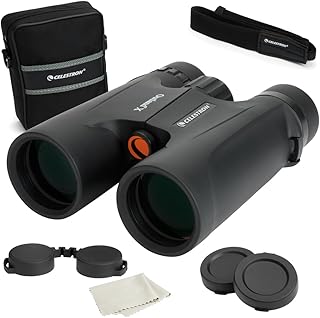
At $99.99 the Outland X is the most honest answer to “what do I carry as backup glass without thinking about it?” It won’t help you at night, but waterproof construction, multi-coated optics, and a rubber-armored body make it a durable pair to throw in a pack. If you’re stretching a budget toward a thermal, this covers your daylight needs without compromise.
- Pro: Rugged rubber armor and waterproof construction survive abuse far beyond its price tier.
- Pro: BaK-4 prisms and multi-coated optics deliver clear views for under a hundred dollars.
- Con: At 10x magnification, steady handheld use at distance requires good technique — image shake is noticeable.
Skip this if you plan to use it as your primary glassing tool — the 10x magnification amplifies hand tremor, and at this price the image quality has visible limits compared to the Midas UHD.
8. TOPDON TS004 Pro
If the standard TS004 is the best value, the Pro is the best you can buy without hitting four figures. The 512×384 TISR resolution over a 384×288 IR sensor is a meaningful jump — animals resolve as identifiable shapes rather than thermal silhouettes, and the 19mm lens pushes working range out to a distance where the standard model starts guessing. Same 11-hour battery, same IP67 rating, same wireless pairing. You’re paying for clarity and reach.
- Pro: 384×288 native IR sensor is the highest resolution on this list, delivering true ID capability at range.
- Pro: 19mm lens with 50Hz refresh extends useful spotting distance significantly over the standard TS004.
- Con: The $759.99 price tag is nearly double the standard TS004 for what is, in the field, a noticeable but not dramatic improvement for many hunters.
Skip this if you hunt under 250 yards in mixed cover — the extra resolution and lens won’t translate into real-world advantage, and the standard TS004 or AGM Taipan V2 will save you $300 you can spend on better boots.
Buying Guide
IR Sensor Resolution and TISR
Native IR resolution (like 256×192) is the raw detector pixel count. TISR is TOPDON’s software upscaling that interpolates to a higher displayed resolution (like 320×240). In the field, native resolution matters more — you’ll see genuine detail from a 384×288 sensor that no amount of interpolation on a 256×192 can fully replicate. Treat TISR numbers as a marketing bonus, not a spec upgrade.
NETD and Thermal Contrast
NETD (Noise Equivalent Temperature Difference) measures the smallest temperature difference the sensor can detect. Under 25mK means you can separate a deer from a rock on a 45-degree day. Over 50mK and you’re waiting for proper temperature drop. In late-season conditions where animal-to-ambient difference is small, a low NETD is the single most important spec you can check before buying.
Lens Aperture and Working Range
At a fixed sensor resolution, a larger lens gathers more thermal radiation and pushes your effective spotting distance forward. A 10mm lens gives you 150 yards of usable glassing. A 19mm lens pushes past 300. A 25mm lens gets you into genuine mid-range territory. Match your lens size to the terrain you actually hunt — an oversized lens on a tight-timber property is dead weight.
Our Verdict
Top pick: TOPDON TS004. It hits the sweet spot of resolution, build quality, battery life, and price that most hunters will never need to outgrow. For the vast majority of hunting situations, it’s the complete answer.
Budget pick: GOYOJO G210. At $349 it’s a real thermal detector that answers the question of whether you even want to own one, without a financial commitment that stings.
Condition where another product wins: If you hunt open terrain and need ID at 350+ yards in marginal light, the RIX Storm S2 earns its $799 price through its combination of large lens, low NETD, and light weight in a single handheld form factor.
FAQ
Can a thermal monocular be mounted on a rifle?
Not directly in most cases — a monocular is a handheld spotting tool, not a weapon sight. Some hunters use them in conjunction with a thermal clip-on scope for glassing before they pick up their rifle, keeping both eyes open and preserving the mount integrity.
How far can a 256×192 thermal monocular detect a deer?
Detection and identification are different. A 256×192 sensor can detect a deer out to roughly 400-500 yards but won’t reliably identify it as a deer rather than another warm shape beyond 150-200 yards. Lens size and NETD determine where that useful range falls.
Is thermal legal for hunting in my state?
Laws vary significantly. Some states allow thermal for night predators like coyotes but ban it for big game entirely. Always check your specific game regulations before relying on thermal as a hunting tool rather than a spotting tool during legal shooting hours.
Do I need Wi-Fi on a thermal monocular?
Not for the hunt itself, but wireless image transfer to a phone is genuinely useful for documenting sightings, marking GPS coordinates on a property map, or sharing a hotspot with a partner in real time. It’s a convenience feature, not a performance one.


